 0
0
 0
0
Read Time:5 Minute, 20 Second
Published: August 9, 2026
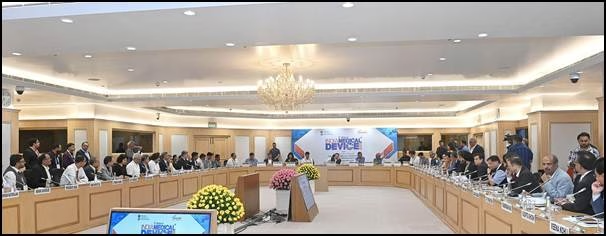
NEW DELHI — Union Minister of Chemicals & Fertilizers and Health & Family Welfare Shri Jagat Prakash Nadda convened a flagship CEO Roundtable on the second day of the India Medical Device 2026 conference at Vigyan Bhawan, New Delhi. The high-level summit brought together top government policymakers and over 40 chief executives from global, domestic, and small-to-medium MedTech enterprises to chart a strategic path for India’s rapidly growing medical device ecosystem.
Organized by the Department of Pharmaceuticals in association with the Federation of Indian Chambers of Commerce & Industry (FICCI), the event addressed critical strategies for domestic manufacturing, global expansion, and the integration of novel health technologies into public health insurance schemes. A central theme emerging from the conference was the imperative to balance cutting-edge medical innovation with rigorous clinical evidence to ensure sustainable, affordable patient care.
High-Level Dialogue Strategy for Global MedTech Scale
The CEO Roundtable served as an interactive forum intended to strengthen domestic supply chains, streamline regulations, and facilitate global market entries for Indian-manufactured medical technologies. Among the leaders present were Shri Manoj Joshi (Secretary, Department of Pharmaceuticals), Dr. M. Srinivas (Member, NITI Aayog), Smt. Punya Salila Srivastava (Secretary, Ministry of Health and Family Welfare), and Shri Amardeep Singh Bhatia (Secretary, DPIIT). Industry representatives included key executives from FICCI’s Medical Devices Committee.
Discussions focused on expanding India’s domestic capabilities beyond low-technology consumables toward complex, high-value systems, such as advanced imaging equipment, robotic surgical instruments, and implantable cardiovascular devices.
Industry leaders pointed out that while initiatives like the National Medical Devices Policy and Production-Linked Incentive (PLI) schemes have stimulated manufacturing, sustained momentum requires unified regulatory alignment and clear pathways for public sector procurement.
┌─────────────────────────────────────────────────────────────────┐
│              INDIA MEDTECH ECOSYSTEM AT A GLANCE                │
├──────────────────────────────────────┬──────────────────────────┤
│ Sector Market Size (2026 Estimate)   │ > USD 15 Billion         │
├──────────────────────────────────────┼──────────────────────────┤
│ Primary Strategic Focus              │ Domestic Self-Reliance   │
│                                      │ & Global Export Expansion│
├──────────────────────────────────────┼──────────────────────────┤
│ Regulatory Baseline Requirement      │ Credible Clinical        │
│                                      │ Effectiveness Data       │
├──────────────────────────────────────┼──────────────────────────┤
│ Core Mechanism for Public Access     │ Health Technology        │
│                                      │ Assessment (HTA)         │
└──────────────────────────────────────┴──────────────────────────┘
Rigorous Clinical Evidence: The Pillar for Healthcare Reimbursement
Prior to the CEO Roundtable, a pivotal technical session titled “Reimbursement Mechanisms for Innovative Therapies in India’s Path to Universal Health Coverage (UHC)” examined how cutting-edge care can be funded across diverse patient demographics.
Chairing the session, Dr. Rajiv Bahl, Director General of the Indian Council of Medical Research (ICMR) and Secretary of the Department of Health Research, emphasized that clinical efficacy must drive all regulatory, procurement, and coverage decisions.
“Medical innovations should translate into affordable, accessible, and sustainable healthcare,” stated Dr. Bahl during his address. “Robust clinical evidence should underpin regulatory, reimbursement, and procurement decisions… Seeking exemptions from evidence generation may make it difficult for technologies to establish their value before Health Technology Assessment (HTA), reimbursement, and procurement authorities.”
Dr. Bahl’s remarks address a longstanding structural debate in MedTech: balancing rapid regulatory approval with long-term evaluation of safety and cost-effectiveness. In health economic evaluations, high-quality clinical data serves as the foundation for measuring whether an advanced therapy delivers proportional improvements in patient outcomes compared to existing standard-of-care treatments.
Market Dynamics: Growth vs. Public Health Access
India’s medical device market is currently valued at over $15 billion, ranking among the fastest-expanding sectors in the national economy. However, an estimated 70% to 80% of high-end medical devices sold in India remain imported, leading to high capital costs for hospitals and substantial out-of-pocket expenses for patients.
To realize the country’s Universal Health Coverage targets under Ayushman Bharat and state-level healthcare programs, health economists note that reimbursement models must evolve beyond basic hospital stay coverage to encompass advanced outpatient, diagnostic, and minimally invasive device technologies.
Conference delegates highlighted several necessary steps to achieve sustainable technology adoption:
-
Transparent Health Technology Assessments (HTA): Establishing standardized criteria to quantify clinical value versus economic outlay.
-
Realistic Pricing Pathways: Creating pricing structures that respect manufacturer research-and-development costs while maintaining public affordability.
-
Clinician Engagement & Capacity Building: Expanding training programs so healthcare providers across tier-2 and tier-3 cities can safely deploy complex diagnostic and therapeutic tools.
Potential Challenges and Counterarguments
While the shift toward evidence-backed reimbursement is widely endorsed by public health advocates, some industry stakeholders caution that overly rigid clinical trial requirements could slow down patient access to breakthrough therapies.
MedTech innovation cycles are typically shorter than those for pharmaceuticals, with device iterations occurring every 18 to 24 months. Representatives from medical device startups noted during discussions that requiring multi-year clinical trials for minor iterative upgrades could impose high financial burdens on smaller manufacturers (MSMEs), potentially stifling local innovation.
In response, health system experts suggest a balanced approach: utilizing real-world evidence (RWE) gathered post-market, alongside conditional reimbursement frameworks that allow promising technologies to reach patients while clinical data collection continues.
Practical Takeaways for Patients and Healthcare Providers
For the general public and practicing clinicians, the policies discussed at Vigyan Bhawan hold direct, real-world implications:
-
For Patients: Stricter clinical evidence mandates ensure that new therapies introduced under national health insurance programs are both safe and proven effective. Over time, scaled domestic production aims to lower the price of medical procedures, reducing out-of-pocket medical debt.
-
For Clinicians: Standardized clinical guidelines and Health Technology Assessments provide clear, objective frameworks when recommending novel diagnostic tools or advanced surgical implants to patients.
-
For Healthcare Institutions: Structured reimbursement pathways allow public and private hospitals to invest in modern technologies with clear visibility on coverage and claim settlements.
Next Steps in Policy Realization
The deliberations from India Medical Device 2026 are expected to inform upcoming policy adjustments within the Department of Pharmaceuticals and the National Health Authority. As government committees finalize reimbursement guidelines for advanced care, the primary focus remains establishing a cohesive MedTech ecosystem that fosters commercial innovation without compromising patient safety or public fiscal sustainability.
Medical Disclaimer
This article is for informational purposes only and should not be considered medical advice. Always consult with qualified healthcare professionals before making any health-related decisions or changes to your treatment plan. The information presented here is based on current research and expert opinions, which may evolve as new evidence emerges.
References
-
-
Press Information Bureau (PIB), Government of India.Union Minister Shri Jagat Prakash Nadda Chairs CEO Roundtable at India Medical Device 2026.Published: August 8, 2026. Delhi, India.Available from: Press Information Bureau, Ministry of Chemicals & Fertilizers.
-


Happy
0 %

Sad
0 %

Excited
0 %

Sleepy
0 %

Angry
0 %

Surprise
0 %