 0
0
 0
0
NEW DELHI — In a move that could transform both traditional healthcare and the global wellness economy, India’s Ministry of Ayush has forged a major academic alliance to modernize its centuries-old herbal healthcare sector.
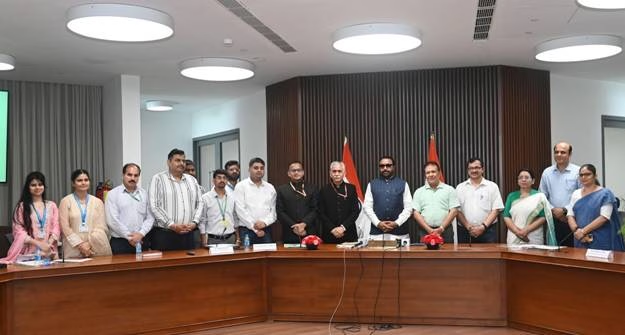
The National Medicinal Plants Board (NMPB), operating under the Ministry of Ayush, officially signed a Memorandum of Understanding (MoU) with the University of Delhi’s Bhaskaracharya College of Applied Sciences (BCAS) at Kartavya Bhawan. The high-profile partnership, unveiled in the presence of Union Minister Shri Prataprao Jadhav, aims to combine traditional botanical knowledge with rigorous modern science. The initiative will focus on advanced research, bio-friendly product development, and sustainable post-harvest technologies.
As global consumer demand for natural health products surges, this collaboration seeks to establish the scientific validation required to elevate Indian medicinal plants on the international stage. Public health experts view it as a critical step toward ensuring that traditional remedies meet modern safety, efficacy, and environmental standards.
Validating the Medicine Cabinet: The Push for Rigorous Science
For decades, traditional systems of medicine like Ayurveda, Siddha, and Unani have relied heavily on India’s vast biodiversity, which includes one of the world’s richest repositories of medicinal flora. However, a persistent critique from the global medical community has been the lack of standardized, evidence-based data regarding chemical consistency, safety profiles, and clinical efficacy.
The new partnership directly addresses these gaps by leveraging the specialized expertise of BCAS in food technology, nutraceuticals (nutrition-based health products), and post-harvest processing. Rather than relying solely on historical texts, researchers will utilize modern analytical chemistry, pharmacology, and biotechnology to investigate the active compounds within these plants.
“Integrating traditional knowledge with strict scientific methodology is exactly what the natural product sector needs,” says Dr. Anita Sharma, a pharmacology researcher and global health analyst not involved in the initiative. “If we want these traditional botanicals to be accepted globally as credible health interventions, we must provide the same level of chemical standardization and empirical evidence expected of any modern healthcare product.”
From Farm to Pharmacy: Focus on Sustainability and Safety
The scope of the MoU extends far beyond the laboratory bench. A primary pillar of the collaboration is the development of innovative, sustainable packaging and post-harvest technologies.
Currently, the supply chain for medicinal plants faces significant challenges. Poor storage and improper post-harvest handling often lead to fungal contamination, degradation of active therapeutic compounds, and massive product wastage. By introducing advanced processing techniques, the partnership aims to stabilize raw plant materials immediately after harvest, preserving their health benefits.
Furthermore, the initiative introduces an environmental health angle. Shri Mahesh Dadhich, Chief Executive Officer of the NMPB, highlighted plans to develop eco-friendly packaging derived directly from medicinal plant resources. These bio-based materials are intended to serve as safe, sustainable alternatives to conventional plastic and aluminum-based packaging, which carry significant environmental footprints.
Public Health and Economic Implications
From a public health perspective, the standardization of medicinal plants has direct safety implications for consumers. Unregulated herbal supplements can sometimes vary wildly in potency or contain undeclared contaminants. By establishing clear scientific protocols and technology transfers to industry, this initiative aims to create a highly regulated marketplace of reliable, safe, and quality-tested wellness products.
Additionally, the project bridges public health with environmental restoration. The NMPB plans to encourage the cultivation of medicinal plants in specific ecological zones, including riverine areas. This approach aims to achieve three goals simultaneously:
-
Biodiversity Conservation: Protecting endangered plant species from over-harvesting in the wild.
-
Ecological Restoration: Stabilizing riverbanks and fragile ecosystems using native flora.
-
Livelihood Generation: Increasing farmers’ income by introducing high-value, research-backed medicinal crops to their standard crop rotations.
The economic objective aligns with India’s broader “bioeconomy” goals. By converting raw botanical resources into high-value nutraceuticals and patented health products, the collaboration intends to foster a new wave of innovation-led enterprises and scientific breakthroughs.
Balancing the Equation: Limitations and Future Challenges
While the initiative holds substantial promise, public health experts urge measured optimism. Translating laboratory research into scalable, commercially viable healthcare products is a notoriously long and difficult process.
One significant hurdle is the natural variability of plants. Unlike synthetic pharmaceuticals, which feature a single, precisely measured chemical entity, medicinal plants contain complex mixtures of hundreds of compounds. The concentration of these active ingredients can shift dramatically based on soil quality, weather, altitude, and harvest timing. Achieving uniform therapeutic consistency across large commercial batches remains a daunting technical challenge.
Furthermore, medical authorities emphasize that traditional remedies and nutraceuticals should complement, not replace, primary modern medical care.
“While expanding our library of plant-based therapies is highly valuable, consumers must remember that lifestyle modifications and prescribed medical treatments remain the bedrock of managing chronic diseases,” cautions Dr. Sharma. “Evidence-based validation will help us understand what these plants can safely do—and, just as importantly, what they cannot do.”
Ultimately, the success of this ambitious partnership will be measured in the coming years by its tangible outputs: whether it yields peer-reviewed clinical data, successful technology transfers to the health industry, and verifiable improvements in both consumer safety and agricultural sustainability.
References
-
Institutional Announcement: Press Information Bureau (PIB) Delhi, Ministry of Ayush, Government of India. “Ministry of Ayush signs MoU with University of Delhi to advance research, innovation and sustainable utilisation of medicinal plants.” Published July 15, 2026.
Medical Disclaimer: This article is for informational purposes only and should not be considered medical advice. Always consult with qualified healthcare professionals before making any health-related decisions or changes to your treatment plan. The information presented here is based on current research and expert opinions, which may evolve as new evidence emerges.