 0
0
 0
0
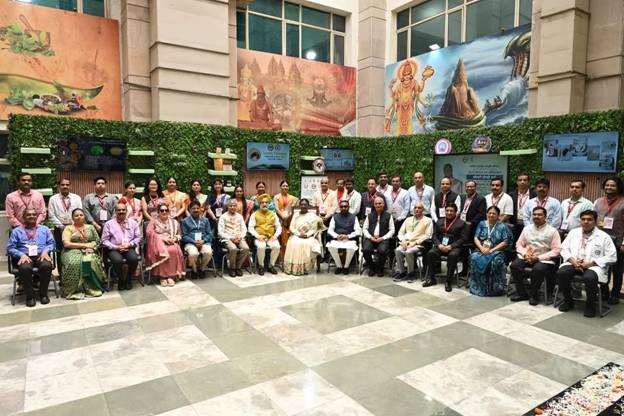
NEW DELHI — In a landmark move aimed at transforming traditional healthcare, Indian President Smt. Droupadi Murmu inaugurated ‘Saushrutam 2026’ on July 15, 2026, at the All India Institute of Ayurveda (AIIA). The three-day international seminar marks a decisive push by the Indian government to integrate ancient Ayurvedic surgical traditions with cutting-edge medical technology. Highlighting this shift, President Murmu unveiled a state-of-the-art, Artificial Intelligence (AI)-enabled 3 Tesla High-Field MRI facility at the institute, signaling a new era of evidence-based, integrative diagnostics.
The global summit, organized by the AIIA under the Ministry of Ayush, coincides with Sushruta Jayanti—a day honoring Acharya Sushruta, widely regarded as the historical pioneer of systematic surgical practices. The event has drawn medical professionals, researchers, and policymakers from nine countries, including the United Kingdom, Austria, Israel, and Thailand, to establish standardized, scientifically validated clinical protocols for Ayurvedic surgery.
The AI Leap: Enhancing Precision in Integrative Care
The centerpiece of the conference’s technological announcements is the installation of the AI-enabled 3 Tesla MRI scanner. In modern medicine, 3 Tesla (3T) MRI imaging provides double the magnetic field strength of standard 1.5T scanners, offering exceptionally clear images of soft tissues, blood vessels, and neurological pathways.
By embedding AI algorithms into this high-field imaging system, the facility can rapidly analyze complex scans, track structural changes in the body, and reduce scanning times for patients. For integrative medicine, this technology serves as a objective bridge. Clinicians will now be able to monitor the anatomical and physiological outcomes of traditional therapies—such as Kshara Sutra (medicated thread therapy for complex fistulas) or Agnikarma (thermal micro-cauterization)—using the highest standards of contemporary diagnostic visualization.
“The integration of traditional knowledge with advanced technologies and modern diagnostics does not dilute Ayurveda; it expands its credibility,” President Murmu stated during her address. She emphasized that validating historical methodologies through rigorous, modern scientific frameworks is essential for expanding the system’s global acceptance.
Empowering the Female Workforce and Protecting Ecosystems
Beyond technological tools, the summit addressed systemic challenges within the healthcare workforce and the environmental pipeline supporting Ayurvedic pharmacology.
Resolving Career Stagnation for Female Graduates
The National Commission for Indian System of Medicine (NCISM) released a critical observational study at the seminar titled Evaluation of Professional Career of Ayurveda Female Graduates. The report highlights a stark contrast in the industry: while women make up a substantial percentage of Ayurveda graduates, they face significant barriers in ascending to clinical leadership, research positions, and senior academic roles.
Union Minister of State for Ayush, Shri Prataprao Jadhav, noted that structural policy interventions and institutional support are actively being developed to reverse these trends. “Empowering young women professionals is vital not just for equity, but for the sustainable evolution of global healthcare systems,” Jadhav stated.
Ecological Sustainability as a Medical Prerequisite
President Murmu also issued an urgent call for biodiversity conservation. Because Ayurveda relies heavily on complex phytochemicals derived from specific medicinal plants, over-exploitation and climate change pose direct threats to medicine quality. The President stressed that ensuring a stable, traceable supply chain of medicinal flora via sustainable agriculture is critical if Ayurvedic treatments are to be scaled safely and globally.
The Peer Perspective: The Challenges of Standardization
Independent global health experts view the integration of advanced diagnostics as a positive step, though they urge a cautious approach to implementation.
Dr. Arjan Xanti, a clinical researcher in integrative gastroenterology based in Vienna (who is not participating in the Saushrutam seminar), noted the potential benefits and hurdles:
“Utilizing 3T MRI technology to track tissue healing during specialized wound care or anorectal procedures provides the rigorous, measurable data that Western medical communities require. However, the primary challenge lies in standardization. Traditional systems often rely on highly individualized treatment plans. Merging that philosophy with the standardized, reproducible data models required by AI diagnostics requires meticulous trial design and transparent peer review.”
Furthermore, international delegates emphasized that while treatments like Kshara Sutra have shown high efficacy rates with low recurrence in regional studies, large-scale, multi-center randomized controlled trials (RCTs) remain the gold standard for achieving true integration into global healthcare guidelines.
What This Means for Global Health Consumers
For health-conscious consumers and patients, the formal integration of AI diagnostics at institutions like the AIIA promises two major advancements:
-
Objectively Monitored Safety: Patients choosing complementary therapies can have their progress monitored using the same high-resolution imaging used in major oncology and neurology centers, providing an extra layer of diagnostic safety.
-
Affordable High-Tech Diagnostics: The newly inaugurated facility at the AIIA is mandated to provide high-quality, AI-driven imaging services to the public at affordable rates, lowering the financial barrier to advanced healthcare.
As Delhi Lieutenant Governor Taranjit Singh Sandhu observed during the opening ceremonies, the future of global medicine is moving steadily toward preventive, lifestyle-based, and holistic models. By anchoring ancient knowledge traditions to verifiable, modern diagnostic metrics, the medical community moves closer to a unified healthcare model where traditional wisdom and modern science complement rather than contradict each other.
References
Institutional & Event Sources
-
Press Information Bureau (PIB) Delhi: Government of India. “President of India inaugurates ‘Saushrutam 2026’…” Published July 15, 2026.
Medical Disclaimer: This article is for informational purposes only and should not be considered medical advice. Always consult with qualified healthcare professionals before making any health-related decisions or changes to your treatment plan. The information presented here is based on current research and expert opinions, which may evolve as new evidence emerges.