 0
0
 0
0
Read Time:4 Minute, 54 Second
NEW DELHI — India’s Ministry of Ayush has unveiled an ambitious strategic roadmap to transform Sowa-Rigpa—one of the world’s oldest surviving traditional medical traditions—into a globally recognized, evidence-based healthcare system.
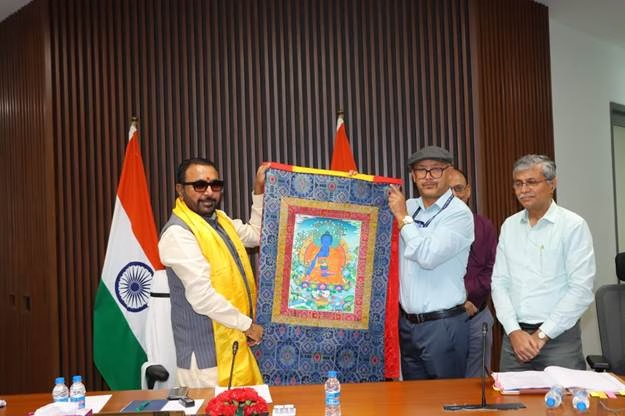
During the 2nd Governing Body Meeting of the National Institute of Sowa-Rigpa (NISR) held in New Delhi, Union Minister of State (Independent Charge) for Ayush and Minister of State for Health & Family Welfare, Shri Prataprao Jadhav, called for a shift from foundational infrastructure development to rigorous scientific research, manuscript digitization, and international validation.
Moving Beyond Regional Borders to Evidence-Based Validation
Sowa-Rigpa, which translates to “Knowledge of Healing” in the Bhoti language and is commonly referred to as the Amchi system of medicine, has been practiced for centuries across the Trans-Himalayan belt. While recognized by the Government of India within the Ayush framework alongside Ayurveda, Yoga, Unani, Siddha, and Homeopathy, Sowa-Rigpa has historically remained geographically localized to regions such as Ladakh, Sikkim, Himachal Pradesh, Arunachal Pradesh, and West Bengal’s Darjeeling district.
The Ministry’s new directive aims to integrate Sowa-Rigpa into mainstream global health practices by establishing a standardized, research-backed framework.
“Our goal is no longer limited to developing infrastructure; it is to establish Sowa-Rigpa as a mainstream healthcare system in India and across the world,” stated Union Minister Shri Prataprao Jadhav during the address. “Our foremost commitment is to establish Sowa-Rigpa as an evidence-based system of medical science before the world. To achieve this, we must accelerate our research strategies, and the establishment of an independent research council will be the first important step.”
To support this scientific push, the Ministry outlined plans to build an ecosystem that pairs traditional clinical observation with modern laboratory methodologies, clinical trial protocols, and bio-prospecting.
Preserving Ancient Knowledge Through Modern Technology
A critical component of the strategy involves preserving the foundational texts of Sowa-Rigpa. Hundreds of historical manuscripts written in the Bhoti language contain centuries of pharmacological formulas, therapeutic protocols, and ecological data regarding high-altitude flora.
The Ministry proposed a systematic initiative to digitize, transcribe, and translate these ancient texts into multiple languages. This effort will be carried out in coordination with the NISR, the Gyan Bharatam Mission, and the Ministry of Culture, with the goal of making this repository accessible to international researchers and medical historians.
Additionally, the strategy highlights environmental sustainability in the Indian Himalayan Region (IHR). Because Sowa-Rigpa relies heavily on rare, high-altitude medicinal plants, the government emphasizes:
-
Sustainable cultivation and conservation of medicinal biodiversity.
-
Bio-prospecting and agroforestry partnerships with local Himalayan communities.
-
Strengthening regional care models to support equitable economic development.
Institutional Progress and Leadership
The Ministry highlighted the institutional development led by NISR, situated in Leh, Ladakh. The Governing Body formally recognized Dr. Padma Gurmet, Director of NISR, who was conferred the prestigious Padma Shri honor in 2026 for his contributions toward reviving, preserving, and institutionalizing Sowa-Rigpa.
Dr. Gurmet presented a comprehensive action plan detailing NISR’s recent progress in clinical services, academic course standardization, and field outreach programs designed to train practitioners in evidence-based protocols.
Vaidya Rajesh Kotecha, Secretary of the Ministry of Ayush, reaffirmed the government’s structural support for traditional healthcare disciplines, emphasizing that scientific validation remains essential for public safety and international adoption.
Clinical Relevance and Public Health Context
Sowa-Rigpa shares historical roots with Ayurvedic philosophy, Tibetan medicine, and traditional Asian healing modalities. Its diagnostic framework focuses on balance among body systems, incorporating pulse diagnosis, physical examination, and holistic lifestyle adjustments. Therapeutic modalities typically involve multi-herb formulations, dietary regimens, and mild external therapies.
       Ancient Sowa-Rigpa Foundation
 (Bhoti Manuscripts & Himalayan Tradition)
                   │
                   ▼
  Modern Institutional Framework (NISR)
                   │
    ┌──────────────┴──────────────┐
    ▼                             ▼
Scientific Validation     Biodiversity & Digitization
(Clinical Trials &       (Text Archiving & Rare
Research Council)         Plant Conservation)
    │                             │
    └──────────────┬──────────────┘
                   ▼
  Global Evidence-Based Healthcare System
Understanding the Systems of Medicine
| Healthcare System | Historical Origin | Primary Diagnostic Methods | Treatment Modalities |
| Sowa-Rigpa (Amchi) | Trans-Himalayan Region | Pulse analysis, tongue examination, urine analysis | High-altitude botanical formulas, dietary modifications, physical therapies |
| Ayurveda | Indian Subcontinent | Pulse (Nadi), physical constitution (Dosha) analysis | Herbal preparations, panchakarma therapies, lifestyle changes |
| Modern Western Medicine | Global / Evolving | Laboratory testing, diagnostic imaging, pathology | Pharmaceuticals, surgical intervention, targeted therapies |
While integrative healthcare approaches continue to grow in popularity among consumers seeking holistic wellness, public health experts emphasize the importance of rigorous testing.
Independent researchers note that for traditional systems like Sowa-Rigpa to gain broader global acceptance, plant-based remedies must undergo chemical standardization, safety profiles, and randomized controlled clinical trials to verify efficacy and rule out adverse herb-drug interactions. Establishing an independent research council under the Ayush framework represents a structured effort to address these precise requirements.
What This Means for Patients and Health-Conscious Consumers
For consumers interested in integrative medicine, the formalization and standardization of Sowa-Rigpa offers several practical implications:
-
Quality Assurance: Standardized academic curricula and research protocols aim to ensure that practitioners meet verified clinical standards.
-
Safety & Consistency: Digitization and laboratory validation help identify active botanical compounds, ensuring consistent dosing and reducing contamination risks.
-
Integrative Options: As evidence builds, validated Sowa-Rigpa therapies may serve as complementary support alongside conventional care, particularly for preventive health and chronic lifestyle management.
Consumers are advised to consult primary healthcare providers before introducing traditional or herbal supplements into their routine, particularly when managing chronic health conditions or taking prescription medications.
References
-
Press Information Bureau (PIB), Delhi. (2026, August 7). Union Ayush Minister Chairs 2nd Governing Body Meeting of the National Institute of Sowa-Rigpa. Ministry of Ayush, Government of India.
Medical Disclaimer: This article is for informational purposes only and should not be considered medical advice. Always consult with qualified healthcare professionals before making any health-related decisions or changes to your treatment plan. The information presented here is based on current research and expert opinions, which may evolve as new evidence emerges.


Happy
0 %

Sad
0 %

Excited
0 %

Sleepy
0 %

Angry
0 %

Surprise
0 %