 0
0
 0
0
Read Time:6 Minute, 9 Second
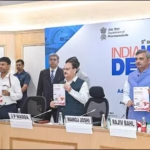
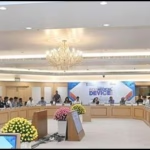
CHANDIGARH, India — In what health policy analysts are calling a potential turning point for global health equity, health ministers representing the expanded 11-member BRICS bloc have unanimously signed a landmark alliance to pool medical, technological, and research resources.
The agreement, announced at the conclusion of the 16th BRICS Health Ministers’ Meeting in Chandigarh, India, shifts the economic coalition from individual national healthcare goals toward a unified, cross-border infrastructure. Representing nearly 45% of the global population, the coalition—comprising Brazil, Russia, India, China, South Africa, Egypt, Ethiopia, Indonesia, Iran, Saudi Arabia, and the United Arab Emirates—aims to accelerate progress toward Universal Health Coverage (UHC), a framework designed to ensure citizens receive essential medical care without facing crippling financial hardship.
Moving From Policy Intent to Coordinated Action
Universal Health Coverage has sat on the global agenda for decades under the United Nations Sustainable Development Goal 3 (SDG 3). However, achieving equitable access has remained elusive across developing and emerging economies due to fragmented supply chains, uneven clinical infrastructure, and soaring out-of-pocket costs.
The 2026 Chandigarh Declaration signals a structural transition. Rather than relying solely on isolated domestic policies, the member states have established a shared framework covering nine priority areas. Key components include joint regulatory standards for pharmaceuticals, shared pandemic surveillance networks, cross-border digital health platforms, and shared strategies to tackle non-communicable diseases (NCDs) such as diabetes, cardiovascular conditions, and obesity.
       BRICS 2026 Universal Health Coverage Strategy

 [ Nine Key Priority Areas ]
 ├── 1. Non-Communicable Diseases (BRICS Mission for Healthy Lifestyles)
 ├── 2. Mental Health (Centres of Excellence Network)
 ├── 3. Tuberculosis Eradication
 ├── 4. Traditional & Integrative Medicine (WHO-linked Data Sharing)
 ├── 5. Pandemic Preparedness & Health Security
 ├── 6. Nuclear Medicine Research & Diagnostics
 ├── 7. Digital Health Infrastructure & AI Integration
 ├── 8. Medical Product Regulatory Harmonization
 └── 9. National Public Health Institutes Collaboration
Health officials emphasize that the initiative is designed to address both immediate clinical demands and long-term systemic vulnerabilities.
“By pooling expertise, BRICS is laying the foundations for more accessible, affordable, and resilient healthcare for billions of people across the Global South and beyond,” noted reports reviewing the summit outcomes.
Mental Wellness and Lifestyle Diseases Lead Strategic Agenda
Among the primary initiatives unveiled are two major proposals spearheaded by India:
1. The BRICS Mission for Healthy Lifestyles
This framework targets the rapid rise of non-communicable conditions across emerging economies. By standardizing early-screening protocols and public prevention campaigns across member borders, the initiative aims to reduce the burden of chronic illness on public health systems.
2. Network of Centres of Excellence on Mental Wellness
Anchored by India’s National Institute of Mental Health and Neurosciences (NIMHANS), this network connects research institutions across all 11 member nations. Mental health disorders affect hundreds of millions within the bloc, yet treatment gaps often exceed 75% in lower-income regions due to acute specialist shortages and social stigma.
“Integrating mental health into primary care frameworks isn’t a luxury—it is a fundamental medical necessity,” explained Dr. Ananya Sen, an independent global health policy researcher not involved in the drafting of the declaration. “When psychological care is treated as an isolated specialty, patients delay seeking treatment until conditions become severe. Broadening access through primary care centers reduces both clinical complications and economic strain on families.”
Integrating Traditional Medicine into Modern Frameworks
A historical milestone in the 2026 declaration is the formal inclusion of Traditional, Complementary, and Integrative Medicine (TCIM). For the first time, BRICS health ministers established a dedicated expert working group tasked with validating traditional therapies using modern scientific methodologies.
Rather than treating traditional therapies as anecdotal remedies, the agreement establishes multi-country clinical trials, standardized research protocols, and open-access digital repositories linked directly to the World Health Organization’s (WHO) International Traditional Medicine Clinical Trial Registry.
+-----------------------------------------------------------------------+
|                 BRIDGING TRADITIONAL & MODERN MEDICINE                 |
+-----------------------------------------------------------------------+
|                                                                       |
|  [ Traditional Knowledge ]  ──►  Rigorous Clinical Validation         |
|                                  (Multi-Country Trials)               |
|                                            │                          |
|                                            ▼                          |
|  [ Evidence-Based TCIM ]    ◄──  Digital Repositories & WHO Sync      |
|                                                                       |
+-----------------------------------------------------------------------+
This structured integration seeks to give primary care providers vetted, evidence-based options while ensuring consumer safety through strict regulatory oversight of botanical and non-pharmacological interventions.
Blueprints for Scale: The Ayushman Bharat Case Study
To demonstrate how universal access can operate in high-density, resource-constrained environments, host nation India presented outcomes from its Ayushman Bharat initiative. The national insurance program currently provides fully subsidized, secondary and tertiary hospital care—including complex procedures like neurosurgery, oncology treatments, and organ transplants—to hundreds of millions of low-income citizens.
Delegates evaluated how aspects of India’s digital health stack, alongside public insurance delivery models in Brazil (Sistema Único de Saúde) and China, could be adapted to fit varying domestic contexts in newer member states such as Ethiopia and Egypt.
Additionally, bilateral discussions flourished alongside the main summit. Officials from Cuba and India outlined plans to expand joint efforts using artificial intelligence in early diagnostic screening, alongside expanded trade in generic pharmaceuticals and biotechnology.
Statistical Realities and Historical Friction
Despite the ambitious scope of the 2026 declaration, independent public health experts point to stark internal disparities that present operational challenges:
| Health Indicator | BRICS Regional Range | Global Target Benchmark (SDG 3) |
| Life Expectancy at Birth | 53.0 – 73.5 years | > 70 years universally |
| Under-5 Mortality (per 1,000 live births) | 10.3 – 44.6 deaths | < 25 deaths per 1,000 |
| Out-of-Pocket Health Expenditure | ~15% – 60%+ of total expenditure | < 15–20% to prevent impoverishment |
Epidemiologists note that historical data published in The Lancet underscores how previous commitments among BRICS members frequently stalled during execution phases. Historically, differing governance structures, varying national budgets, and disparate electronic health record (EHR) systems prevented full operational alignment.
“The primary obstacle to joint health initiatives of this magnitude has rarely been political goodwill—it’s execution logistics,” noted Dr. Marcus Vance, a public health economist. “Harmonizing drug regulatory approvals across 11 different national agencies, ensuring data privacy across national boundaries, and maintaining long-term funding commitments through domestic political shifts require sustained, multi-year coordination.”
What This Means for Everyday Healthcare
For everyday consumers and patients across member and partner countries, the practical outcomes of this agreement are intended to manifest over the coming years through several real-world pathways:
-
Lower Prescription Costs: Standardizing drug regulations and encouraging bulk cross-border sourcing of essential medications aims to reduce out-of-pocket costs for critical pharmaceuticals.
-
Broader Primary Care Services: Integrating basic mental health screenings and validated integrative medicine into local clinics will expand the scope of routine doctor visits.
-
Enhanced Pandemic Defenses: Shared regional monitoring databases aim to detect local pathogen outbreaks earlier, preventing regional lockdowns through faster, targeted interventions.
As heads of state prepare to convene for the main BRICS Summit in New Delhi, the healthcare declaration sets a clear technical foundation. Whether this ambitious framework successfully translates into expanded clinic visits and reduced patient costs will depend on the implementation details hashed out in the months ahead.
Medical Disclaimer: This article is for informational purposes only and should not be considered medical advice. Always consult with qualified healthcare professionals before making any health-related decisions or changes to your treatment plan. The information presented here is based on current research and expert opinions, which may evolve as new evidence emerges.
References
-
The News Mill. “16th BRICS Health Ministers’ meeting concludes under India’s chairship.” July 23, 2026. https://thenewsmill.com/2026/07/16th-brics-health-ministers-meeting-concludes-under-indias-chairship/


Happy
0 %

Sad
0 %

Excited
0 %

Sleepy
0 %

Angry
0 %

Surprise
0 %