 0
0
 0
0
In the modern world, plastic is nearly impossible to escape. It is in our cars, our clothing, our phones, and, increasingly, our bodies. New global estimates suggest that the average person may ingest anywhere from 0.1 to 5 grams of microplastics per week—roughly the weight of a credit card. This staggering figure, compiled by researchers at the University of Newcastle and later reviewed in the Journal of Hazardous Materials Letters, has sparked a global conversation among scientists, regulators, and the public.
While these tiny fragments are now pervasive in the environment, their direct impact on human health remains a subject of intense scientific scrutiny. As the particles make their way through our food, water, and even the air we breathe, experts are urging a stance of “pragmatic precaution” rather than panic, calling for more rigorous long-term research into the biological consequences of a life lived in plastic.
Key Findings: How Much Are We Actually Consuming?
The conversation around plastic ingestion shifted significantly in 2019 following a landmark study by Kieran Cox and colleagues. Conducted for the World Wildlife Fund (WWF), the analysis reviewed over 50 scientific papers to estimate human intake. The findings suggested that, depending on age, sex, and dietary habits, an adult could consume between 39,000 and 52,000 microplastic particles annually. For those who rely solely on bottled water, that number could jump by tens of thousands of additional particles.
However, the “credit card a week” analogy has faced academic pushback. Subsequent models published in Environmental Science & Technology suggest that while the particle count is high, the actual mass might be lower for the average person, potentially in the microgram range.
“The debate over whether it is five grams or five micrograms is important for toxicology, but it doesn’t change the fundamental reality,” says Dr. Elena Rossi, an environmental health researcher not involved in the original study. “The pervasive nature of these particles is undeniable. We are no longer just living with plastic; we are living of it.”
What Are Microplastics and How Do They Enter the Body?
Microplastics are defined as plastic particles smaller than 5 millimeters. They originate from various sources:
-
Secondary fragments: Larger plastic waste breaking down in the sun and ocean.
-
Synthetic fibers: Shedding from polyester or nylon clothing during washing.
-
Microbeads: Tiny exfoliants in personal care products.
-
Industrial shedding: Particles from food packaging and processing machinery.
These fragments enter our bodies through three primary routes. Ingestion is the most common, occurring through contaminated seafood, salt, honey, and particularly drinking water. Inhalation follows closely behind, as indoor dust often contains synthetic fibers from carpets and upholstery. Dermal contact is considered a minor contributor, as the skin serves as a robust barrier against most particle sizes.
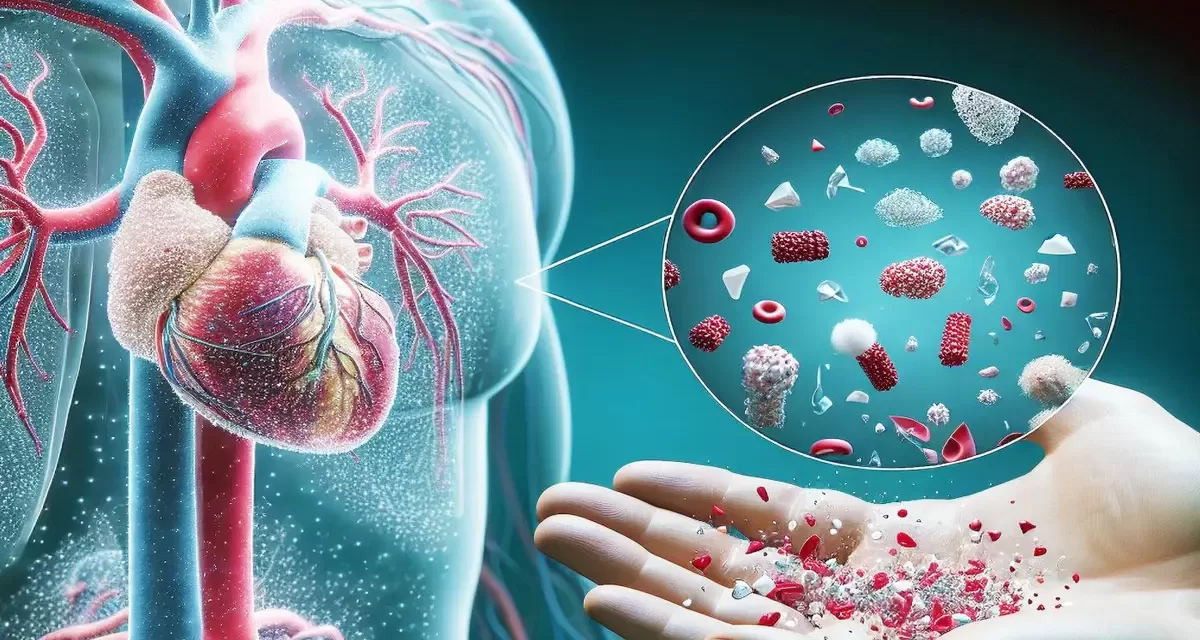
Once inside, most microplastics pass through the digestive system. However, evidence suggests that the smallest particles—nanoplastics under 1 micrometer—may be capable of crossing the intestinal lining to enter the bloodstream and lymphatic system.
What Science Says About Cellular and Organ-Level Effects
While large-scale human clinical trials are difficult to conduct, laboratory and animal studies have identified three primary areas of concern regarding how microplastics interact with our biology.
1. Oxidative Stress and Inflammation
Microplastics can act as physical irritants. When cells encounter these foreign objects, they may produce reactive oxygen species (ROS). This leads to oxidative stress, which can damage DNA and proteins. In animal models, chronic exposure has been linked to low-grade inflammation, a known precursor to metabolic syndrome and neurodegenerative diseases.
2. Immune System Activation
The body’s immune system is designed to find and eliminate foreign invaders. Macrophages, the “scouts” of the immune system, have been observed attempting to engulf microplastics. If the body cannot clear these particles efficiently, it can lead to persistent localized inflammation in the gut or lungs.
3. Chemical “Hitchhikers”
Perhaps the greatest concern is not the plastic itself, but what it carries. Microplastics are “sticky” and can adsorb heavy metals and organic pollutants from the environment. Additionally, they contain additives like bisphenols and phthalates. These are known endocrine-disrupting compounds (EDCs) that can interfere with hormone signaling, potentially impacting reproductive health and thyroid function.
Dr. Mugdha Tapdiya, Director of Internal Medicine at Fortis Hospital, Vasant Kunj, notes that the ability of these particles to translocate across epithelial barriers is a critical focus of current research. “Microplastics can interact directly with cells,” she explains, noting that the intersection of toxicology and chronic disease is the next frontier for environmental medicine.
The Public Health Perspective: Cause for Alarm?
Regulatory bodies, including the World Health Organization (WHO), have flagged plastic pollution as a high priority. However, they also maintain that current evidence does not yet prove widespread clinical harm at today’s average exposure levels.
The challenge for public health officials is the “silent” nature of the exposure. Unlike a viral outbreak, the effects of microplastics likely accumulate over decades. This makes it difficult to isolate plastic as the sole cause of a specific ailment, especially when it coexists with other environmental pollutants.
Study Limitations and Counterarguments
It is vital to maintain perspective on the current data. Critics of the “5 grams per week” estimate point out several limitations:
-
Indirect Estimation: Most figures are based on mathematical models rather than direct measurements of plastic in human tissue.
-
Variability: Microplastics are not a single substance; they vary in shape, size, and chemical makeup, making “one-size-fits-all” toxicity claims inaccurate.
-
Relative Mass: Compared to the total mass of food and water a human consumes in a week, even 5 grams remains a small fraction of total intake.
Practical Steps for Daily Life
You cannot completely eliminate microplastic exposure, but you can reduce your “particle load” with simple lifestyle adjustments.
-
Filter Your Water: High-quality tap water filters are often more effective at removing microplastics than the processes used for some bottled waters.
-
Rethink the Microwave: Avoid heating food in plastic containers. Heat accelerates the leaching of both microplastics and chemical additives into food.
-
Dust and Ventilate: Since inhalation is a major route, using a vacuum with a HEPA filter and ensuring good airflow can reduce the concentration of synthetic fibers in your home.
-
Choose Natural Fibers: When possible, opt for cotton, wool, or linen clothing to reduce the shedding of synthetic microfibers in your home and the water supply.
The Path Forward
The “Precautionary Principle” suggests that when an activity raises threats of harm to human health, precautionary measures should be taken even if some cause-and-effect relationships are not fully established.
As Dr. Tapdiya suggests, the early mechanistic evidence at the cellular level is enough to justify vigilance. We are currently in a period of “scientific waiting,” where the data is catching up to the ubiquity of the material. Until then, reducing single-use plastics and being mindful of food storage are sensible steps for any health-conscious consumer.
Medical Disclaimer: This article is for informational purposes only and should not be considered medical advice. Always consult with qualified healthcare professionals before making any health-related decisions or changes to your treatment plan. The information presented here is based on current research and expert opinions, which may evolve as new evidence emerges.
References
- https://www.ndtv.com/health/did-you-know-you-might-be-eating-around-5-grams-of-microplastics-every-week-11327819