 0
0
 0
0
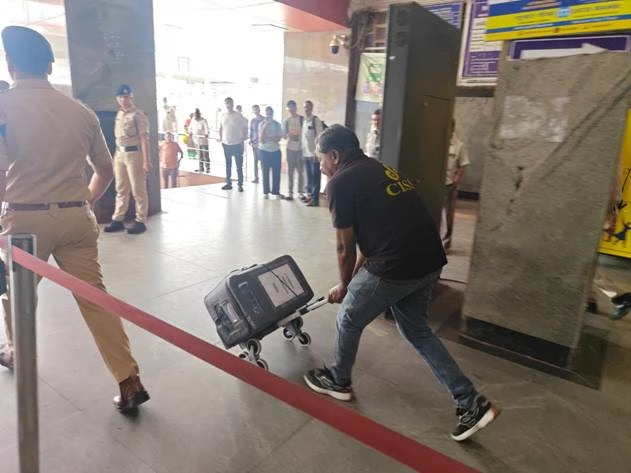
AHMEDABAD, INDIA — In a landmark event that marks a new frontier for medical logistics in South Asia, Indian Railways successfully transported a live donor heart aboard a high-speed passenger train for the first time in the country’s history.
On July 31, 2026, medical teams, railway officials, and law enforcement synchronized operations to move the vital organ from Surat to the U.N. Mehta Institute of Cardiology & Research Centre in Ahmedabad via Train No. 20901, the Mumbai Central–Gandhinagar Capital Vande Bharat Express.
The success of the mission opens up promising new possibilities for organ transplant networks, demonstrating that high-speed rail can serve as a dependable, cost-effective alternative to air transport for time-critical medical supplies.
A Race Against the Ischemic Clock
When a donor heart is removed for transplantation, time becomes the single most critical variable. Cardiac tissue experiences cold ischemia—a period where the organ is preserved in a cold solution without blood flow or oxygen.
According to guidelines from the International Society for Heart and Lung Transplantation (ISHLT), the ideal cold ischemic time for a donor heart is under four hours. Exceeding six hours dramatically increases the risk of primary graft dysfunction, a major cause of early mortality post-transplant.
Traditionally, organ preservation relies on chartered flights or commercial airlines to bridge long distances between cities, backed by police-led “Green Corridors” on roads. However, air transport carries steep costs and is vulnerable to severe weather delays or air traffic congestion.
By leveraging the punctuality and semi-high-speed performance of the Vande Bharat Express—which operates at service speeds up to 160 km/h—the multi-agency team established a reliable land-based alternative. The 260-kilometer route between Surat and Ahmedabad was covered with surgical precision, ensuring the donor heart arrived well within its functional viability window.
Surgical Precision on the Rails: How the Mission Unfolded
The operation required synchronized execution across four separate entities: Indian Railways, the Railway Protection Force (RPF), the Gujarat State Police, and medical transplant specialists.
       [ Surat Hospital ]
               │  (Surgical Retrieval)
               ▼
   [ Surat Railway Station ]
               │  (Vande Bharat Express)
               ▼
 [ Ahmedabad Railway Station ]
               │  (RPF & Police Green Corridor)
               ▼
[ U.N. Mehta Cardiology Institute ]
-
Retrieval & Transit: The donor heart was harvested at a medical facility in Surat, secured in a specialized organ preservation container maintained at 2–4°C, and dispatched to Surat Station under a police escort.
-
Onboard Protocol: Onboard the Vande Bharat Express, train crew and medical personnel monitored the transit while track dispatchers prioritized the train’s passage through signal sectors.
-
Green Corridor Execution: Upon arrival at Platform No. 1 at Ahmedabad Railway Station, a dedicated “Green Corridor” created jointly by the RPF and local traffic police allowed the ambulance to traverse urban roads to the U.N. Mehta Institute without encountering red lights or traffic bottlenecks.
“In such life-saving missions, every minute is crucial,” stated Shri Ved Prakash, Divisional Railway Manager, Ahmedabad. “The successful transportation of a live donor heart… demonstrates our commitment to serving society beyond conventional passenger and freight transportation.”
Expanding the Medical Supply Chain
This milestone comes at a crucial time for organ transplantation infrastructure in developing healthcare systems.
  TRADITIONAL AIR LOGISTIC VS. HIGH-SPEED RAIL LOGISTICS

  AIR TRANSPORT:
  [Hospital] ──> [Airport Traffic] ──> [Flight] ──> [Airport Traffic] ──> [Recipient]
  High Cost | Weather Dependent | Double Airport Transit Delays

  HIGH-SPEED RAIL:
  [Hospital] ──────> [City Center Station] ──> [Express Rail] ──────> [Recipient]
  Lower Cost | Weather Resistant | Direct City-Center Connectivity
While air transport remains essential for cross-country organ transfers exceeding 500 kilometers, rail networks offer distinct advantages for intercity distances between 200 and 400 kilometers:
-
City-Center Connectivity: Railway stations are located within urban centers, reducing the ground transport time required to reach suburban airports.
-
Weather Independence: High-speed rail operations are significantly less prone to fog or monsoon cancellations compared to aviation.
-
Cost Efficiency: Train-based logistics cost a fraction of private air charter services, making organ transplantation logistics more accessible to public health systems.
External organ procurement specialists note that integrating rail networks into national organ registries could significantly increase the geographic catchment area for donor organs.
Dr. Arvinder Singh Soin, a pioneer in liver transplantation and Chairman of Medanta Liver Transplant Institute (not involved in the Surat operation), commented on the systemic implications: “Establishing multi-modal transit options—combining road, air, and now express rail—is vital for reducing discard rates of donor organs. When regional train lines can guarantee tight schedules, they effectively bridge the gap between regional donor hubs and major tertiary care institutions.”
Limitations and Future Outlook
While this mission marks an encouraging precedent, experts emphasize that train-based organ transport is not a universal solution for every transplant scenario.
-
Fixed Timetables: Unlike charter aircraft or ambulances, commercial trains run on fixed schedules. For rail transport to become a routine option, organ procurement networks need protocol agreements for unscheduled express stops or dedicated medical coaches on high-frequency routes.
-
Ischemia Limits for Other Organs: Different organs have different cold ischemia tolerances:
-
Heart & Lungs: 4 to 6 hours (Most time-sensitive)
-
Liver: 8 to 12 hours
-
Kidneys: Up to 24 to 36 hours
-
While kidneys and livers easily tolerate longer train journeys, heart and lung transfers will always depend on strict time limits, restricting rail usage to high-speed corridors.
Indian Railways and public health authorities are evaluating lessons from this pilot mission to establish standardized operating procedures (SOPs) for future emergency medical transfers along high-speed Vande Bharat corridors nationwide.
Summary for Patients & Families
-
What happened: Indian Railways transported a donor heart via the Vande Bharat Express from Surat to Ahmedabad for a successful transplant operation.
-
Why it matters: It proves that express trains can provide safe, fast, and cost-effective transportation for time-sensitive organ transplants over intercity distances.
-
What’s next: Health authorities are reviewing how to build rail logistics into regional organ donation registries to help save more lives across the country.
Medical Disclaimer
Medical Disclaimer: This article is for informational purposes only and should not be considered medical advice. Always consult with qualified healthcare professionals before making any health-related decisions or changes to your treatment plan. The information presented here is based on current research and expert opinions, which may evolve as new evidence emerges.
References & Sources
-
Official Press Release: Press Information Bureau (PIB) Delhi, Ministry of Railways, Government of India. “Indian Railways Successfully Transports India’s First Live Donor Heart by Train; Vande Bharat Express Enables Life-saving Mission.” Published July 31, 2026.