 0
0
 0
0
Published: April 3, 2026
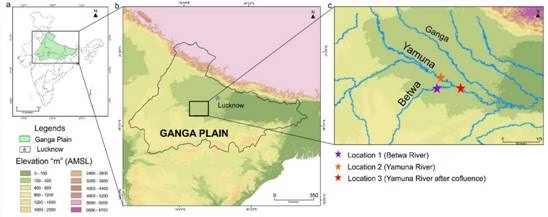
In the heart of the Bundelkhand region in Uttar Pradesh, where the Betwa and Yamuna rivers merge, a silent crisis is unfolding beneath the water’s surface. While these rivers have long been the lifeblood for millions—providing water for drinking, bathing, and agriculture—new research reveals a stark disparity in who pays the price for their pollution.
A landmark study published in Nature Scientific Reports has found that children face a significantly higher risk of non-carcinogenic health complications from heavy metal exposure compared to adults in the same region. Using advanced probabilistic modeling, researchers discovered that in roughly two-thirds of all exposure scenarios, children’s safety thresholds were exceeded, primarily due to toxic levels of arsenic, lead, and cadmium.
Beyond Averages: A New Way to Measure Risk
Traditionally, environmental safety is measured by taking water samples and comparing the average metal concentration to a set safety limit. However, scientists from the Birbal Sahni Institute of Palaeosciences (BSIP) argue that this “one-size-fits-all” approach fails to protect the most vulnerable.
“The risk isn’t just about what is in the water; it’s about who is interacting with it,” explains the research team. To capture this nuance, the study utilized Monte Carlo simulations—a sophisticated statistical technique that ran 10,000 virtual “what-if” scenarios. These simulations accounted for variations in body weight, daily water intake, and seasonal pollution spikes.
The results were sobering. For children, the Hazard Index (HI)—a metric used to determine the probability of non-cancerous health effects—exceeded safety thresholds in 67% of simulated scenarios. For adults, while the risk remained present, it did not reach the same critical frequency.
Why Children are Most Vulnerable
The study highlights a biological and behavioral reality: children are not just “small adults.” Their developing systems and higher intake-to-body-mass ratio make them biological sponges for environmental toxins.
-
Physiological Development: Children’s organs are still maturing, and their bodies are less efficient at detoxifying heavy metals like lead and arsenic.
-
Higher Exposure: Proportional to their body weight, children drink more water and breathe more air than adults, meaning they ingest a higher concentration of contaminants per kilogram of body mass.
-
Long-term Accumulation: Early childhood exposure sets the stage for “chronic loading,” where metals accumulate in bone and soft tissue, potentially leading to developmental delays, cognitive impairment, and kidney dysfunction later in life.
“When we see a 67% exceedance rate in children, we are looking at a public health red flag,” says Dr. Ananya Sharma, a public health expert not involved in the study. “Arsenic and lead, even at low levels, can interfere with neurodevelopment, leading to permanent shifts in a child’s cognitive trajectory.”
The “Sink” Effect: How Sediments Store Poison
This latest research builds upon a 2025 study which identified the surficial sediments of the Ganga plain as “major sinks” of contamination. Essentially, the riverbed acts like a storage unit for toxic metals.
Under normal conditions, these metals sit in the sediment. However, during monsoon seasons or changes in water flow (hydrological conditions), these contaminants are “remobilized”—stirred back up into the water column. This creates a secondary source of pollution that persists even if the original industrial dump is stopped.
The confluence of the Betwa and Yamuna rivers creates a unique “mixing bowl” effect. The hydraulic mixing of these two different chemical systems increases the mobilization of metals, making the water at the junction particularly hazardous.
Sources of Contamination: A Human Footprint
The study identifies a cocktail of natural and human-driven (anthropogenic) sources contributing to the toxic load:
-
Agricultural Runoff: Pesticides and fertilizers leaching into the groundwater.
-
Untreated Effluents: Industrial discharge from nearby manufacturing hubs.
-
Thermal Power Generation: Heavy metals from coal ash and cooling processes.
-
Urban Sewage: Poorly managed domestic waste from growing populations.
The Carcinogenic Concern
Beyond the immediate non-carcinogenic risks—such as skin lesions or gastric distress—the study raised alarms regarding arsenic exposure. The researchers found that under realistic exposure variability, the risk of developing cancer over a lifetime was “substantial” for those living near the confluence. Arsenic is a well-documented human carcinogen, linked to cancers of the skin, bladder, and lungs.
Public Health Implications and Policy
The BSIP study is more than an academic exercise; it is a call for targeted mitigation. By identifying that the risk is highest at the confluence, health authorities can prioritize these areas for advanced water filtration and stricter industrial regulation.
What this means for residents:
-
Water Safety: Households in the Bundelkhand region should ideally use certified filtration systems that specifically target heavy metals (RO systems with mineral management).
-
Monitoring: Local health clinics should be alerted to look for early signs of heavy metal toxicity in children, such as unexplained fatigue, abdominal pain, or developmental plateaus.
“This integrated, uncertainty-aware approach establishes a new method for river health assessment,” the study authors noted. By moving away from simple averages and toward “probabilistic risk,” the research provides a more honest look at the dangers facing the next generation.
Limitations and Counterarguments
While the study is robust, some environmental scientists suggest that the Monte Carlo simulations rely on “virtual scenarios” which may overestimate risk if local communities have already shifted to using deep-bore wells rather than river water for drinking. Furthermore, the study focused on specific heavy metals; the presence of emerging contaminants like microplastics or pharmaceutical waste was not the primary focus, suggesting the total health risk could be even more complex.
Conclusion
The waters of the Betwa and Yamuna are a mirror reflecting the environmental cost of rapid development. While the rivers continue to flow, the research is clear: the current level of contamination is a debt being passed down to the children of the Ganga Plain. Without evidence-based water safety policies and immediate intervention at industrial sources, the “hazard index” for the region’s youth will only continue to rise.
References
-
Press Information Bureau (PIB) Delhi, “Children face higher risk from river metal contamination,” April 2, 2026.
Medical Disclaimer: This article is for informational purposes only and should not be considered medical advice. Always consult with qualified healthcare professionals before making any health-related decisions or changes to your treatment plan. The information presented here is based on current research and expert opinions, which may evolve as new evidence emerges.