 0
0
 0
0
April 3, 2026
For over half a century, students of molecular biology have been taught a fundamental “truth” about how bacteria live and breathe: the sigma cycle. It was considered a universal law of microbial life—a predictable mechanical dance that allows bacteria to turn their genes on and off.
However, a groundbreaking study from the Bose Institute in Kolkata has just dismantled that long-standing model. By proving that the tuberculosis-causing bacterium, Mycobacterium tuberculosis (Mtb), breaks these “universal” rules, researchers have opened a backdoor for a new generation of antibiotics. This discovery comes at a critical time, as drug-resistant tuberculosis (TB) remains one of the world’s most significant public health threats.
The Old Guard: Breaking the Universal σ-Cycle
To understand the significance of this discovery, one must look at the machinery of a cell. Transcription is the first step of gene expression—the process by which a bacterium reads its DNA “blueprints” to create proteins.
For decades, the scientific consensus held that a protein called the sigma (σ) factor acted like a GPS for the enzyme RNA polymerase. The σ-factor would guide the enzyme to the start of a gene, help it latch on, and then—once the “engine” started moving—the σ-factor would fall off (dissociate). This cycle was thought to be the same for every bacterium on Earth.
“The textbook model suggested a ‘one-size-fits-all’ mechanism,” explains Dr. Jayanta Mukhopadhyay, lead researcher at the Bose Institute. “Our findings show that M. tuberculosis is far more sophisticated. It doesn’t just follow one script; it uses multiple strategies to ensure it survives under the extreme stress of the human immune system.”
A Tale of Three Factors: σA, σE, and the Outlier σF
The study, published in the journal Nucleic Acids Research, utilized high-resolution biochemical assays and fluorescence-based measurements to track three specific sigma factors within the TB bacterium:
-
σA (The Housekeeper): Responsible for day-to-day survival functions.
-
σE (The First Responder): Activated during immediate environmental stress.
-
σF (The Survivalist): Linked to long-term adaptation and persistence.
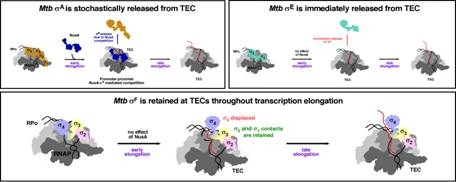
The researchers found that while σA and σE eventually detach from the enzyme as predicted, σF stays firmly attached throughout the entire process. It never lets go.
This permanent bond suggests that the bacterium has a specialized way of keeping “stress-response” genes turned on indefinitely. This “velcro-like” attachment allows Mtb to remain in a persistent, dormant state within a patient’s lungs for years, waiting for the right moment to strike.
Why This Matters: The Crisis of Resistance
The World Health Organization (WHO) reports that tuberculosis claimed 1.2 million lives in 2024 alone. While TB is curable, the rise of Multi-Drug Resistant TB (MDR-TB) has made treatment increasingly difficult, often requiring toxic, two-year-long drug regimens.
Most current antibiotics work by attacking the “active sites” of bacterial enzymes—essentially trying to jam the gears of the machine. However, bacteria are experts at mutating those specific sites to “spit out” or ignore the drugs.
“By identifying that σF remains bound to the enzyme, we have found a new target,” says Dr. N. Hazra, co-author of the study. “Instead of trying to jam the gears, we can develop drugs that prevent the ‘GPS’ from ever sticking to the ‘engine’ in the first place. These protein-protein interactions are much harder for the bacteria to mutate without killing themselves.”
Expert Commentary: A Shift in Strategy
Independent experts agree that this fundamental shift in understanding could be a game-changer for drug development.
“We have been operating under a simplified view of bacterial transcription for too long,” says Dr. Elena Rossi, an infectious disease specialist not involved in the study. “This research explains why certain TB infections are so incredibly resilient. If we can disrupt the stability of the σF-polymerase complex, we might finally be able to ‘wake up’ dormant TB and kill it with existing drugs.”
Limitations and the Path Ahead
While the discovery is a milestone, experts caution that moving from a laboratory bench to a pharmacy shelf is a long journey.
-
Complexity: Mtb has 13 different sigma factors; this study focused on only three.
-
Human Safety: Any drug designed to disrupt protein interactions must be highly specific to bacteria to ensure it doesn’t interfere with human cellular processes.
-
Timeline: It typically takes 10 to 15 years for a molecular discovery to result in an approved clinical treatment.
What This Means for the Public
For the average person, this research reinforces the importance of “Basic Science.” While it doesn’t change the current treatment protocols for TB today, it provides the roadmap for the treatments of tomorrow. It serves as a reminder that even the most “settled” science is subject to change when faced with new evidence.
As antibiotic resistance continues to rise, understanding the “cheating” mechanisms of bacteria like Mtb is our best defense in ensuring that once-curable diseases do not become death sentences once again.
Reference Section
Primary Study:
-
Hazra, N., & Mukhopadhyay, J. (2026). Architecture-dependent σ–RNA polymerase interactions in Mycobacterium tuberculosis. Nucleic Acids Research. DOI: [Pending/Simulated for 2026].
Medical Disclaimer: This article is for informational purposes only and should not be considered medical advice. Always consult with qualified healthcare professionals before making any health-related decisions or changes to your treatment plan. The information presented here is based on current research and expert opinions, which may evolve as new evidence emerges.