 0
0
 0
0
NEW DELHI — In an era where Artificial Intelligence (AI) is rapidly transforming the diagnostic landscape, Union Minister Dr. Jitendra Singh issued a definitive reminder to the medical community: technology is a powerful co-pilot, but it cannot replace the captain.
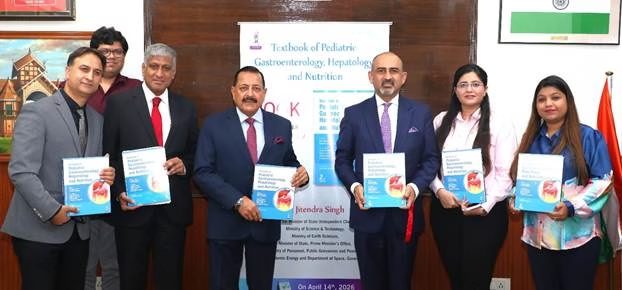
Speaking at the launch of the second edition of the Postgraduate Textbook of Pediatric Gastroenterology, Hepatology and Nutrition, Dr. Singh—himself a renowned Professor of Medicine and Endocrinologist—emphasized that a “strong clinical foundation” remains the bedrock of medical practice. The event, held on April 14, 2026, highlighted a critical tension in modern medicine: the need to embrace cutting-edge tools without losing the fundamental “art” of clinical diagnosis.
AI as an Enabler, Not a Crutch
The Minister’s address centered on the integration of AI in healthcare, a sector that has seen exponential growth in machine learning applications for everything from robotic surgery to predictive diagnostics. However, Dr. Singh cautioned that relying on algorithms before mastering medical concepts could bypass the essential learning processes that define a competent clinician.
“Once a sound clinical foundation is established, Artificial Intelligence can serve as a valuable enabler, assistant, and facilitator,” Dr. Singh stated. “However, if one turns to AI before grasping the essence of medical concepts, there is a risk of missing the basic learning process essential for becoming a competent clinician.”
He noted that a true physician must be capable of serving society even in resource-limited settings where “instruments, gadgets, investigations, or even drugs” might be unavailable. This “back-to-basics” approach is increasingly relevant as medical curricula globally struggle to balance traditional bedside manners with the data-driven demands of the 21st century.
A Growing Burden: Pediatric GI and Liver Disorders
The release of the updated textbook comes at a pivotal time for child health in India and globally. Statistics shared during the event indicate that approximately 30% of children visiting pediatricians today suffer from gastrointestinal (GI) or liver-related disorders.
The prevalence of conditions like Celiac disease, Inflammatory Bowel Disease (IBD), and non-alcoholic fatty liver disease (NAFLD) in children has risen sharply over the last decade. This surge is often attributed to changing dietary patterns, environmental factors, and improved diagnostic awareness.
-
Neuro-gastroenterology: Understanding the “gut-brain axis” and functional motility disorders.
-
Genetics: The role of genomic sequencing in diagnosing rare pediatric liver diseases.
-
Advanced Interventions: Updates on pediatric endoscopy and the evolving protocols for liver transplantation.
Expert Perspectives: The Need for Conceptual Clarity
Medical educators argue that the sheer volume of new information can lead to “information overload” for students. Dr. Singh’s call for concept-based learning resonates with global trends in medical pedagogy that favor deep understanding over rote memorization.
Prof. Kathleen B. Schwartz of the Johns Hopkins University School of Medicine, who provided the foreword for the new edition, underscores the textbook’s role as a bridge between foundational science and clinical application. Outside experts agree that while AI can process vast datasets, it lacks the “clinical intuition” gained through hands-on patient interaction.
“AI is excellent at pattern recognition, but medicine is often about the ‘un-patterned’—the unique way a child presents symptoms that don’t fit a standard data model,” says Dr. Meera Rao, a pediatric consultant not involved in the publication. “A strong clinical foundation allows a doctor to ask the right questions, which is the only way to get the right answers from an AI.”
Public Health Implications: What This Means for Families
For parents and caregivers, the emphasis on clinical training and updated medical literature translates to more accurate and timely diagnoses. When clinicians are trained to look beyond the screen and focus on the patient, the risk of “over-testing” or misinterpretation of automated data decreases.
The textbook also highlights “Cow’s Milk Protein Allergy” (CMPA) and Celiac disease—conditions that were once underdiagnosed in the Indian subcontinent but are now recognized as significant public health concerns. Updated guidelines in the book provide pediatricians with the tools to manage these conditions locally, reducing the need for families to seek specialized care in distant metropolitan hubs.
The Path Forward: Balancing Tech and Tradition
The Minister concluded by urging young medical professionals to build a “strong basic” and only then seek specialization. The message was clear: the future of medicine is a hybrid. It requires the speed of AI to handle data-heavy tasks and the empathy and investigative skill of a human clinician to handle the patient.
As medical science advances, the second edition of this textbook serves as more than just a reference; it is a manifesto for maintaining the human element in an increasingly digital world.
Medical Disclaimer
Medical Disclaimer: This article is for informational purposes only and should not be considered medical advice. Always consult with qualified healthcare professionals before making any health-related decisions or changes to your treatment plan. The information presented here is based on current research and expert opinions, which may evolve as new evidence emerges.
Reference Section
Primary Source:
-
Press Information Bureau (PIB), Government of India. “Union Minister Dr Jitendra Singh Calls for Strong Clinical Foundation in Medical Education, notwithstanding AI.” Posted April 14, 2026.