 0
0
 0
0
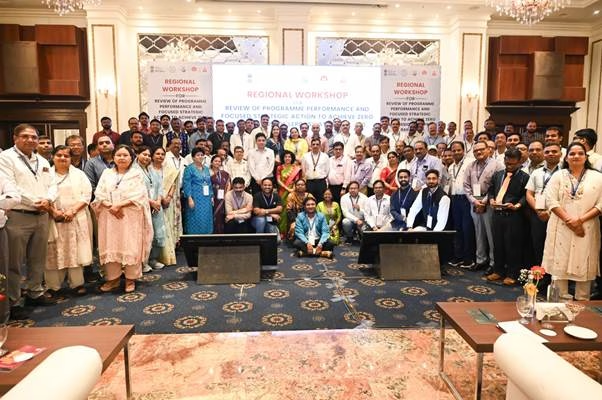
NAVA RAIPUR, CHHATTISGARH — The Union Ministry of Health and Family Welfare concluded a high-level, two-day regional workshop on June 12, 2026, aimed at shifting India from the “control” phase of leprosy to complete eradication. The meeting brought together nearly 200 public health leaders, state officials, and global health experts to design state-specific roadmaps. The ultimate objective is achieving zero transmission of leprosy across all districts.
While India officially achieved the benchmark for eliminating leprosy as a public health problem at the national level in 2005, public health officials emphasize that the bacterial infection remains deeply entrenched in specific geographic hotspots. The fresh mobilization aims to deploy aggressive door-to-door screening and preventive drug regimens to finally break the chain of transmission.
The Core Challenge: Concentrated Burdens
According to data presented at the workshop, India detected 91,783 new cases of leprosy during the 2025–26 fiscal year, translating to a national prevalence rate of 0.56 cases per 10,000 people. While the national average remains comfortably below the World Health Organization (WHO) elimination threshold of less than 1 case per 10,000 population, aggregate figures obscure a more complicated local reality.
A cluster of five high-priority states — Maharashtra, Chhattisgarh, Jharkhand, Odisha, and Madhya Pradesh — currently accounts for nearly 50 percent of the entire national leprosy burden.
Districts Exceeding the Elimination Threshold (>1 case per 10,000 population):
├── Chhattisgarh: 23 districts
├── Jharkhand: 21 districts
├── Odisha: 18 districts
├── Maharashtra: 18 districts
└── Madhya Pradesh: 10 districts
Furthermore, Chhattisgarh, Jharkhand, Odisha, Maharashtra, and the Union Territory of Chandigarh have not yet achieved consistent sub-national elimination status.
“The challenge now lies in sustaining our gains and accelerating action in these remaining endemic pockets,” stated Smt. Aradhana Patnaik, Additional Secretary and Mission Director of the National Health Mission (NHM). She urged state officials to implement rigid accountability frameworks, identify local implementation bottlenecks, and deploy corrective actions without delay.
Modern Weaponry: Single-Dose Prevention
To completely interrupt transmission, the National Leprosy Eradication Programme (NLEP) is shifting toward a proactive, preventative model. Instead of waiting for symptomatic patients to visit clinics, healthcare workers will rely on specialized Leprosy Case Detection Campaigns (LCDC) to find hidden infections early.
A key pillar of this accelerated strategy is expanding Post-Exposure Prophylaxis (PEP) using Single-Dose Rifampicin (SDR). Prophylaxis means giving a medicine to prevent an infection before it takes hold. When an individual is diagnosed with leprosy (the index case), healthy individuals in close daily contact with them are given a single dose of the antibiotic rifampicin. Clinical trials have shown that this simple step reduces the risk of contacts developing leprosy by up to 60 percent over two years.
NLEP Operational Strategy:
[Index Case Detected]
       │
       ▼
[Rigorous Contact Tracing] ──► (Screening family, neighbors, and co-workers)
       │
       ▼
[SDR Prophylaxis Administered] ──► (Halts transmission cycle in healthy contacts)
Public health workers will systematically integrate screening into existing community health frameworks. These include the Rashtriya Bal Swasthya Karyakram (RBSK) for children and Community-Based Assessment Checklists (CBAC) used by frontline village health workers.
Re-evaluating Quality of Life and Early Intervention
Independent experts note that the proportion of children and disabled individuals among new cases is a crucial measure of how actively a disease is spreading. Of the new cases detected in India over the past year, 4.18 percent were children.
“When we see leprosy in young children, it tells us the bacteria is actively circulating in households right now,” says Dr. Ananya Sharma, an independent public health epidemiologist not involved in the ministry workshop. “It means people are being exposed today, not decades ago.”
Additionally, 2.12 percent of the newly diagnosed individuals already exhibited Grade-2 Disability (visible deformity or impairment) at the time of their first evaluation. This lag indicates that many individuals are living with the disease for months or years before being properly diagnosed.
To support those already affected, Dr. Sunil V. Gitte, Deputy Director General (Leprosy), reported that the government performed 1,591 reconstructive surgeries over the past year. Furthermore, the program distributed more than 1.03 lakh pairs of Micro Cellular Rubber (MCR) protective footwear and over 1.25 lakh self-care kits designed to prevent secondary injuries in patients who have lost sensation in their hands or feet.
Addressing Stigma and Operational Hurdles
Despite the availability of highly effective, free Multi-Drug Therapy (MDT) that cures leprosy within 6 to 12 months, ancient social stigmas continue to hamper eradication efforts. Fear of isolation or community discrimination frequently causes individuals to hide initial symptoms, such as pale, numb patches on the skin.
The Cyclical Impact of Social Stigma:
[Fear of Social Stigma]
       │
       ▼
[Delayed Diagnosis & Treatment]
       │
       ▼
[Advanced Nerve Damage / Visible Disability]
       │
       ▼
[Reinforced Community Stigma]
To counter this, the revised state action plans place a heavy emphasis on Social and Behaviour Change Communication (SBCC). Health workers are tasked with educating rural communities that leprosy is simply a mild bacterial infection, that it is completely curable, and that it is not hereditary or a curse.
Balancing the Scope: Limitations to Watch
While the workshop’s roadmaps provide a solid conceptual framework, independent observers point out several structural challenges:
-
Frontline Worker Burnout: The success of contact tracing relies heavily on Accredited Social Health Activists (ASHAs) and local health workers who are already balancing multiple national campaigns, from immunization to maternal health.
-
Migratory Vulnerabilities: Tracking contacts becomes exceptionally difficult in endemic districts characterized by high seasonal labor migration, which can easily disrupt the delivery of preventative single-dose treatments.
-
Diagnostic Precision: Early leprosy can be difficult to spot without continuous, hands-on clinical training for primary health center staff.
Public Health Implications for Consumers
For the general public, the primary takeaway from current medical consensus is that early detection completely prevents disability. If you or a family member notices a persistent, light-colored or reddish patch on the skin that has lost its normal sensation to heat, cold, or pain, you should seek a screening at the nearest primary health center.
Treatment with Multi-Drug Therapy is completely free across all government facilities, and early intervention renders the patient entirely non-infectious within just a few doses, protecting both the individual and their surrounding community.
References
- https://www.pib.gov.in/PressReleasePage.aspx?PRID=2272194®=48&lang=1
Medical Disclaimer: This article is for informational purposes only and should not be considered medical advice. Always consult with qualified healthcare professionals before making any health-related decisions or changes to your treatment plan. The information presented here is based on current research and expert opinions, which may evolve as new evidence emerges.