 0
0
 0
0
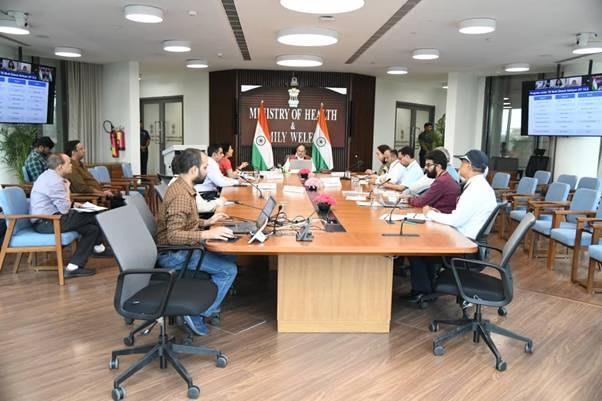
NEW DELHI — In a major push toward seamless healthcare governance, Union Minister of Health and Family Welfare Shri J. P. Nadda chaired a high-level virtual review meeting on July 7, 2026, with Kerala’s State Health Minister Shri K. Muraleedharan. The bilateral session evaluated the ground-level implementation of India’s most critical public health initiatives in Kerala, focusing on eliminating tuberculosis, scaling up free diagnostic and drug services, and reinforcing food and drug regulatory oversight.
The meeting serves as a critical checkpoint for India’s federal health architecture. Officials evaluated data from the National Health Mission (NHM) alongside state-specific operational hurdles. Representatives from both sides sought to align regional execution with national healthcare goals, ensuring that affordable, high-quality care remains accessible to Kerala’s 35 million citizens.
Directing Resources to the Frontlines: The Flagship Agenda
The virtual summit brought together an array of top-tier policymakers, including Smt. Punya Salila Srivastava (Union Health Secretary), Smt. Aradhana Patnaik (Additional Secretary and Mission Director, NHM), and Kerala’s Principal Health Secretary, Dr. Sharmila Mary Joseph.
The core agenda targeted several foundational pillars of public health:
-
TB-Mukt Bharat Abhiyaan: Evaluating localized active case-finding and the distribution of nutritional support (Nikshay Poshan Yojana) to eliminate Tuberculosis.
-
Free Drugs and Diagnostics Service Initiatives: Streamlining supply chains to eliminate out-of-pocket expenditure on essential medicines and lab tests at primary care levels.
-
Human Resources & Medical Education: Addressing staffing shortages under the NHM framework and expanding infrastructure within state medical colleges.
-
Regulatory Systems: Upgrading the operational capacity of state blood banks, drug laboratories, and food safety mechanisms.
Shri K. Muraleedharan provided a detailed brief on Kerala’s structural progress, while highlighting specific regional challenges that require technical and financial assistance from the Central Government. Acknowledging these efforts, Shri J. P. Nadda reiterated the Union government’s commitment to supporting Kerala’s healthcare ecosystem, emphasizing that cooperative federalism is vital to achieving national health targets.
Strengthening Regulatory Systems and Safety Frameworks
A notable highlight of the review was the active participation of India’s top regulatory watchdogs: Dr. Rajeev Raghuvanshi, the Drugs Controller General of India (DCGI), and Shri Amit Sharma, Executive Director of the Food Safety and Standards Authority of India (FSSAI). Their involvement underlines a growing policy shift toward treating drug efficacy and food safety as core components of preventative public health rather than isolated administrative tasks.
Public health policy experts view this joint oversight as essential for protecting consumers from substandard medications and foodborne illnesses.
“When the Central and State apparatus align on regulatory oversight, it closes the operational loopholes that counterfeit drugs or sub-standard food distribution chains exploit,” noted Dr. Harilal S. Nair, a public health policy analyst based in New Delhi, who was not involved in the meeting. “For a highly literate, health-conscious state like Kerala, integrating robust FSSAI protocols with grassroots primary healthcare creates a powerful preventative buffer against chronic and acute health crises.”
Balancing Progress with Grassroots Demands
While Kerala historically boasts some of India’s finest health indicators—including low infant mortality rates and high life expectancy—the state faces distinct modern challenges. An aging population and a high prevalence of non-communicable diseases (NCDs) like diabetes and cardiovascular conditions place immense strain on public clinics.
Independent healthcare analysts point out that while expanding “Free Diagnostic Initiatives” sounds excellent on paper, maintaining the equipment and ensuring consistent supply lines for reagents in rural centers remains a logistical hurdle.
Furthermore, medical professional associations frequently highlight that adding infrastructure without rapidly onboarding permanent medical staff can lead to clinical burnout under the NHM framework. The commitment by both ministers to systematically address “Human Resources for Health” signals a mutual understanding that physical facilities are only as good as the professionals running them.
What This Means for Daily Healthcare Decisions
For the average citizen visiting a public clinic in Kerala, these high-level deliberations translate to tangible, everyday improvements:
-
Reduced Out-of-Pocket Costs: Stricter enforcement of the Free Drugs and Diagnostics Initiatives means patients can expect reliable access to essential therapies and blood panels without being redirected to private, high-cost pharmacies.
-
Enhanced Drug and Blood Safety: Heightened DCGI and state blood bank monitoring ensures the safety, purity, and efficacy of blood transfusions and prescribed pharmaceuticals.
-
Robust Food Quality Controls: Increased localized FSSAI intervention protects everyday consumers by enforcing stricter hygiene and safety compliance across local food markets and production units.
As the resolutions from this review meeting roll out, the ongoing coordination between New Delhi and Thiruvananthapuram will act as a blueprint for how states and the center can collaborate to build resilient, equitable healthcare infrastructure.
References
-
Press Information Bureau (PIB), Government of India: Official dispatch dated July 7, 2026, details titled: “Union Health Minister Shri J. P. Nadda Virtually Reviews Implementation of Key Health Programmes in Kerala with State Health Minister Shri. K. Muraleedharan.” pib.gov.in
Medical Disclaimer: This article is for informational purposes only and should not be considered medical advice. Always consult with qualified healthcare professionals before making any health-related decisions or changes to your treatment plan. The information presented here is based on current research and expert opinions, which may evolve as new evidence emerges.