 0
0
 0
0
AHMEDABAD, GUJARAT — In a major infrastructure reclamation effort, public health facilities across Gujarat successfully removed more than 5.14 lakh (514,000) unusable items over a single week, state health officials announced at the conclusion of the drive on July 7, 2026. The massive campaign, dubbed the “Namo Swachhta Abhiyan,” targeted more than 12,000 public health institutions across the state. By systematically disposing of broken furniture, decommissioned medical devices, and outdated IT equipment, authorities have successfully freed up 1,806 rooms that were previously blocked by clutter—effectively restoring substantial clinical space for patient care and treatment without the need for new construction.
Reclaiming Space in High-Volume Healthcare Systems
Public hospitals often contend with high patient volumes, tight storage capacities, and slow maintenance administrative cycles. Over time, these factors can lead to an accumulation of damaged or redundant items that take up valuable real estate within clinical environments.
The week-long drive, which ran from July 1 to July 7, 2026, aimed to directly address these operational bottlenecks. According to official government data released at the campaign’s conclusion, authorities identified a total of 5,72,563 unusable items across the state’s healthcare network. Of those, 514,456 items were permanently disposed of on-site.
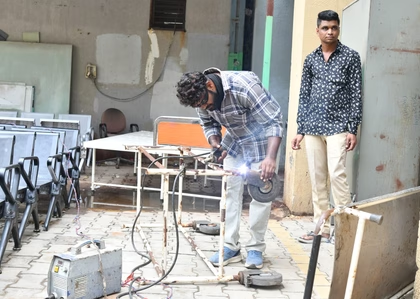
Rather than sending everything to a landfill, the campaign also emphasized resource recovery. Crews repaired 41,681 items—including furniture, grounded vehicles, ambulances, electronics, and various medical devices—returning them to active service. The momentum continued right up to the final day of the initiative, where workers identified 22,667 unusable items, successfully disposing of 15,530 and clearing an additional 129 rooms in a 24-hour window.
The Public Health Logic: Why Decluttering Intersects with Care Quality
While removing broken chairs and old computers may seem like a purely administrative task, public health experts emphasize that environmental order is deeply intertwined with patient safety and infection control.
According to guidelines from the Centers for Disease Control and Prevention (CDC), environmental cleaning and disinfection serve as core standard practices essential to safe, high-quality care across all healthcare delivery settings. When corridors, storage areas, and potential clinical spaces are overwhelmed by clutter, executing routine, thorough disinfection protocols becomes significantly harder for hospital staff.
Furthermore, data from the World Health Organization (WHO) and UNICEF highlights a persistent global challenge: half of healthcare facilities worldwide lack basic hygiene services at the point of care or toilets. In crowded public healthcare systems, facility-level gaps can compound rapidly. Hospital-acquired infections not only threaten vulnerable patients but also act as a primary driver for the development of antimicrobial resistance—the phenomenon where bacteria and viruses evolve to resist existing medications.
By clearing out redundant equipment and freeing up 1,806 rooms, the drive directly tackles crowding, which is a known risk factor in disease transmission within hospital wards.
Expert Perspectives on Systemic Maintenance
Independent public health policy experts view the initiative as a pragmatic step forward, but caution that structural improvements require more than periodic clean-ups.
“In public health systems with very high patient footprints, clutter isn’t just an eyesore; it’s a workflow obstacle,” says Dr. Ananya Sharma, a Delhi-based health systems management specialist who was not involved in the Gujarat drive. “Freeing up over 1,800 rooms instantly expands a system’s capacity. However, the real victory isn’t the disposal number itself—it is establishing an administrative mechanism where broken items are surveyed, repaired, or discarded on a rolling basis, rather than letting them accumulate for years.”
The WHO’s global report on infection prevention and control (IPC) underscores this perspective, noting that while strong environmental sanitation and water, sanitation, and hygiene (WASH) services can prevent a vast majority of healthcare-associated infections, these interventions must be continuous. A single week-long campaign can generate immediate spatial momentum, but long-term patient safety hinges on steady, daily adherence to rigorous cleaning protocols, waste segregation, and device sterilization.
Limitations and Sustained Accountability
Public health observers point out that a clean room does not automatically equate to a sterile or safe environment. A hospital can successfully clear out its old inventory and still present infection risks if basic commodities—such as running water, reliable hand hygiene supplies, and standardized waste management protocols—are missing or inconsistently utilized by staff. Decluttering is a foundational pillar of environmental health, but it cannot substitute for a fully realized, heavily monitored infection prevention system.
The primary challenge moving forward is sustainability. Historically, rapid cleanliness drives yield highly visible, immediate benefits, but those gains can slowly erode if the underlying causes—such as procurement delays for replacement parts, backlogged maintenance requests, and weak institutional accountability—are left unaddressed.
Recognizing this challenge, Gujarat state officials stated that hospital cleanliness and infrastructure upkeep will be transitioned to a system of daily monitoring moving forward. The success of this transition will serve as the ultimate test of whether the newly recovered clinical spaces remain open and safe for patient care over the coming years.
What This Means for Patients and Families
For everyday health consumers and families navigating public medical facilities, the message from global health guidelines remains clear: visible order and sanitation are strong indicators of a facility’s safety culture.
When visiting a clinic or hospital, patients should look for simple, standard signs of good infection control practices:
-
Clear, unblocked hallways and accessible care areas.
-
Visible, well-stocked hand hygiene stations (soap and water or alcohol-based rubs) near points of care.
-
Properly segregated and orderly waste disposal bins.
-
Regular, visible cleaning of shared surfaces and equipment by maintenance staff.
While large-scale administrative overhauls happen at the state level, public health safety is ultimately maintained through daily vigilance, proper resource allocation, and continuous community awareness.
References
- https://bhaskarlive.in/gujarat-health-facilities-undergo-major-clean-up-clearing-more-than-5-14-lakh-unusable-items/
Medical Disclaimer: This article is for informational purposes only and should not be considered medical advice. Always consult with qualified healthcare professionals before making any health-related decisions or changes to your treatment plan. The information presented here is based on current research and expert opinions, which may evolve as new evidence emerges.