 0
0
 0
0
NEW DELHI — In a major escalation of its national healthcare strategy, the Government of India has launched a massive inter-ministerial initiative to transform its flagship tuberculosis (TB) elimination campaign into a nationwide grassroots movement.
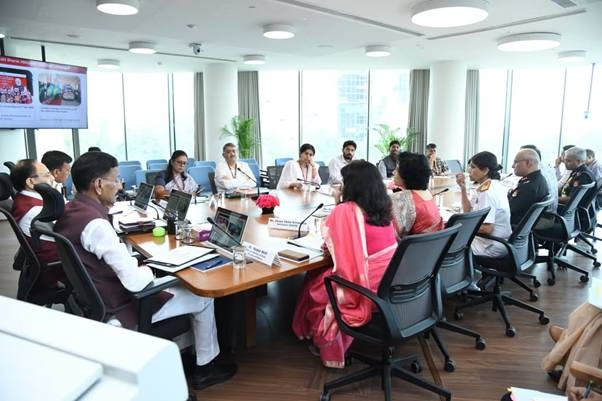
Union Minister of Health and Family Welfare Shri Jagat Prakash Nadda chaired a high-level review meeting on July 7, 2026, uniting the forces of the Ministries of Youth Affairs and Sports, Labour and Employment, and Defence. The high-level convergence aims to leverage millions of youth volunteers, military cadets, and corporate workplaces to track, screen, and support patients in every district across the nation.
The aggressive strategy builds upon the momentum of the TB Mukt Bharat Abhiyaan (National TB Elimination Campaign), which has screened more than 28 crore (280 million) vulnerable individuals since December 2024. The campaign has notified over 39 lakh (3.9 million) TB patients, remarkably uncovering 12.93 lakh (1.29 million) asymptomatic cases through targeted chest X-ray screenings. These individuals showed no visible symptoms but were actively capable of spreading the bacterial infection within their communities.
Harnessing Youth Power to Break the Chain of Transmission
A central pillar of the newly expanded strategy is the mobilization of India’s massive youth demographic. Following directives from Prime Minister Narendra Modi to turn TB elimination into a Jan Andolan (people’s movement), the Health Ministry is rapidly scaling up the “TB Mukt Bharat Toli” (Youth TB Taskforce) model.
TB MUKT BHARAT ABHIYAAN PROGRESS (Since Dec 2024)
├── Total Vulnerable Individuals Screened: 28 Crore (280 Million)
├── Total TB Patients Notified: 39 Lakh (3.9 Million)
└── Asymptomatic Cases Caught via X-Ray: 12.93 Lakh (1.29 Million)
The plan integrates millions of Mera Yuva (MY Bharat) volunteers and National Cadet Corps (NCC) cadets into local screening programs. These youth networks will lead community mobilization drives, conduct household contact education, and track treatment adherence.
Furthermore, Dr. Mansukh Mandaviya, Union Minister of Youth Affairs and Sports, and Labour and Employment, proposed tapping into India’s vast medical student community—comprising nearly 6 lakh (600,000) undergraduate and 2 lakh (200,000) postgraduate medical students—to serve as clinical field anchors through medical colleges nationwide.
To streamline execution at the local level, the government plans to deploy approximately 600 trained officers from the Pratibha Setu program to serve as dedicated coordinators on District TB Committees, bridging the gap between central policy, medical deans, and local district health officers.
Mandating “TB-Free Workplaces” in High-Risk Sectors
Recognizing that tuberculosis disproportionately strikes the working-age population, the inter-ministerial coalition is introducing a strict “TB-Free Workplace Framework.” The initiative targets high-risk industrial sectors where crowded conditions or environmental hazards accelerate lung disease:
-
Mining and Quarrying (due to silica dust exposure, which severely compromises lungs)
-
Construction and Textiles
-
Transportation and Logistics
-
Migrant Labor Communities
The framework mandates the integration of routine TB screenings into everyday occupational health practices. Backed by the Employees’ State Insurance Corporation (ESIC) and the Directorate General Factory Advice Service and Labour Institutes (DGFASLI), the initiative seeks to push employers and trade unions to guarantee treatment continuity without the fear of job loss or wage discrimination for infected workers.
Global Context and Public Health Implications
Tuberculosis remains one of the world’s deadliest infectious killers. According to the World Health Organization (WHO), Mycobacterium tuberculosis infects the lungs and spreads through the air when an infected person coughs or sneezes. While standard TB presents with a persistent cough, fever, and weight loss, asymptomatic TB (subclinical infection) acts as a silent driver of the epidemic.
“Identifying nearly 1.3 million asymptomatic individuals is a monumental public health victory,” says Dr. Arvinder Singh, an independent public health policy expert based in New Delhi, who was not present at the inter-ministerial meeting.
“Asymptomatic patients feel completely healthy but can still shed bacteria. If you do not actively seek them out using tools like mobile chest X-rays, they remain hidden, inadvertently driving community transmission for months or years.”
The campaign’s “differentiated care approach” has already assessed and provided individualized clinical and social support to over 20 lakh (2 million) patients. Nutrition is a critical component of recovery; over 5.7 lakh (570,000) community nutritional donors, known as Ni-kshay Mitras, have stepped forward to distribute more than 38.9 lakh (3.89 million) specialized nutrition baskets to low-income patients undergoing treatment.
Challenges, Resistance, and Structural Obstacles
Despite the impressive statistics, independent medical experts urge caution regarding the massive logistical hurdles ahead. Successfully scaling up an inter-ministerial campaign requires flawless coordination across deep bureaucratic divides.
“The numbers look fantastic on paper, but the real test lies in rural diagnostic infrastructure,” notes Dr. Singh. “We must ensure that when a youth volunteer flags a suspected case in a remote village, there is a working digital X-ray machine and an uninterrupted supply of anti-TB medications nearby. Furthermore, we must actively combat the deeply entrenched social stigma surrounding TB, which frequently causes individuals to hide their symptoms to avoid being ostracized by their communities or employers.”
Public health analysts also point out that high-risk industrial sectors like construction and mining rely heavily on informal, unorganized migrant labor. Tracking these highly mobile workers across state lines to ensure they complete their grueling 6-to-9-month antibiotic regimens presents a significant administrative challenge for the ESIC.
What This Means for Citizens
For the average citizen, the government’s push signals a shift toward proactive health seeking. Public health authorities urge individuals—especially those living in densely populated urban settings or working in industrial environments—to participate voluntarily in community screening camps.
Early detection not only prevents irreversible lung scarring but also completely halts transmission to family members within 2 to 4 weeks of starting proper medical treatment.
Reference Section
Government & Policy Sources
-
Press Information Bureau (PIB) Delhi: Official communique, Union Health Minister Shri Jagat Prakash Nadda chairs high level meeting with Ministries of Youth Affairs & Sports, Labour & Employment, and Defence to strengthen support for TB Mukt Bharat Abhiyaan, Published July 7, 2026.
- Medical Disclaimer: This article is for informational purposes only and should not be considered medical advice. Always consult with qualified healthcare professionals before making any health-related decisions or changes to your treatment plan. The information presented here is based on current research and expert opinions, which may evolve as new evidence emerges.