 0
0
 0
0
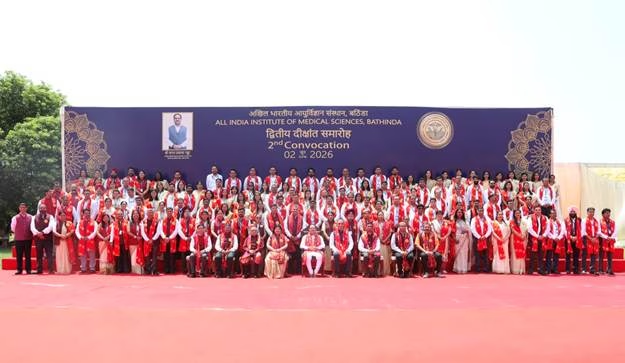
BATHINDA, PUNJAB — Union Minister for Health and Family Welfare, Shri J.P. Nadda, declared a decisive shift in India’s medical landscape, moving away from a traditional “curative-only” system toward a comprehensive, preventive healthcare framework. Speaking at the second convocation ceremony of the All India Institute of Medical Sciences (AIIMS) Bathinda, Nadda linked the nation’s health directly to its economic and developmental goals, asserting that a healthy population is the fundamental baseline required to achieve a developed nation status by 2047.
To support this model, the Health Minister inaugurated several advanced medical facilities at the institute, including a state-of-the-art Positron Emission Tomography–Computed Tomography (PET-CT) scanner and a second High Energy Linear Accelerator (HELA) unit. These additions are designed to significantly boost tertiary cancer care and diagnostic accuracy for patients across Punjab and its neighboring states.
Expanding High-Tech Infrastructure and Localized Specialized Care
The newly unveiled facilities target critical gaps in regional healthcare. The PET-CT and HELA installations address a long-standing need for precision oncology (targeted cancer treatment) in Punjab, a region historically burdened by high cancer prevalence. By allowing clinicians to pinpoint metabolic changes in tissues, the PET-CT scanner enables earlier cancer detection and more accurate disease staging. Meanwhile, the second HELA unit doubles the hospital’s capacity to deliver high-energy radiation therapy, cutting down patient wait times for critical treatments.
Beyond oncology, the Minister inaugurated a dedicated Burns Intensive Care Unit (Burns ICU) to manage severe trauma cases, alongside a new Child Development and Early Intervention Centre (CDEIC). The CDEIC stands as the first specialized facility of its kind in the region, focusing on the early identification and therapeutic management of neurodevelopmental disorders in children.
Data-Driven Screenings and Public Health Scale
The minister highlighted national screening statistics to illustrate the massive scale of the ongoing pivot toward preventive health. Driven by a network of over 1.82 lakh Ayushman Arogya Mandirs (community health centers), front-line health workers have conducted millions of preventative screenings nationwide:
-
Oral Cancer: Over 36 crore individuals screened.
-
Breast Cancer: More than 17 crore women screened.
-
Cervical Cancer: Over 9 crore women screened.
-
Cardiovascular & Metabolic Risk: More than 42 crore individuals screened each for diabetes and hypertension.
At the institutional level, AIIMS Bathinda has integrated into this preventive model by running twice-monthly Ayushman camps across 59 local villages, combining in-person diagnostic screenings with telemedicine consultations to manage non-communicable diseases before they require advanced hospital admission.
Medical Education Pipeline and its Challenges
The infrastructure upgrades coincide with a rapid expansion of India’s medical training system. Over the past decade, the number of active AIIMS institutions grew to 23, while total medical colleges expanded from 387 to more than 820. This push raised undergraduate (MBBS) seats to over 1.28 lakh and postgraduate positions to over 86,000, with an additional 75,000 seats projected over the next five years.
Medical Training Expansion (Past Decade)
===================================================
AIIMS Institutions:    [2] ----> 23
Medical Colleges:      [387] ---------> 820+
Undergraduate Seats:   [59,000] ------------> 128,000+
Postgraduate Seats:    [31,000] ------> 86,000+
===================================================
Public health experts note that while expanding the seat capacity addresses the raw shortage of medical professionals, maintaining educational quality remains a critical variable. Independent healthcare analysts frequently point out that rapid institutional growth can outpace the availability of experienced, senior faculty members capable of mentoring specialists. Ensuring that new tertiary centers maintain standard clinical protocols across all 23 AIIMS campuses remains a central operational hurdle for the ministry.
Balancing Artificial Intelligence with Clinical Empathy
Addressing the graduating class, Nadda urged the incoming doctors to integrate digital health solutions, such as artificial intelligence (AI) triage tools, precision medicine algorithms, and remote telemedicine, into their daily workflows. However, he emphasized that technological tools must serve as analytical supports rather than replacements for clinical empathy.
“Infrastructure may constitute the ‘hardware’ of healthcare, but healthcare professionals are its ‘software,'” Nadda stated, reminding graduates that human observation and compassionate communication remain vital to successful patient compliance and clinical outcomes.
References
-
Ministry of Health and Family Welfare (MoHFW) / Press Information Bureau (PIB) Delhi: Direct event proceedings, infrastructure declarations, and national screening metrics [Published 02 JUN 2026].
Medical Disclaimer: This article is for informational purposes only and should not be considered medical advice. Always consult with qualified healthcare professionals before making any health-related decisions or changes to your treatment plan. The information presented here is based on current research and expert opinions, which may evolve as new evidence emerges.