 0
0
 0
0
NEW DELHI — The Indian Ministry of Health and Family Welfare issued an urgent public health advisory on Tuesday, June 2, 2026, confirming that no cases of Ebola virus disease have been detected in India. The proactive directive mandates heightened vigilance and strict screening measures for travelers returning from Ebola-affected regions in Central Africa.
The advisory comes three weeks after the World Health Organization (WHO) declared the current Ebola outbreak in the Democratic Republic of Congo (DRC) and Uganda a Public Health Emergency of International Concern (PHEIC). This declaration marks only the 17th time in history that an Ebola outbreak has triggered such a high level of global health alert in the DRC.
Key Developments and Government Response
“As on June 2, 2026, there are no cases of Ebola disease reported in the country,” the Health Ministry stated in an official post on X (formerly Twitter), emphasizing that the measures are strictly precautionary to prevent domestic transmission.
Under the direction of Union Health Secretary Punya Salila Srivastava, who chaired a high-level review meeting with health secretaries from all states and Union Territories, the central government has deployed a multi-layered defense strategy:
-
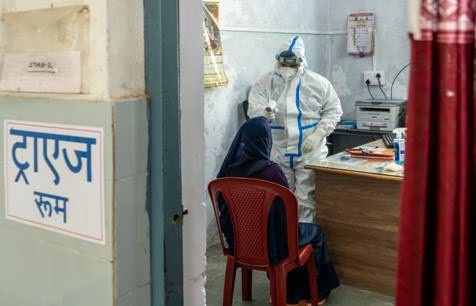
Enhanced Airport Screening: Rigorous health screening has been reinstated at all international ports of entry for passengers arriving directly or via transit from Ebola-hit countries.
-
21-Day Health Monitoring: Travelers arriving from affected regions must undergo health monitoring for 21 days—the maximum incubation period of the virus.
-
Centralized Testing: The National Institute of Virology (NIV) in Pune has been designated as the primary laboratory facility for Ebola diagnostic confirmation.
-
Public Assistance: The government has activated its 24×7 Health Helpline (1075) to provide information and address public anxieties.
Standard Operating Procedures (SOPs) have been circulated to all states, detailing strict protocols for isolation, quarantine, case management, and rapid referral pathways.
Understanding Ebola Virus Disease
Ebola Virus Disease is a rare but severe zoonotic illness—meaning it originates in animals and spreads to humans. It is initially transmitted to people through close contact with the blood, secretions, organs, or other bodily fluids of infected animals, such as fruit bats, monkeys, or chimpanzees.
Once a human is infected, the virus spreads from person to person through direct contact with broken skin or mucous membranes (such as the eyes, nose, or mouth) and bodily fluids (blood, saliva, vomit, urine, or feces) of a symptomatic individual.
[Infected Animal] ---> [Patient Zero] --(Direct Contact via Fluids)--> [Human Transmission]
According to health authorities, the incubation period ranges from 2 to 21 days. Crucially, individuals are not contagious until they actively develop symptoms. Symptoms typically appear abruptly and include:
-
Sudden fever, intense fatigue, and muscle pain
-
Severe headache and sore throat
-
Vomiting, diarrhea, and abdominal pain
-
Impaired kidney and liver function
-
In advanced stages, internal and external bleeding (such as oozing from the gums or blood in stools)
Official Guidance: “If you have travelled from or transited through an Ebola-affected country in the last 21 days and develop symptoms such as fever, headache, muscle pain, vomiting, diarrhoea, or unexplained bleeding, isolate yourself and inform local health authorities immediately,” the Health Ministry advised.
Global Outbreak Context
The current international outbreak involves the Bundibugyo virus species, which presents a distinct epidemiological profile compared to the more widely known Zaire ebolavirus.
As of mid-May 2026, international health agencies reported the following data from the epicenter:
| Metric | Reported Figures |
| Laboratory-Confirmed Cases (DRC) | 8 cases |
| Suspected Cases (DRC) | 246 cases |
| Suspected Deaths (DRC) | 80 deaths |
| Confirmed Cases (Uganda) | 2 cases (1 death) |
| Initial Sample Positivity Rate | 61.5% (8 of 13 samples) |
The outbreak is currently concentrated in three health zones within the Ituri Province of the DRC—Bunia, Rwampara, and Mongbwalu—with additional transmission risks noted in North Kivu and South Kivu. Public health officials have raised alarms over at least four deaths among healthcare workers showing symptoms consistent with viral hemorrhagic fever, pointing to potential gaps in infection prevention and control within local clinics.
Why the Bundibugyo Species Presents Unique Challenges
The biological differences between Ebola strains have significant implications for public health management.
The Vaccine Gap
Unlike the Zaire ebolavirus, for which highly effective, licensed vaccines exist (such as Ervebo® and Zabdeno/Mvabea®), there are currently no licensed vaccines or specific antiviral therapeutics approved for the Bundibugyo species. Treatment relies entirely on early, intensive supportive care, including intravenous fluids, rehydration, and symptom-specific medications.
Mortality Rates
Historically, the Zaire strain is the deadliest, carrying an average case fatality rate of roughly 66.6%. Peer-reviewed meta-analyses indicate that the Bundibugyo species maintains a lower, yet still highly dangerous, average case fatality rate of approximately 32.8% (95% CI, 25.8–40.2%), with some past outbreaks reaching up to 50%.
Complicating Ground Factors
Containment efforts in Central Africa are severely hindered by geopolitical challenges. The WHO noted that the outbreak is unfolding in a region marked by long-standing humanitarian crises, armed conflict, dense semi-urban pockets, and high population mobility, which facilitates the silent spread of the virus across borders.
Independent Expert Analysis
Infectious disease specialists urge the public to remain calm, noting that India’s health infrastructure is well-equipped to handle the threat.
“India’s surveillance architecture has a proven track record of preventing exotic viral incursions,” says Dr. Amit Prasad, an independent public health epidemiologist not involved in drafting the advisory. “During the massive 2014 West African Ebola outbreak, India successfully screened tens of thousands of passengers and isolated suspects without recording a single domestic case. The early activation of the NIV Pune testing framework means we can differentiate Ebola from common local tropical fevers within hours.”
Practical Implications for Readers
For Travelers
-
Avoid non-essential travel to the outbreak hotspots in the DRC and Uganda.
-
If you must travel, retain all boarding passes, itineraries, and transit documentation for at least 21 days post-return to facilitate retrospective contact tracing if required.
-
Declare any history of travel or sudden onset of fever honestly at airport immigration desks.
For the General Public
-
Practice consistent hand hygiene using soap and water or alcohol-based sanitizers.
-
Avoid sharing unverified social media rumors regarding domestic outbreaks; rely solely on official updates from the Ministry of Health.
-
Understand that the risk to the general domestic population remains exceptionally low.
Limitations in Current Data and Balanced Reporting
While the numbers coming out of Central Africa appear relatively low, international health agencies urge cautious interpretation. The WHO acknowledges significant gaps in tracking the true geographic spread of the virus. The stark discrepancy between the 8 laboratory-confirmed cases and the 246 suspected cases, combined with a high sample positivity rate (61.5%), strongly suggests that the outbreak may be larger than current surveillance indicates.
However, health authorities emphasize that the situation does not warrant panic. Neither the WHO nor the European Centre for Disease Prevention and Control (ECDC) recommends any restrictions on international trade or travel. The ECDC currently assesses the risk of importation to regions outside of Central Africa as “very low,” given the specific transmission requirements of the virus.
Union Health Minister J P Nadda reaffirmed this stance, stating that the surveillance mechanisms are functioning strictly out of “abundant caution” to ensure total national preparedness rather than in response to any immediate domestic threat.
Medical Disclaimer
This article is for informational purposes only and should not be considered medical advice. Always consult with qualified healthcare professionals before making any health-related decisions or changes to your treatment plan. The information presented here is based on current research and expert opinions, which may evolve as new evidence emerges.
References
-
Ministry of Health and Family Welfare, Government of India. (June 2, 2026). “Health advisory on Ebola disease.” Economic Times Health. Source Link