 0
0
 0
0
SHENZHEN, China — In a coordinated effort to halt an ongoing global public health crisis, more than 100 international health and automotive experts convened in Shenzhen this May to overhaul vehicle safety regulations. The target of their initiative is a sobering statistic: road traffic crashes claim roughly 1.19 million lives annually across the globe. Strikingly, individuals outside of passenger cars—pedestrians, cyclists, and motorcyclists—comprise more than half of those fatalities.
Co-hosted by the World Health Organization (WHO) and the China Automotive Technology and Research Center (CATARC), the high-level workshop ran alongside the 4th World Automobile Standards and Innovation Conference. Government officials representing 13 countries, spanning regions from Southeast Asia to Sub-Saharan Africa, joined forces with United Nations regulators and industry engineers. Their goal is to address deep regulatory gaps in vehicle manufacturing standards, shifting the focus of automotive safety from the inside of the cabin to the street outside.
The Stark Reality of Roadway Inequality
For decades, automotive safety innovations prioritized the vehicle occupant through reinforced steel frames, crumple zones, and internal airbags. However, epidemiologists and public health metrics reveal a profound demographic imbalance in who survives a collision. According to the WHO Global Status Report on Road Safety, a staggering 90% of traffic-related fatalities occur in low- and middle-income nations.
The physical disparity is even more acute. Pedestrians, cyclists, and two-wheel riders possess no protective metallic shield during an impact. Data compiled by the European Transport Safety Council highlights this growing risk:
-
Pedestrian Fatalities: Increased by 3% globally to 274,000 deaths annually, representing nearly a quarter of all road traffic losses.
-
Cyclist Fatalities: Surged by nearly 20% to 71,000 deaths.
-
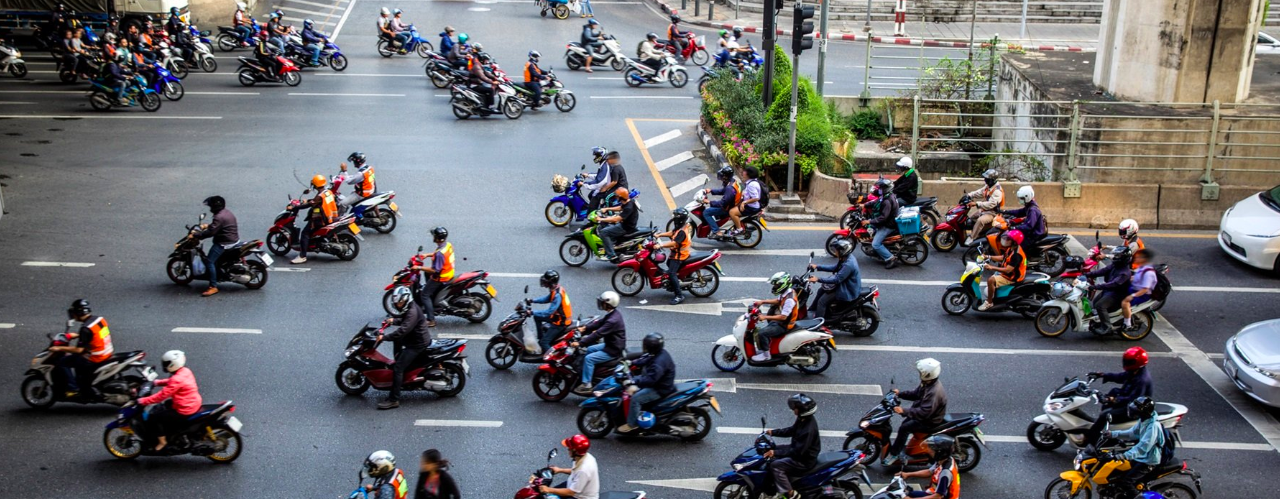
The Two-Wheel Peril: Motorcyclists face an exponential threat, suffering 13.8 fatalities per 100 million person-kilometers traveled, compared to just 0.7 for passenger car occupants.
Compounding this danger is a critical regulatory vacuum. Currently, 40% of UN Member States maintain no globally recognized vehicle safety performance standards. This leaves millions exposed to traffic hazards, particularly as economic shifts trigger an unprecedented rise in motorized two-wheel transportation.
“The number of motorcycles on the world’s roads is rising at an astonishing rate,” noted Dr. Fangfang Luo, a WHO Technical Officer specializing in road safety, who spoke at the conference. “Protecting these riders is key to ensuring we meet the global goal of a 50% drop in road deaths by 2030. We need a comprehensive approach that bridges stronger vehicle regulations with safer infrastructure.”
Next-Generation Tech: From AI to Active Crash Prevention
To stem these numbers, regulators are turning to automated vehicle systems designed to mitigate human error before an impact can occur. Public health agencies are monitoring three critical regulatory and technological developments:
1. Pedal Error Prevention Systems
The United Nations has adopted Regulation No. 175, governing Acceleration Control for Pedal Error (ACPE). This vehicle safety system utilizes proximity sensors to detect when a driver mistakenly stomps on the accelerator rather than the brake. If an obstacle—such as a pedestrian or a wall—is detected within 1.5 meters, the system overrides the throttle, preventing unintended acceleration. The regulation applies to automatic passenger vehicles and is rolling out across early-adopting nations this June.
2. Predictive Artificial Intelligence
On the preventative front, researchers at Johns Hopkins University have introduced “SafeTraffic Copilot,” an analytical AI tool designed to map regional collision risks. Rather than reacting after an intersection becomes an established accident hotspot, the tool analyzes environmental and traffic flow variables to identify high-risk locations. This allows municipal health authorities and civil engineers to deploy preventative safety infrastructure before crashes manifest.
3. Holistic Safety Rating Overhauls
Consumer safety groups are shifting their baseline testing to demand external protection. Euro NCAP completely revised its safety rating architecture. Moving away from purely measuring internal cabin impact forces, the updated five-star scoring standard heavily weighs structural designs and sensors that mitigate trauma to pedestrians and cyclists during an accident.
Road Safety is a Pediatric Health Imperative
The mobilization of global health bodies like the WHO stems from a stark demographic truth: traffic injuries remain the leading killer of children and young adults aged 5 to 29 globally. Beyond the baseline mortality rate, between 20 million and 50 million individuals survive traffic impacts each year with non-fatal injuries, many of whom are left with permanent physical disabilities.
For health-conscious consumers, this regulatory shift changes the calculus of purchasing a family vehicle. Public health advocates suggest looking beyond traditional crash-test ratings and actively seeking models equipped with advanced driver assistance systems (ADAS). Features such as pedestrian-detecting automatic emergency braking (AEB), blind-spot intervention, and active lane-keeping support are migrating from premium upgrades to essential health-protective tools.
Industry Friction and Implementation Bottlenecks
Despite technical breakthroughs, significant hurdles remain before these safety measures become universal. Because UN regulations are typically non-binding until adopted into individual national laws, the global rollout of features like ACPE remains fragmented.
Furthermore, safety mandates frequently run into industrial resistance. In the United States, the National Highway Traffic Safety Administration (NHTSA) recently pushed back its planned consumer safety rating updates to 2027. The delay occurred after automobile manufacturers requested additional lead time to refine and standardize complex systems like active blind-spot intervention. This friction illustrates an ongoing challenge in public health: balancing immediate safety ambitions against industrial manufacturing timelines.
A follow-up international summit planned for late 2026 aims to tackle these adoption hurdles, focusing on standardized crash investigations and localized motorcycle safety initiatives in emerging markets. While technology provides the toolset, experts emphasize that a true reduction in traffic mortality requires harmonized legislation alongside structural changes to urban transit systems.
Medical Disclaimer
This article is for informational purposes only and should not be considered medical advice. Always consult with qualified healthcare professionals before making any health-related decisions or changes to your treatment plan. The information presented here is based on current research and expert opinions, which may evolve as new evidence emerges.
References
- https://www.who.int/news/item/14-06-2026-global-experts-strengthen-vehicle-safety-regulations–apply-new-road-safety-technologies