 0
0
 0
0
Vijayawada, Andhra Pradesh — June 17, 2026
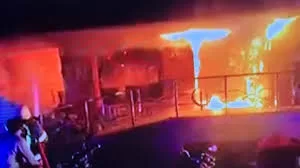
A major tragedy was averted on Wednesday morning when a fire erupted in the emergency ward of Rainbow Children’s Hospital in Currency Nagar, Vijayawada. The blaze sent thick smoke and flames through the facility, triggering immediate panic among families and healthcare workers. Despite the highly volatile environment, all infants, children, and adult patients undergoing treatment were evacuated safely. No injuries or casualties were reported, a outcome local authorities credit to the rapid, disciplined response of the hospital staff and the timely intervention of the local fire department.
Technical Failure Triggers Emergency Ward Blaze
The fire originated within the hospital’s emergency ward, with preliminary investigations pointing to an electrical short circuit inside an air conditioning (AC) vent and electrical panel. Hospital personnel noticed smoke plumes billowing from the ceiling ventilation and initiated emergency protocols before external emergency teams arrived.
Two fire tenders were immediately deployed to the scene. Firefighters worked in tandem with healthcare staff to contain the blaze and prevent it from breaching adjacent critical care wards. While the emergency ward itself was completely gutted and vital medical machinery was destroyed, the hospital’s integrated fire-detection auto-sensors functioned as designed. The system provided an immediate auditory warning that allowed internal teams to execute their evacuation protocols without delay.
Systemic Vulnerabilities: The Anatomy of Hospital Fires
While the outcome in Vijayawada demonstrates the value of active emergency preparedness, the incident underscores a persistent safety crisis within the wider Indian healthcare infrastructure. Data reveals that hospitals present unique, highly complex challenges during environmental emergencies.
According to a comprehensive study published in the peer-reviewed Journal of Failure Analysis and Prevention (JFAP), which analyzed hospital fire incidents across India from 2010 onward, electrical short circuits are the dominant threat.
Hospital Fire Triggers in India (JFAP Data Trend)
=================================================
[████████████████████████████████████] 89% Electrical Short Circuits
[█] 4% Flammable Chemicals
[██] 7% Other/Undetermined
The peer-reviewed paper—co-authored by researchers Shravishtha Juyal, Tabassum-Abbasi, Tasneem Abbasi, and S. A. Abbasi from the University of Petroleum and Energy Studies and Pondicherry University—noted an escalating frequency of hospital fire accidents nationwide. Their findings revealed an almost equal distribution between sectors: 49% occurred in private facilities and 51% in government-run institutions. Strikingly, the data showed that roughly 50% of the facilities evaluated were non-compliant with basic national safety protocols.
Why Healthcare Facilities Experience Higher Risk
“Hospital fires are uniquely dangerous because most patients inside the facility are physically incapable of self-evacuation,” explained Ronald Debbarma, Senior Consultant (Forest Fire) at the Policy & Planning Division of the National Disaster Management Authority (NDMA), who was not involved in the Vijayawada incident response.
Debbarma emphasized that specific hospital layouts amplify these hazards:
“Hospitals feature specialized zones, such as Intensive Care Units (ICUs) and Neonatal Intensive Care Units (NICUs), that are highly vulnerable. These areas house critically ill individuals and fragile newborn babies who depend entirely on mechanical life support and active human assistance to move.”
Maintaining absolute compliance with international fire safety benchmarks remains an uphill battle for many institutions, though select hospitals utilize rigorous third-party frameworks. Dr. Dinesh Kumar Chirla, Director of Intensive Care Services at Rainbow Children’s Hospitals, noted that the facility has long prioritized international safety guidelines. The institution holds a Joint Commission International (JCI) accreditation, a global standard that evaluates fire prevention, structural maintenance, and equipment safety protocols.
India’s Fire Safety Requirements for Healthcare
To mitigate these risks, the National Building Code (NBC) of India enforces strict structural and operational guidelines designed to give facilities a buffer window during a thermal event.
| Structural Component | NBC Requirement Specification |
| Fire-Resistant Construction | Structural elements must withstand flames for 1 to 2 hours without collapsing. |
| Fire Doors | Must possess a 1 to 1.5-hour thermal resistance rating and feature automatic self-closing mechanisms. |
| Exit Stairwells | Must be enclosed in 2-hour fire-rated materials to provide safe passage. |
| Active Detection Systems | Integrated automatic sprinkler systems paired with alarms wired directly to a central control room. |
| Evacuation Routes | A minimum of two clearly marked, unobstructed exit paths per floor. |
| Staff Readiness | Comprehensive mandatory fire drills conducted every six months for all staff tiers. |
To further address systemic gaps, the Ministry of Health, following extensive consultations with the Bureau of Indian Standards and AIIMS, implemented the updated National Guidelines for Fire and Life Safety in Healthcare Facilities (2026) in May 2026. This updated framework enforces stricter mandates on early-stage smoke detection, medical gas line safety valves, and automated alarm systems.
What Patients and Families Need to Verify
The successful evacuation in Vijayawada highlights a critical lesson for consumers: institutional preparedness directly dictates patient survival rates during a crisis. Public health experts suggest that families look beyond clinical reputations and actively assess a facility’s safety credentials.
When admitting a loved one, especially to long-term or pediatric care, families should verify the following parameters:
-
Valid Fire NOC (No Objection Certificate): Historical audits show significant gaps; following the 2021 Bhandara hospital tragedy, a subsequent review revealed that over 80% of assessed government hospitals in Maharashtra had skipped periodic fire safety audits.
-
Active Staff Training: Functional hardware is useless without trained operators. During the 2020 Shrey Hospital fire in Ahmedabad, which resulted in eight fatalities, staff members were unable to operate external extinguishers due to a lack of training.
-
Unobstructed Emergency Corridors: Physical exits must remain clear. In the devastating 2016 Murshidabad Hospital fire in West Bengal, which claimed 50 lives, investigators found that the primary emergency exit gate had been locked.
Unresolved Questions and the Path Forward
Despite the successful evacuation, specific operational questions remain under investigation by local municipal officials in Vijayawada. It is currently unverified whether the electrical panel inside the Currency Nagar facility complied fully with the latest NBC wire capacity ratings, or if recent thermal imaging—thermographic inspections used to detect hidden electrical hotspots before they spark—had been conducted. The hospital administration has not yet published an official inventory of the destroyed neonatal and emergency medical equipment.
The incident occurs against a broader backdrop of recurring regional electrical fires. In Telangana alone, short-circuit-driven fires caused 304 fatalities across 18,000 recorded incidents between 2015 and 2021. More recently, in March 2026, an electrical short circuit inside an ICU in Cuttack resulted in 10 patient deaths.
NDMA experts emphasize that preventing future disasters requires a shift from reactive containment to strict, proactive compliance. This includes maintaining functional alarm systems 24/7, establishing multiple independent emergency exits per ward, and treating biannual mock drills as essential clinical protocols rather than administrative formalities. The swift evacuation at Rainbow Children’s Hospital proves that when early detection infrastructure and trained healthcare staff work together, catastrophic loss of life can be prevented.
Medical Disclaimer
Medical Disclaimer: This article is for informational purposes only and should not be considered medical advice. Always consult with qualified healthcare professionals before making any health-related decisions or changes to your treatment plan. The information presented here is based on current research and expert opinions, which may evolve as new evidence emerges.
References
-
NewsMeter. “Vijayawada: Fire breaks out at Rainbow Children’s Hospital; no casualties reported.” June 17, 2026.