 0
0
 0
0
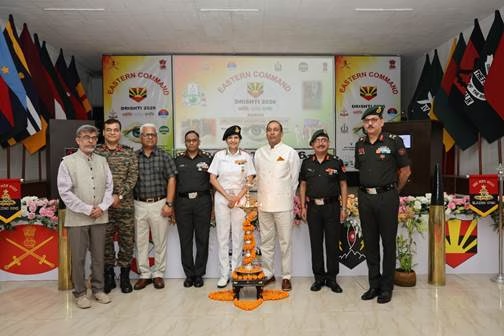
RANCHI, India — A specialized team of military ophthalmologists from the Indian Army and Indian Air Force launched a mega advanced surgical eye camp at the Military Hospital Namkum in Ranchi, Jharkhand, on June 15, 2026. Running through June 19, the high-tech humanitarian mission—dubbed “Operation DRISHTI”—aims to restore vision and prevent blindness for more than 200 high-risk beneficiaries, including veterans, military dependents, and underprivileged civilians, entirely free of cost.
By airlifting state-of-the-art surgical suites directly into the state capital, the initiative brings tertiary-level medical care to a region historically burdened by high rates of preventable blindness and limited access to specialized microsurgery.
Deploying World-Class Eye Care to the Frontlines of Public Health
The logistics of the five-day camp mirror a tactical military deployment, but the enemy here is blindness. To ensure the highest standard of care, the Indian Air Force airlifted sophisticated diagnostic and microsurgical infrastructure from apex institutions directly to Ranchi.
The surgical convoy is led by Brigadier Dr. Sanjay Kumar Mishra, Consultant and Head of the Department of Ophthalmology at the Army Hospital (Research & Referral) in New Delhi. Dr. Mishra and his team are tackling some of the most prevalent and visually debilitating ocular conditions using cutting-edge techniques:
-
Phacoemulsification for Cataracts: A modern, sutureless cataract surgery that uses ultrasonic vibrations to fragment and aspirate a cloudy lens, replacing it with a foldable intraocular lens (IOL). This technique allows for rapid visual recovery compared to older, large-incision methods.
-
Minimally Invasive Glaucoma Surgery (MIGS): A micro-surgical approach that uses microscopic equipment and incisions to lower intraocular pressure (fluid pressure inside the eye). MIGS offers a safer profile and quicker healing times than traditional glaucoma filtration surgeries, preserving the optic nerve from irreversible damage.
-
Anti-VEGF Intravitreal Injections: Direct injections of specialized medications into the vitreous cavity (the jelly-like space in the back of the eye) to treat advanced vitreo-retinal diseases. These injections stop the growth of abnormal, leaking blood vessels that cause rapid vision loss.
“Operation DRISHTI represents a profound synthesis of tactical efficiency and medical altruism,” stated Vice Admiral Arti Sarin, Director General of the Armed Forces Medical Services (DGAFMS). “This mission is a testament to the military’s dual identity as both a formidable guardian of the nation’s borders and a compassionate architect of social resilience.”
Addressing a Critical Public Health Gap
The arrival of Operation DRISHTI in Jharkhand addresses a stark epidemiological need. According to data from the National Programme for Control of Blindness and Visual Impairment (NPCB&VI) and the World Health Organization (WHO), cataracts remain the leading cause of blindness in India, responsible for over 62% of cases. Furthermore, visual impairment disproportionately impacts rural and low-income demographics due to a shortage of sub-specialists outside major metropolitan areas.
Independent public health experts emphasize that bringing advanced procedures like MIGS and retinal injections to camp settings is a substantial leap forward. Traditionally, charitable eye camps in developing countries have focused exclusively on high-volume, basic cataract extractions.
“While basic cataract surgeries are vital, patients suffering from co-morbidities like glaucoma or diabetic retinopathy—a leading cause of vitreo-retinal disease—are routinely left behind in rural outreach,” said Dr. Alok Ranjan, a retired public health administrator and community ophthalmologist based in eastern India, who is not involved with the camp. “By providing advanced therapies like anti-VEGF injections and MIGS for free, this initiative addresses complex blinding diseases that are usually financially catastrophic for underprivileged families.”
The Ranchi deployment marks the ninth iteration of Operation DRISHTI. The flagship outreach programme has systematically targeted remote or underserved geographies across India, having previously conducted successful surgical interventions in Leh (Ladakh), Lakshadweep, Bhuj (Kutch), and Bagdogra.
Operational Realities and Safety Guardrails
Conducting advanced microsurgery outside a permanent tertiary hospital setting requires stringent quality control to prevent catastrophic complications, such as endophthalmitis (a severe, potentially blinding internal eye infection).
To mitigate these risks, the Armed Forces medical team has established strict protocols:
-
Airlifted Sterilization Infrastructure: The use of specialized, rapid-cycle autoclaves and laminar airflow systems inside the Namkum military hospital’s operating theatres to replicate New Delhi standards.
-
Rigorous Pre-Operative Screening: Beneficiaries undergo extensive triage to rule out active systemic infections, uncontrolled blood pressure, or advanced diabetes, which could compromise surgical outcomes.
-
Mandatory Follow-Up Care: Post-operative examinations are scheduled at 24-hour, 7-day, and 30-day intervals, coordinated through local military and civil health channels to monitor healing and distribute necessary post-surgical steroid and antibiotic drops.
Despite these safeguards, experts note that outreach camps inherently face limitations compared to fixed-facility care. Long-term management is a primary concern, particularly for chronic conditions like glaucoma and retinal diseases. While a single cataract surgery can permanently cure a patient’s blindness, glaucoma requires lifelong monitoring of intraocular pressure, and retinal diseases often demand a series of anti-VEGF injections spaced weeks apart to sustain visual gains.
What This Means for Community Health Choices
For health-conscious consumers and families caring for aging relatives, the specialized focus of Operation DRISHTI underscores the importance of comprehensive eye examinations. Public health bodies like the American Academy of Ophthalmology (AAO) and the All India Ophthalmological Society (AIOS) recommend that adults undergo a baseline eye screening at age 40, as asymptomatic diseases like glaucoma—often called the “silent thief of sight”—can destroy vision without warning.
For the residents of Jharkhand, the camp provides an immediate, lifesaving corridor to sight restoration. For the broader public health ecosystem, it serves as a viable operational blueprint for how mobile military logistics can be effectively leveraged to eliminate the surgical backlog in developing nations.
Reference Section
-
Press Information Bureau (PIB), Government of India. Ministry of Defence. Advanced Surgical Eye Camp ‘Operation DRISHTI’ Commences in Jharkhand. Published June 16, 2026. Portal Ref: PIB Delhi.
Medical Disclaimer: This article is for informational purposes only and should not be considered medical advice. Always consult with qualified healthcare professionals before making any health-related decisions or changes to your treatment plan. The information presented here is based on current research and expert opinions, which may evolve as new evidence emerges.