 0
0
 0
0
NEW DELHI — In a historic milestone for public health, India performed 20,138 organ transplants in 2025—the highest number ever recorded in a single year. The surge reflects a fourfold increase in life-saving procedures since 2013 and cements India’s position as a global leader in transplant surgery.
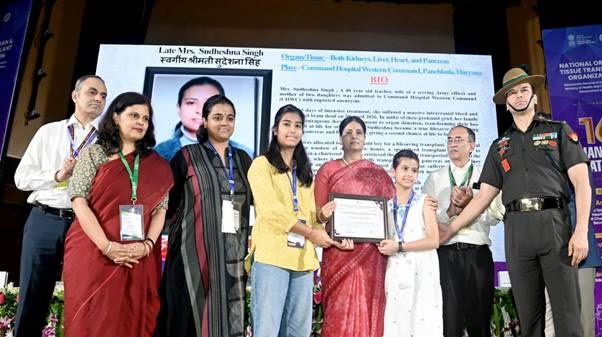
The figures were announced during the 16th Indian Organ Donation Day (IODD) national event, organized by the National Organ and Tissue Transplant Organization (NOTTO) under the Union Ministry of Health & Family Welfare. Addressing an audience of healthcare professionals, policymakers, and donor families, Union Minister of State for Health and Family Welfare, Smt. Anupriya Patel, praised the growing spirit of public generosity while urging the nation to bridge the lingering gap between organ demand and supply.
“Organ donation is the highest expression of compassion, offering a second chance at life to those battling end-stage organ failure,” Patel stated during her address.
Record Growth and Global Standing
According to data released in the NOTTO Annual Report 2025–26, India currently ranks third globally in total organ transplants performed annually, trailing only the United States and China. Furthermore, the country retains its position as the global leader in living donor organ transplants.
While living donations historically accounted for the overwhelming majority of procedures in the region, deceased donor transplants are seeing a dramatic rise. Deceased organ donations grew more than fourfold, rising from 837 in 2013 to 3,526 in 2025. Annual transplant totals also saw a 6.5 percent increase over the 18,911 procedures completed in 2024.
+-----------------------------------------------------------------------+
|                 INDIA ORGAN TRANSPLANT PROGRESSION                    |
+-----------------------------------------------------------------------+
| Year | Total Transplants | Deceased Donor Transplants                 |
+------+-------------------+--------------------------------------------+
| 2013 | 4,990             | 837                                        |
| 2025 | 20,138            | 3,526                                      |
+-----------------------------------------------------------------------+
Central to this upward trajectory is expanding public engagement. Following sustained awareness campaigns—including personal appeals from Prime Minister Narendra Modi—the national digital pledge portal has registered over 500,000 verified organ donation pledges. In 2025 alone, more than 258,000 citizens formally pledged their organs and tissues.
Infrastructure, Digital Reform, and Policy Guidelines
To sustain this momentum and streamline logistics, the Ministry of Health unveiled several national digital and regulatory initiatives:
-
‘Jug Jug Jiyo Abhiyaan’: A year-long, nationwide awareness campaign designed to dispel cultural myths and drive community-level participation across rural and urban centers.
-
‘e-प्रत्यारोपण’ Platform & NOTTO App: A unified, secure digital ecosystem connecting hospitals, clinicians, donors, and waitlisted patients. The system centralizes registration, wait-list tracking, and organ allocation to ensure complete transparency.
-
National Brain Stem Death Certification Guidelines: Standardized clinical criteria to assist medical teams in identifying and certifying brain stem death efficiently and ethically.
-
National Guidelines on Swap Transplantation: Formal procedures to facilitate paired kidney exchanges (swap donations), helping incompatible donor-recipient pairs find matching partners safely.
The government’s institutional network now spans 31 States and Union Territories, encompassing NOTTO, five Regional (ROTTO), and 26 State (SOTTO) organizations alongside roughly 1,200 registered hospitals. Tertiary care access has also expanded; ten newly established All India Institutes of Medical Sciences (AIIMS) facilities now offer kidney transplants, with selected centers performing liver and heart surgeries.
Financial access is being supported concurrently. Kidney transplantation is covered under the Ayushman Bharat Pradhan Mantri Jan Arogya Yojana (AB PM-JAY) for eligible beneficiaries, while post-transplant immunosuppressant medications are increasingly distributed through more than 20,000 Jan Aushadhi Kendras (generic medicine outlets).
Expert Perspectives and Public Health Context
Independent medical experts note that standardized national guidelines represent a major evolutionary step for South Asian transplant medicine.
“Establishing clear, nation-wide protocols for brain stem death certification and paired donor swaps addresses two of the largest bottlenecks in transplant logistics,” says Dr. Arvinder Singh Soin, a pioneer in liver transplantation and Chairman of the Medanta Liver Transplant Institute (not directly involved in the policy launch). “Clear protocols give clinical teams the legal and ethical clarity needed to act swiftly when a potential deceased donor is identified. Seconds count when preserving organ viability.”
Public health specialists also point out that overcoming socio-cultural misconceptions remains critical. Misunderstandings regarding religious stances on organ donation frequently lead families to decline consent during moments of acute grief. Medical authorities emphasize that all major world religions support organ donation as an act of altruism and life-saving service.
Limitations and the Burden of Chronic Disease
Despite these record-breaking numbers, health authorities acknowledge that the supply of organs falls far short of national demand. Hundreds of thousands of patients in India suffer from end-stage renal, hepatic, and cardiac disease, with many dying on waiting lists before a suitable organ becomes available.
Furthermore, medical experts emphasize that surgical advances alone cannot resolve the crisis. Preventive health measures must address the root causes of organ failure—namely poorly managed hypertension, type 2 diabetes, fatty liver disease, and substance abuse. Integrating lifestyle interventions, routine health screenings, and early disease management remains the primary defense against chronic organ damage.
What This Means for Patients and Families
For citizens and healthcare consumers, these administrative and technological shifts offer concrete improvements in navigation and care quality:
-
Increased Transparency: The centralized e-प्रत्यारोपण platform reduces administrative delay and ensures fair, criteria-based organ allocation.
-
Greater Access to Paired Swaps: Incompatible living donors now have a structured, legal pathway to participate in paired organ exchanges, significantly shortening wait times for kidney patients.
-
Easier Pledging: Citizens interested in becoming donors can easily register through official digital channels using standard verification.
-
Decentralized Care: Expanded transplant capabilities at regional AIIMS institutions allow patients to undergo complex surgeries closer to home, reducing travel costs and emotional strain.
Summary of Recognized Excellence
At the event, the Ministry presented the National Organ Donation Awards to honor top-performing regions and institutions:
-
Best ROTTO (Northern Region): PGIMER, Chandigarh
-
Best State (Highest Deceased Donors): Tamil Nadu
-
Best State (North Eastern Region): Assam
-
Best Union Territory: Delhi
Special honors were also presented to deceased donor families, recognizing their selflessness during moments of personal tragedy to give others a second chance at life.
References
-
Government Source: Press Information Bureau (PIB), Ministry of Health and Family Welfare, Government of India. 16th Indian Organ Donation Day Report, Published Aug 3, 2026.
Medical Disclaimer: This article is for informational purposes only and should not be considered medical advice. Always consult with qualified healthcare professionals before making any health-related decisions or changes to your treatment plan. The information presented here is based on current research and expert opinions, which may evolve as new evidence emerges.