 0
0
 0
0
LANSING, Mich. — Confirmed cases of cyclosporiasis in Michigan have climbed past 6,000 as state and federal public health agencies expand their investigation into a major foodborne parasite outbreak linked to contaminated fresh produce, state health officials announced Monday.
According to the latest update from the Michigan Department of Health and Human Services (MDHHS), the state has documented 6,148 laboratory-confirmed cases and 102 hospitalizations. No deaths have been reported to date. The sharp surge—reflecting an addition of 1,146 cases over a single weekend—highlights the rapid pace of real-time public health surveillance as laboratories process backlogged clinical specimens.
The Michigan outbreak is part of an ongoing multi-state investigation spearheaded by the Centers for Disease Control and Prevention (CDC) and the U.S. Food and Drug Administration (FDA). Federal epidemiologists have traced a significant cluster of illnesses to shredded iceberg lettuce supplied by Taylor Farms de Mexico and served at select Taco Bell restaurants across Indiana, Kentucky, Michigan, Ohio, and West Virginia.
The Investigation: Tracing a Elusive Parasite
Tracking foodborne parasites presents unique challenges for public health investigators compared to bacterial pathogens like E. coli or Salmonella.
While state health officials continue to identify fresh salad greens as the primary vector in Michigan, local investigators have stopped short of assigning sole responsibility to a single distributor for all statewide cases.
At the federal level, the traceback investigation experienced a technical complication when an early positive laboratory result from a Taylor Farms lettuce sample was re-evaluated and classified as a false positive by the FDA. Despite this laboratory reinterpretation, federal health officials emphasized that epidemiologic and supply-chain data strongly maintain the connection to shredded iceberg lettuce from that supplier.
“A false-positive laboratory result does not negate compelling epidemiological evidence,” noted Dr. Elena Rostova, an independent infectious disease epidemiologist and professor of public health not involved in the official investigation. “When dozens of unrelated patients in different counties report eating the same specific ingredient at the same chain during the same incubation window, the statistical signal remains exceptionally strong even if direct microscopic identification in product samples proves challenging.”
The CDC and FDA confirmed that active recalls and targeted distribution warnings remain fully in effect while investigative teams collect additional environmental and supply-chain samples.
Understanding Cyclosporiasis: Symptoms, Risks, and Medical Care
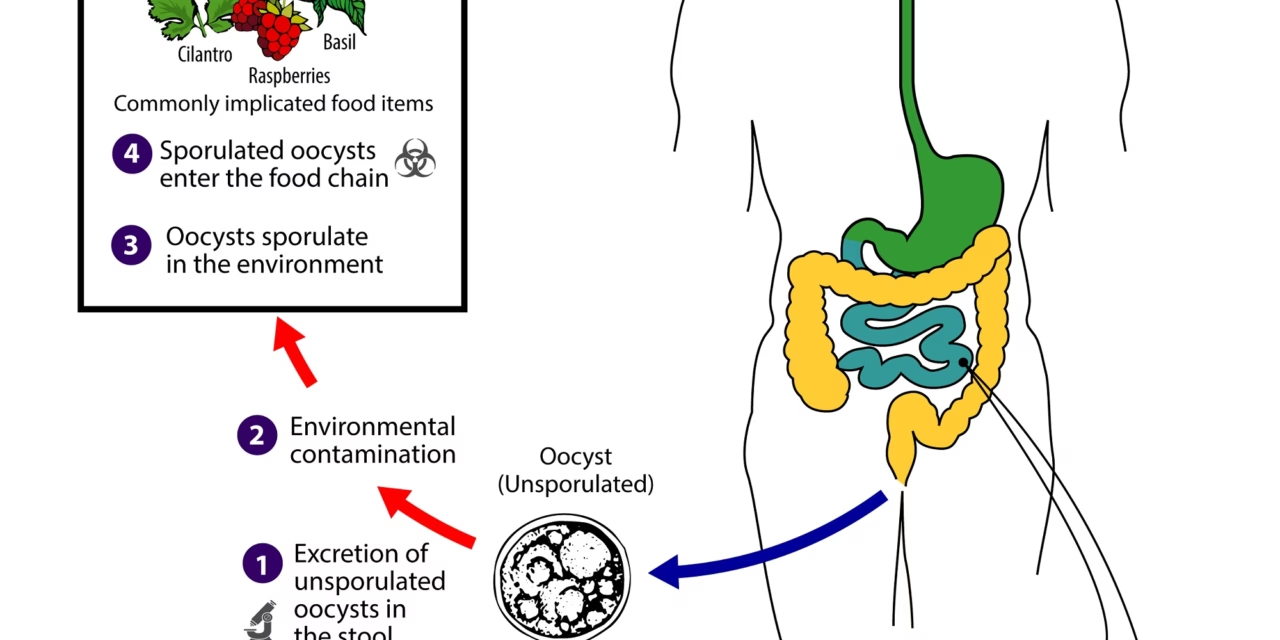
Cyclosporiasis is an intestinal illness caused by Cyclospora cayetanensis, a microscopic single-celled parasite. Individuals contract the infection by ingesting food or water contaminated with microscopic oocysts (the parasite’s egg-like form).
Timeline of Cyclosporiasis Infection
├── Exposure: Ingestion of contaminated produce/water
├── Incubation: 2 to 14 days (typically ~7 days)
└── Illness Duration: Days to over 30 days if untreated
Key Symptoms to Watch For
-
Primary indicator: Frequent, watery diarrhea
-
Associated symptoms: Severe abdominal cramping, bloating, increased gas, nausea, loss of appetite, low-grade fever, and persistent fatigue
-
Complications: Dehydration and substantial unintentional weight loss
Symptoms typically manifest about one week after initial exposure, though the incubation window ranges from two days to more than two weeks. Without targeted antimicrobial treatment, symptoms can follow a relapsing pattern that persists for several weeks to over a month.
Clinical Management
Unlike typical bacterial gastroenteritis, cyclosporiasis does not respond to standard over-the-counter anti-diarrheal medications or common broad-spectrum antibiotics like ciprofloxacin.
The CDC identifies trimethoprim-sulfamethoxazole (TMP-SMX)—commonly known by brand names such as Bactrim or Septra—as the primary evidence-based treatment choice. For patients with sulfa allergies, alternative regimens may be evaluated by treating clinicians, though efficacy data remains more limited.
Medical providers urge vulnerable populations—including older adults, pregnant individuals, young children, and immunocompromised patients—to seek prompt medical evaluation if they experience persistent gastrointestinal symptoms.
Public Health Implications and Practical Consumer Guidance
The scale of the Michigan outbreak underscores broader vulnerabilities within the globalized supply chain for fresh, ready-to-eat produce.
Because Cyclospora oocysts require days to weeks outside the host in specific environmental conditions to become infectious, direct person-to-person transmission is extremely rare. Instead, contamination typically occurs at the farm level through irrigation water contaminated with human sewage or unhygienic harvesting conditions.
| Diagnostic & Safety Aspect | Clinical & Consumer Reality |
| Home Washing | Routine cold-water washing reduces surface dirt but does not reliably remove Cyclospora oocysts anchored to leaf folds. |
| Pre-Washed Labels | “Pre-washed” or “Triple-washed” bagged greens are not 100% immune during farm-level contamination events. |
| Diagnostic Testing | Requires specific stool PCR or ova-and-parasite (O&P) testing; standard routine stool cultures often miss parasites. |
“Consumers often assume that washing lettuce thoroughly at home will wash away parasites, but Cyclospora sticky outer walls adhere firmly to leafy greens,” explained Dr. Rostova. “While standard kitchen hygiene is always advisable, consumer washing alone cannot remediate a systemic contamination event. Adhering to official recall notices is the primary defense.”
Recommended Actions for Consumers:
-
Check Recalled Products: Review local store and restaurant notices regarding shredded iceberg lettuce and bagged salad mix recalls.
-
Avoid Suspect Batches: Do not consume recalled produce or shredded iceberg lettuce from affected food-service locations in the five listed Midwestern states.
-
Sanitize Surfaces: Wash cutting boards, utensils, and countertops with hot, soapy water after contact with raw produce.
-
Consult Healthcare Providers: If you consumed greens from implicated sources and developed watery diarrhea lasting more than a few days, contact a primary care physician and request specific parasitic stool testing.
Limitations and Looking Ahead
Public health officials emphasize that current case numbers represent a dynamic snapshot rather than a final count. Because reporting pipelines involve symptom onset, clinical visits, laboratory stool testing, and state verification, official case tallies inherently lag behind actual community transmission by several days to weeks.
Furthermore, as state epidemiologists refine traceback models, specific supplier attributions may be updated. The presence of overlapping supply chains in regional food distribution means additional produce items or sources could be evaluated before the investigation concludes.
For healthcare providers across the Midwest, public health agencies recommend maintaining a high index of suspicion for cyclosporiasis when evaluating patients presenting with prolonged watery diarrhea during the summer months.
References
-
Reuters Health. Michigan Cyclosporiasis Cases Surge Past 6,000 in Ongoing Produce Safety Probe. Published July 20, 2026.
Medical Disclaimer: This article is for informational purposes only and should not be considered medical advice. Always consult with qualified healthcare professionals before making any health-related decisions or changes to your treatment plan. The information presented here is based on current research and expert opinions, which may evolve as new evidence emerges.