 0
0
 0
0
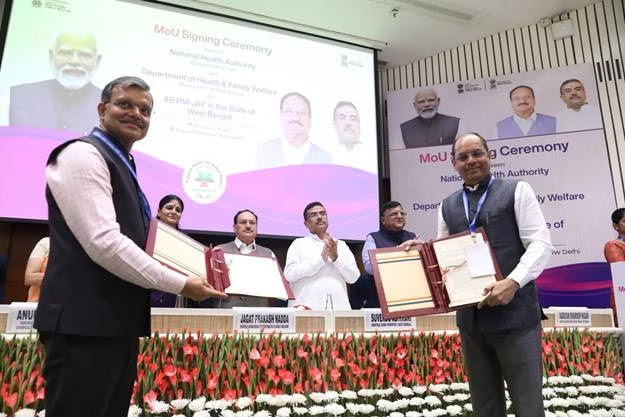
NEW DELHI — In a historic shift for India’s public health landscape, West Bengal has officially signed a Memorandum of Understanding (MoU) to implement the Ayushman Bharat Pradhan Mantri Jan Arogya Yojana (AB PM-JAY). The agreement, finalized on June 8, 2026, makes West Bengal the 36th and final State/Union Territory to adopt the flagship health assurance program. This integration marks the absolute culmination of nationwide rollout for the world’s largest government-funded health scheme, bridging a long-standing gap in regional healthcare access.
The official signing ceremony was convened in New Delhi by the National Health Authority (NHA) and the Department of Health & Family Welfare of West Bengal. The event was led by Union Health Minister Shri Jagat Prakash Nadda and West Bengal Chief Minister Shri Suvendu Adhikari. The move transitions the state away from its independent reliance on localized health schemes, extending standardized federal health security to an estimated 1.43 crore (14.3 million) eligible families, translating to approximately 6 crore citizens across the state.
Expanding the Safety Net: Key Provisions and Demographics
The implementation of AB PM-JAY inside West Bengal establishes an annual cashless, paperless health cover of up to ₹5 lakh per family for secondary and tertiary care hospitalization. According to data released by the NHA, the structural breakdown of the state’s newly approved 1.43 crore beneficiary families includes:
-
1.24 Crore Families: Core eligible households determined via socio-economic vulnerability metrics.
-
15.95 Lakh Families: Senior citizens aged 70 years and above, who receive additional coverage benefits irrespective of socio-economic standing.
-
3.06 Lakh Families: Frontline healthcare workers, including Accredited Social Health Activists (ASHAs), Anganwadi Workers, and Anganwadi Helpers.
Dr. Sunil Kumar Barnwal, Chief Executive Officer of the NHA, confirmed that the central government will inject an estimated ₹1,000 crore annually to finance the state’s beneficiary base. Patients will gain instantaneous, digital access to a combined national web of over 36,000 empanelled public and private healthcare facilities.
Restructuring Financial Protection and Migrant Care
A core socioeconomic driver behind this policy shift is the reduction of catastrophic health spending. “AB PM-JAY is not merely a health scheme, but a transformative initiative for healthcare security and financial protection,” stated Smt. Anupriya Patel, Union Minister of State for Health. Officials noted that national out-of-pocket expenditure (OOPE) on healthcare—the money individuals must pay directly from their own pockets—dropped from 64.6% prior to the scheme’s inception in 2018 to 43.4% dynamically.
Public health experts highlight that the most immediate, practical advantage for West Bengal’s population is national portability.
“West Bengal has historically recorded high rates of interstate migration for manual labor,” explains Dr. Arisudan Dev, an independent health systems policy analyst based in New Delhi. “Previously, state-specific health cards lost all functional validity the moment a worker crossed provincial borders. Under PM-JAY, a migrant worker from West Bengal laboring in Delhi, Maharashtra, or Karnataka can walk into any empanelled hospital and receive identical, cashless tertiary treatments without returning home or facing financial ruin.”
Furthermore, data published in The Lancet underscores the operational efficiency of the digital system, revealing that nearly 90% of eligible cancer patients registered under the scheme successfully secured specialized intervention within 30 days of diagnosis.
Complementary Preventive Care Subsidies
Simultaneous with the insurance expansion, Chief Minister Suvendu Adhikari emphasized that the state is aggressively scaling up parallel preventive health measures. The Government of India recently released ₹527.58 crore to West Bengal as the initial tranche of a comprehensive ₹3,505.59 crore resource envelope allocated under the National Health Mission (NHM) for the 2026–27 fiscal year.
These resources are directly supporting the state’s newly initiated human papillomavirus (HPV) vaccination drive launched on May 30, 2026. The drive targets adolescent girls aged 14 to prevent cervical cancer—the second most frequent cancer among Indian women. Out of a targeted 7.65 lakh beneficiaries, more than 33,000 girls have already been vaccinated within the program’s first ten days. Additionally, the state reports that over 80% of local public representatives have been integrated into the TB Mukt Bharat Abhiyan (Tuberculosis-Free India Campaign) to accelerate community-level containment.
Implementation Challenges and Systemic Limitations
While political and administrative headers celebrate the milestone, health policy experts urge cautious optimism, pointing to critical structural bottlenecks that require monitoring:
-
Public vs. Private Reimbursement Tensions: Historically, private hospital networks in several states have protested low government package rates for complex surgeries, occasionally leading to structural delays or unexpected turnaways for cardholders.
-
The Supply-Side Deficit: Providing an insurance card does not automatically create a hospital bed. In remote districts of North and South 24 Parganas or Purulia, the physical shortage of functional tertiary care centers means residents may still face immense geographical barriers to actualizing their benefits.
-
Integration Friction: Merging West Bengal’s existing medical tracking infrastructure with the Ayushman Bharat Digital Mission (ABDM) ecosystem requires swift electronic health record standardization to avoid systemic administrative lag.
“Universal health coverage is a dual-track system,” notes Dr. Dev. “The demand side is fixed by giving people cards to cover costs. But the supply side—building physical intensive care units, training specialists, and policing private hospital billing compliance—is where the real long-term battle for ‘Swasth Bharat’ (Healthy India) will be decided.”
References
-
National Health Authority (NHA) & Ministry of Health and Family Welfare (MoHFW): Memorandum of Understanding (MoU) Framework Agreement, Government of India; Posted June 8, 2026.
Medical Disclaimer: This article is for informational purposes only and should not be considered medical advice. Always consult with qualified healthcare professionals before making any health-related decisions or changes to your treatment plan. The information presented here is based on current research and expert opinions, which may evolve as new evidence emerges.