 0
0
 0
0
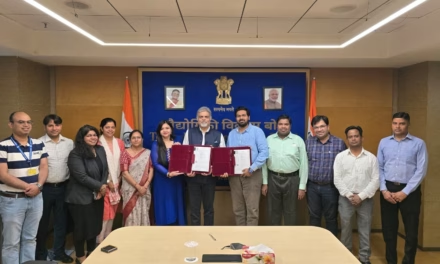
THIRUVANANTHAPURAM — In a major bid to expand its medical education landscape and fortify public healthcare infrastructure, the Kerala state government has formally requested the Union government’s approval to establish a second government medical college in the capital district.
During a National Health Mission (NHM) online review meeting chaired by Union Health Minister J. P. Nadda, Kerala Health Minister K. Muraleedharan urged the Centre to fast-track clearances so the proposed institution can begin admitting its first batch of 100 MBBS students within the current academic year. The ambitious proposal includes a request for ₹150 crore in central financial assistance to upgrade the historical Thiruvananthapuram General Hospital and integrate it with the Women and Children Hospital at Thycaud into a unified teaching facility. Shortly after the high-level meeting, the Kerala Health Department issued an official order naming the nascent institution the K. Karunakaran Memorial Medical College.
The Strategic Blueprint: Upgrading Existing Infrastructure
The core of Kerala’s proposal rests on converting active, high-volume public healthcare facilities into a combined academic and tertiary care center. According to state health officials, Thiruvananthapuram General Hospital already possesses much of the clinical infrastructure, patient footfall, and foundational manpower required to transition into a medical college.
This upgrade forms part of a larger healthcare expansion strategy outlined in Kerala’s recent public health agenda, which received a substantial financial backing of ₹2,076.02 crore in the state budget. Beyond the second capital college, the state is actively pursuing:
-
The establishment of the long-awaited All India Institute of Medical Sciences (AIIMS) in Kerala, with 10 potential sites already identified for federal feasibility studies.
-
The construction of dedicated super-specialty blocks at existing government medical colleges in Idukki, Manjeri, and Wayanad under the Pradhan Mantri Swasthya Suraksha Yojana (PMSSY).
-
The deployment of new trauma care centers, specialized burns units across all districts, and regional centers of excellence in genetics and neurosciences.
National Momentum: The Medical Seat Surge
Kerala’s push aligns with a broader, heavily funded national transition. The Central Government has earmarked ₹15,000 crore under a national scheme specifically designed to create 10,000 additional undergraduate medical seats across India.
Data from the National Medical Commission (NMC) indicates a sharp upward trajectory in medical education capacity. The NMC’s matrix for the 2025–26 cycle recorded more than 1.28 lakh MBBS seats nationwide, with subsequent approvals pushing that figure toward approximately 1.37 lakh seats.
National MBBS Seat Growth Profile (Recent Cycles)

   1.37 Lakh Seats  =======> [Current Expanded Matrix]
   1.28 Lakh Seats  =======> [Initial 2025-26 Framework]
For thousands of medical aspirants in Kerala—where the National Eligibility cum Entrance Test (NEET) competition is notoriously intense—an additional 100 government seats represent an essential, affordable pathway into the medical profession.
Public Health Context: Opportunities and Structural Integration
In the Indian public health ecosystem, medical colleges do heavy lifting. They do not simply operate as schools; they function as crucial regional referral hubs, bringing postgraduate specialists, advanced diagnostic equipment, and academic oversight to public clinical care.
Integrating Thiruvananthapuram General Hospital with the Thycaud Women and Children Hospital could significantly decongest the city’s premier apex institution, Government Medical College Thiruvananthapuram (established in 1951), which currently bears an overwhelming patient load from multiple southern districts.
| Metric Baseline | Existing Capital Medical College (GMCT) | Proposed K. Karunakaran Memorial |
| Annual MBBS Intake | 250 Seats | 100 Seats (Proposed) |
| Operational Mandate | Apex Multi-specialty & Tertiary Referral | Integrated District Health & Teaching Hub |
| Primary Clinical Base | MCH, SATH, and Regional Institutes | General Hospital + Thycaud Hospital |
Balancing Quantity with Quality: Expert Perspectives
Independent health policy analysts and medical educators broadly welcome the expansion of subsidised medical education, yet they urge caution regarding the velocity of these upgrades.
Public health experts emphasize that adding seats on paper is significantly easier than sustaining clinical mentorship in practice. The quality of a medical graduate depends directly on exposure to a diverse clinical caseload, well-equipped laboratories, and structural stability.
To facilitate this nationwide expansion, the NMC has introduced several regulatory relaxations. Notably, the commission removed the historic 150-seat maximum cap per institution and revised the strict geographic distance rules between teaching college campuses and their affiliated clinical hospitals. While these changes grant state governments greater flexibility to turn existing regional hospitals into medical colleges, independent experts warn that regulatory leniency must not compromise the rigorous standards required to train safe, competent physicians.
Obstacles, Unknowns, and the Regulatory Road Ahead
Despite the state’s optimism, several critical regulatory and administrative milestones remain unresolved before the first lecture can begin:
-
Federal Funding & Clearance: The Union Government has not yet issued a formal Essentiality Certificate or approved the requested ₹150 crore grant. While federal officials have promised “serious consideration” under the national expansion budget, formal clearance remains pending.
-
The Academic Calendar Crunch: For admissions to commence in the current academic cycle, the facility must pass rigorous physical inspections by the NMC to verify that lecture halls, dissection rooms, student hostels, and faculty rosters comply with apex medical education standards.
-
Staffing Realignment: Transforming a municipal general hospital into a teaching institution requires re-designating or hiring clinical physicians as academic professors, associate professors, and tutors—a human resources shift that frequently encounters bureaucratic delays.
For the general public and health system watchers, this development represents a major structural shift in how healthcare is distributed in Kerala’s capital. If executed successfully, the project will expand access to specialized healthcare for local communities while giving 100 future doctors an avenue into public medicine. However, the true public health outcome will depend entirely on whether the transition preserves strict educational quality beneath its ambitious timeline.
References
-
Study & Policy Citations: National Medical Commission (NMC). Undergraduate Medical Education Board: Revised Seat Matrix and Institutional Relaxation Norms, published April 2026.
-
Media & Field Reporting:
-
Economic Times Health, “Kerala seeks Union government’s approval for second medical college in state capital,” published July 7, 2026.
-
Medical Disclaimer: This article is for informational purposes only and should not be considered medical advice. Always consult with qualified healthcare professionals before making any health-related decisions or changes to your treatment plan. The information presented here is based on current research and expert opinions, which may evolve as new evidence emerges.