 0
0
 0
0
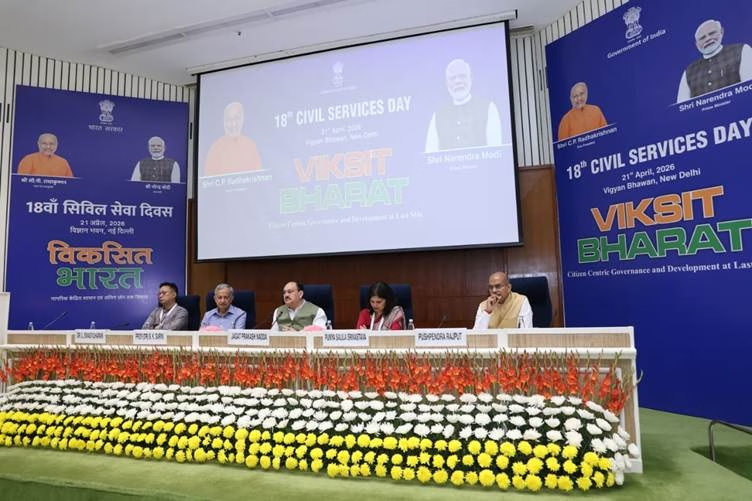
NEW DELHI — In a significant shift for the nation’s public health trajectory, Union Health Minister Shri J.P. Nadda announced a comprehensive transition from purely curative care to a “holistic and inclusive” health policy. Speaking at the 18th Civil Services Day celebrations, Nadda revealed that non-communicable diseases (NCDs) now account for approximately 60% of all deaths in India, necessitating a massive scale-up of preventive infrastructure and lifestyle interventions.
The session, titled “Addressing Non-Communicable Diseases in India: From Preventive to Care,” served as a progress report on India’s ambitious National Program for Prevention and Control of NCDs (NP-NCD). The data presented paints a picture of a nation grappling with a “silent pandemic” of hypertension, diabetes, and cancer, even as the government accelerates its “whole-of-society” response.
The Scale of the Screening Surge
The cornerstone of the government’s strategy is early detection through what is being described as one of the world’s largest voluntary screening drives. Minister Nadda provided staggering figures that highlight the sheer volume of the diagnostic push:
-
Hypertension: 41.5 crore (415 million) people screened; 7.1 crore diagnosed.
-
Diabetes: 41.3 crore screened; 4.7 crore found diabetic.
-
Cancer: 35.3 crore screened for oral cancer; 16.5 crore for breast cancer; and 8.73 crore for cervical cancer.
“Since 2017, we have moved toward voluntary and enhanced screening,” Nadda stated. “We have tried to ensure early detection to help make India healthy. Early detection reduces the burden of cardiovascular diseases, renal failure, and liver complications.”
From “Arogya Mandirs” to Tertiary Excellence
The government’s roadmap emphasizes a “continuum of care” that begins at the village level and extends to high-tech urban centers. Key infrastructure developments include:
-
Primary Care: The establishment of over 1.85 lakh Ayushman Arogya Mandirs, designed as the first contact point for India’s 1.45 billion citizens.
-
Specialized Units: The creation of 107 NCD clinics at the district level and 233 dedicated cardiac care units.
-
Tertiary Expansion: A surge to 880 medical colleges and 23 All India Institutes of Medical Sciences (AIIMS), 20 of which are already operational with super-specialty cancer and cardiology departments.
-
Budgetary Boost: An allocation of ₹64,000 crore under the Health Infrastructure Mission to bridge gaps between primary and secondary care.
The Role of Digital Health
Technology is playing a pivotal role in democratizing healthcare access. The eSanjeevani teleconsultation platform has already served over 46.4 crore patients. This system allows rural patients to interact with city-based specialists through Community Health Officers, effectively “teleporting” expert medical advice to remote areas.
Lifestyle: The 70% Factor
A central theme of the session was the link between modernization and metabolic health. Union Health Secretary, Smt. Punya Salila Srivastava, noted that nearly 70% of NCD risk factors are driven by lifestyle choices.
Data from the National Family Health Survey (NFHS-5) reveals a concerning trend: approximately 24% of women and 23% of men in India are now overweight or obese. Srivastava pointed to high intakes of fats, oils, and processed foods as primary culprits.
“India is witnessing a shift from communicable to non-communicable diseases,” Srivastava said. “Our strategy involves the ’75×25′ initiative and the ‘Swasth Nari, Sashakt Pariwar Abhiyan,’ focusing on behavioral change.”
[Image showing the 75×25 initiative targets for hypertension and diabetes control]
The Minister echoed Prime Minister Modi’s call for a 10% reduction in edible oil consumption and a significant decrease in salt and sugar intake. Programs like “Eat Right India” and “Fit India” are being leveraged to push yoga and physical activity into the daily routines of citizens.
Expert Perspectives and Challenges
While the infrastructure growth is unprecedented, medical experts emphasize that the “knowledge gap” remains a hurdle.
Prof. (Dr.) S. K. Sarin, Director of the Institute of Liver and Biliary Sciences (ILBS), emphasized during the session that the outcome of NCD treatment takes longer than communicable diseases, requiring sustained patient adherence. “Early screening and preventive action are the only ways to reduce the long-term disease burden,” Sarin noted.
Independent public health analysts often point out that while screening numbers are high, the “linkage to care”—ensuring those diagnosed actually receive and continue treatment—is the next great challenge for the Indian healthcare system. The Minister acknowledged this, stating that management and timely referral are now “profile issues” the government is aggressively addressing.
What This Means for You
For the average citizen, the government’s message is clear: Prevention starts at home. 1. Utilize Free Screenings: Visit your local Ayushman Arogya Mandir for regular blood pressure and blood sugar checks.
2. Dietary Discipline: Follow the “10% less” rule for oil, sugar, and salt.
3. Digital Access: Use eSanjeevani for specialist consultations to save on travel costs and time.
4. Early Detection: For women, participating in cervical and breast cancer screenings can be life-saving, as early-stage treatments are significantly more successful.
As India moves toward its goal of a “Viksit Bharat” (Developed India), the health of its workforce remains its most valuable asset. The shift from a curative “sick-care” model to a preventive “well-care” model may be the most critical policy evolution of the decade.
Medical Disclaimer: This article is for informational purposes only and should not be considered medical advice. Always consult with qualified healthcare professionals before making any health-related decisions or changes to your treatment plan. The information presented here is based on current research and expert opinions, which may evolve as new evidence emerges.
References
-
Source Document: Press Information Bureau (PIB) Delhi. “Union Health Minister Shri JP Nadda chairs session, ‘Addressing Non-Communicable Diseases in India: From Preventive to Care’.” Posted 21 April 2026.