 0
0
 0
0
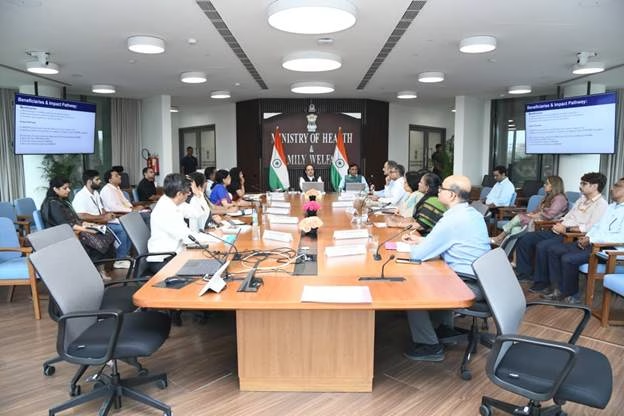
NEW DELHI — In a major effort to humanize hospital care and reduce crowding in India’s public healthcare system, Union Minister for Health and Family Welfare Shri Jagat Prakash Nadda chaired a high-level review meeting on Saturday to evaluate the nationwide expansion of Project SARATHI (Synergistic Action for Responsive and Compassionate Healthcare Initiative).
The high-level meeting, attended by Union Minister for Labour & Employment and Youth Affairs & Sports Dr. Mansukh Mandaviya, focused on building a scalable, technology-driven framework to replicate PGIMER Chandigarh’s successful patient-assistance model across all central government hospitals and public medical institutions nationwide.
Project SARATHI deploys trained youth volunteers to assist patients and their family members with non-clinical hospital navigation, paperwork, and physical mobility. The initiative aims to alleviate administrative burdens on clinicians while transforming the public hospital environment from intimidating to supportive.
The Crisis of Hospital Navigation in Public Healthcare
Public tertiary care centers across developing nations often handle tens of thousands of outpatient visits daily. For patients arriving from rural or underserved regions, entering a major referral hospital can be overwhelming. Complex floor plans, long queues, diagnostic scheduling, and digital registration requirements present significant non-medical barriers to care.
“Patient-centric healthcare extends far beyond clinical interventions,” Shri Nadda stated during the review. “It encompasses ensuring that patients and their attendants receive timely guidance, physical assistance, and compassionate support during what is often a stressful hospital journey. Project SARATHI demonstrates how structured volunteer engagement can improve patient convenience while enabling doctors and nurses to focus strictly on clinical responsibilities.”
Key Findings: The PGIMER Chandigarh Benchmark
The decision to scale Project SARATHI nationwide follows compelling pilot data from the Post Graduate Institute of Medical Education and Research (PGIMER) in Chandigarh.
A formal evaluation conducted by PGIMER’s Department of Community Medicine revealed that structured non-clinical support produces measurable operational improvements:
+-------------------------------------------------------------------------+
|                  PROJECT SARATHI PILOT PERFORMANCE                      |
+------------------------------------+------------------------------------+
| Metric                             | Impact / Volume                    |
+------------------------------------+------------------------------------+
| Total Volunteers Mobilized         | 2,500+ youth participants          |
| Accumulated Service Hours          | > 150,000 hours                    |
| Reduction in Patient Navigation Time| 26% decrease                       |
| Key Support Areas                  | Wayfinding, wheelchair/stretcher   |
|                                    | transport, ABHA ID creation        |
+------------------------------------+------------------------------------+
According to the Department of Community Medicine’s assessment, patients assisted by SARATHI volunteers experienced a 26% reduction in overall navigation time—the duration spent locating departments, diagnostic laboratories, pharmacy counters, and billing stations.
Volunteers assist with wheelchair and stretcher transport, help patients generate Ayushman Bharat Health Account (ABHA) IDs for digital health records, and direct visitors through crowded corridors.
Synergy with MY Bharat and Digital Integration
A central component of the national expansion is the formal integration of Project SARATHI with the MY Bharat (Mera Yuva Bharat) platform, an initiative under the Ministry of Youth Affairs & Sports designed to foster youth leadership and civic engagement.
Dr. Mansukh Mandaviya emphasized that pairing public health infrastructure with youth mobilization creates a dual benefit: youth gain structured volunteer experience and civic exposure, while healthcare facilities receive dependable, non-medical operational support.
The national expansion framework incorporates digital infrastructure managed by the National Health Authority (NHA):
-
Digital Registration & Attendance: Youth sign up and track service hours via the MY Bharat and SARATHI digital portals.
-
ABHA Creation: Volunteers facilitate on-the-spot creation of digital health IDs for visiting patients, aligning with the Ayushman Bharat Digital Mission (ABDM).
-
Real-Time Feedback Systems: Digital survey loops collect real-time patient feedback to evaluate volunteer performance and identify hospital bottlenecks.
Expert Perspectives and Operational Safeguards
Independent public health analysts note that while volunteer initiatives in hospitals are common globally, institutionalizing them at national scale requires strict operational boundaries.
“Large public teaching hospitals are high-density, complex environments,” says Dr. Arvinder Singh, a healthcare administration specialist not directly involved in the meeting. “The success of a volunteer model rests entirely on rigorous training and well-defined scope of work. Non-clinical volunteers must never cross into clinical triage, patient transfer decisions, or administrative paperwork involving sensitive patient data.”
The Ministry’s expansion plan explicitly addresses these boundaries. The proposed policy sets up standardized orientation programs, digital monitoring systems, and strict protocols ensuring volunteers complement existing hospital staff without undertaking clinical responsibilities.
What This Means for Patients and Families
For citizens seeking care at central government facilities—such as AIIMS New Delhi, Safdarjung Hospital, and Lady Hardinge Medical College—the scaling of Project SARATHI offers several practical benefits:
-
Faster Access to Care: Reduced time spent searching for departments or standing in incorrect queues.
-
Enhanced Mobility Support: Immediate access to youth assistance for elderly, disabled, or acutely ill individuals requiring wheelchairs or stretchers.
-
Digital Onboarding Help: Step-by-step assistance in setting up digital health records and accessing online appointment systems.
-
Reduced Stress: A dedicated point of human contact upon entering large, unfamiliar medical complexes.
Looking Ahead: Building a Sustainable Framework
The meeting concluded with directives to establish a joint task force comprising representatives from the Ministry of Health and Family Welfare, the Ministry of Youth Affairs & Sports, and central hospital administrators. The task force is charged with drafting standardized operating procedures (SOPs), safety protocols, and volunteer recognition systems before rolling out the model to central hospitals nationwide.
Senior officials attending the deliberations included Smt. Punya Salila Srivastava (Union Health Secretary), Shri Vijay Nehra (Additional Secretary, MoHFW), Shri Kiran Gopal Vaska (Joint Secretary & MD ABDM, NHA), alongside directors and medical superintendents from major central medical institutions in New Delhi.
By bridging civic youth participation with hospital logistics, India’s health leadership aims to build a more responsive, efficient, and empathetic public health delivery system.
Reference Section
Government Announcements & Official Source
-
Press Information Bureau (PIB), Government of India: Union Health Minister Shri J. P. Nadda Chairs Meeting to Assess Expansion of Project SARATHI Across Healthcare Institutions. Released August 1, 2026. PIB Delhi.
Medical Disclaimer: This article is for informational purposes only and should not be considered medical advice. Always consult with qualified healthcare professionals before making any health-related decisions or changes to your treatment plan. The information presented here is based on current research and expert opinions, which may evolve as new evidence emerges.