 0
0
 0
0
Published: August 2, 2026
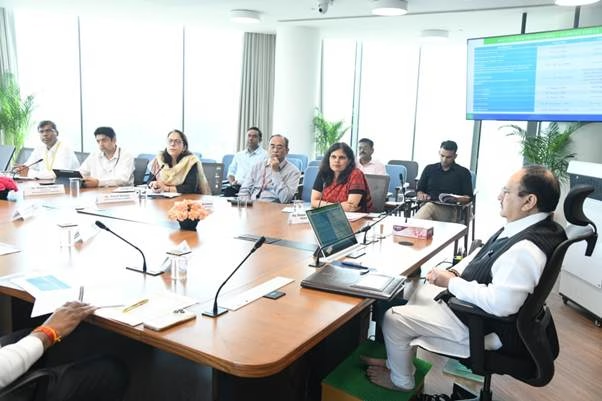
NEW DELHI — In a comprehensive high-level review meeting held on August 1, 2026, Union Minister for Health and Family Welfare Shri Jagat Prakash Nadda assessed the final operational and security preparedness for the upcoming National Eligibility-cum-Entrance Test for Postgraduate (NEET-PG) 2026. Scheduled for August 30, 2026, this year’s medical entrance examination introduces key structural, technological, and logistical reforms designed to streamline candidate experience, prevent fraudulent activities, and maintain absolute transparency across all testing venues.
With a record-breaking 273,183 registered candidates—representing a 12.5% increase from the previous year—the Ministry of Health and Family Welfare (MoHFW) alongside the National Board of Examinations in Medical Sciences (NBEMS) has mobilized over 60,000 examination personnel. The exam will take place in a single shift across more than 1,300 test centers spanning approximately 340 cities nationwide.
During the session, Union Minister Nadda strongly cautioned aspirants against falling victim to misinformation, touts, or claims of paper leaks. He emphasized that advanced encryption technologies and time-bound digital release protocols render prior access to question papers technically impossible.
Key Student-Centric Reforms for 2026
To reduce candidate anxiety and administrative friction, the Health Ministry and NBEMS unveiled four major candidate-centric structural enhancements:
-
Localized Test Center Allocation: Applicants are now required to submit three state preferences, with their residential address state serving as the mandatory primary selection. This policy minimizes long-distance travel for young physicians.
-
Advance City Intimation: To assist candidates in making timely transit and lodging arrangements, NBEMS will issue test city intimations nearly three weeks prior to the examination date.
-
Rationalized Exam Pattern: The test format has been optimized to 180 multiple-choice questions over a 210-minute duration. This adjustment provides candidates with extra time per question while keeping the total duration constant.
-
Dual-Layer Biometric Verification: Mandatory identification during registration and on exam day will incorporate Aadhaar-based systems. For candidates encountering fingerprint verification difficulties, iris scanning will serve as an immediate secondary authentication measure.
Security Architecture and Anti-Fraud Infrastructure
Addressing historical concerns regarding exam integrity in large-scale national tests, the Health Ministry reviewed a multi-layered security framework. Live tracking will occur through central and regional command hubs, supported by independent observers.
| Security Layer | Operational Safeguard |
| Digital Encryption | End-to-end multi-layer encryption with final paper generation occurring shortly before exam commencement. |
| Decryption Controls | Digital keys release the question paper strictly at the scheduled start time at authorized testing terminals. |
| Physical Controls | Dynamic computer allocation, active signal jammers, mandatory frisking, and continuous CCTV surveillance. |
| Reporting Channels | Dedicated NBEMS reporting mechanism set up for candidates to report touts or suspicious activities. |
Expert Perspectives and Public Health Context
Healthcare leadership and educational policy experts have largely welcomed the announced measures, noting that structural transparency is essential to maintaining physician workforce pipelines.
“Standardizing postgraduate entrance logistics directly impacts the mental well-being of young medical professionals,” noted Dr. Arishta Sharma, a senior medical educator not involved in the NBEMS administration. “Reducing travel strain through localized centers and allowing slightly more time per question helps ensure that the assessment evaluates actual clinical knowledge rather than test-taking speed under stress.”
From a broader public health perspective, the smooth execution of NEET-PG is critical for maintaining staffing across tertiary healthcare facilities and teaching hospitals throughout India. Delays or administrative compromises in postgraduate admissions can ripple through the healthcare delivery ecosystem, affecting resident doctor availability in major clinical specialties.
While experts praise the technological safeguards, some student advocacy groups emphasize that continuous monitoring of technical infrastructure at high-density rural and semi-urban centers will be necessary to prevent localized technical glitches on test day.
Advisories for Candidates
The Ministry of Health and NBEMS strongly urge all 273,183 aspirants to rely exclusively on official notices published on the official NBEMS website (natboard.edu.in) and MoHFW portals. Candidates should refrain from engaging with unverified social media channels or third-party agencies claiming guaranteed seat allocations or early access to test materials.
Medical Disclaimer
Medical Disclaimer: This article is for informational purposes only and should not be considered medical advice. Always consult with qualified healthcare professionals before making any health-related decisions or changes to your treatment plan. The information presented here is based on current research and expert opinions, which may evolve as new evidence emerges.
References
-
Press Information Bureau (PIB) Delhi. Union Health Minister Shri Jagat Prakash Nadda Reviews Preparedness for NEET-PG 2026; Student-Centric Reforms to Ensure Smooth, Secure and Transparent Examination. Ministry of Health and Family Welfare, Government of India. Published August 1, 2026