 0
0
 0
0
Read Time:4 Minute, 15 Second
Introduction
- Neonatal mortality accounts for nearly two-thirds of infant deaths in India.
- Despite improvements in institutional deliveries and child survival programs, the neonatal mortality rate (NMR) in 2014 was ~29/1000 live births, contributing significantly to under-five mortality.
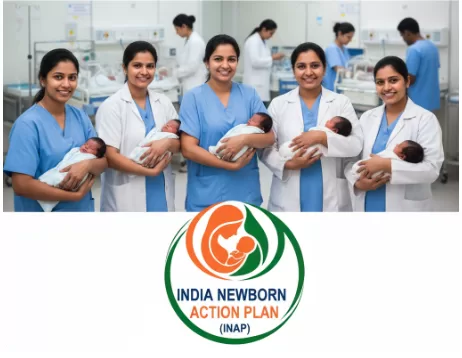
- To align with the Every Newborn Action Plan (ENAP, WHO-UNICEF, 2014), India launched the India Newborn Action Plan (INAP) in September 2014 with the goal of achieving “Single Digit NMR by 2030” across all states.
Background of INAP
- Global Context
- ENAP called for an end to preventable newborn deaths and stillbirths.
- Targets: NMR ≤10 per 1000 live births and stillbirth rate ≤10 per 1000 births by 2035.
- India’s Adaptation
- INAP tailored to Indian epidemiological diversity.
- Dual target:
- Reduce NMR to ≤10 by 2030.
- Reduce stillbirth rate to ≤10 by 2030.
- Principles of INAP
- Equity, Universal coverage, Convergence of maternal-newborn-child health, Accountability, and Community participation.
Strategic Intervention Packages
INAP interventions are organized into six thematic packages, classified as:
- Essential (E): Universal application.
- Situational (S): Depending on epidemiology/disease burden.
- Advanced (A): For states/districts with stronger health system capacity.
1. Pre-conceptional and Antenatal Care
- Essential (E):
- Promotion of adolescent health, prevention of early marriage and pregnancy.
- Universal antenatal registration, minimum 4 ANC visits.
- Birth spacing
- Nutitioal related interventions like balanced diet
- Iron and folic acid supplementation, calcium supplementation.
- Screening for hypertension, gestational diabetes, anemia, infections (syphilis, HIV, hepatitis B).
- Tetanus-diphtheria immunization.
- Screening or anemia , PIH, DM , HTN etc
- Situational (S):
- Screening for hemoglobinopathies (sickle cell, thalassemia) in endemic regions.
- Malaria prophylaxis in high-endemic states.
- Screening for Hepatits , HIV etc
- Advanced (A):
- Use of advanced diagnostics (e.g., ultrasound for congenital anomalies, genetic counselling).
- Preconception counseling and fertility services.
2. Care During Labour and Childbirth
- Essential (E):
- Skilled Birth Attendance at all deliveries.
- Clean and safe delivery practices.
- Partograph use for labour monitoring.
- Active management of third stage of labour (AMTSL).
- Use of corticosteroids
- Immediate resuscitation of newborns (availability of resuscitation corners).
- Situational (S):
- Use of antenatal corticosteroids for preterm labour where neonatal intensive care is available.
- Advanced (A):
- Comprehensive Emergency Obstetric and Neonatal Care (CEmONC) centers.
- Use of technology for intrapartum monitoring (fetal heart monitoring devices).
3. Immediate Newborn Care
- Essential (E):
- Delayed cord clamping.
- Prevention of hypothermia (drying, skin-to-skin contact, delayed bathing).
- Early initiation of breastfeeding within 1 hour of birth.
- Vitamin K1 injection to all newborns.
- Situational (S):
- Chlorhexidine cord application in high neonatal sepsis prevalence areas.
- Advanced (A):
- Use of point-of-care diagnostics for newborn infections.
- Universal newborn screening (hearing, metabolic disorders).
4. Care of Healthy Newborn
- Essential (E):
- Exclusive breastfeeding up to 6 months.
- Kangaroo Mother Care (KMC) for low birthweight babies.
- Immunization as per National Immunization Schedule.
- Home-based Newborn Care (HBNC) visits by ASHAs.
- Situational (S):
- Special counseling in high-prevalence areas for breastfeeding substitutes.
- Advanced (A):
- Lactation management centers at district hospitals.
- E-health support for families through tele-counseling.
5. Care of Small and Sick Newborn
- Essential (E):
- Establishment of Newborn Care Corners (NBCC) at all delivery points.
- Special Newborn Care Units (SNCU) at district hospitals.
- Stabilization Units at CHCs.
- Integrated Management by IMNCI
- Referral transport (102/108 services).
- Situational (S):
- Surfactant therapy and CPAP in neonatal units in high preterm burden states.
- Use of antibiotics guided by regional antimicrobial resistance patterns.
- Advanced (A):
- Neonatal Intensive Care Units (NICUs) with ventilators, advanced imaging.
- Use of advanced therapies (exchange transfusion, therapeutic hypothermia).
6. Care Beyond Newborn Survival
- Essential (E):
- Early childhood development services.
- Screening for developmental delays and disabilities.
- Linkage with ICDS and Rashtriya Bal Swasthya Karyakram (RBSK).
- Situational (S):
- State-led programs for high prevalence conditions (e.g., congenital hypothyroidism, hearing impairment).
- Advanced (A):
- Pediatric rehabilitation centers, early intervention clinics.
- Research and use of digital tools for growth monitoring.
Monitoring and Supervision in INAP
- Framework: Based on RMNCH+A continuum of care.
- Key Components:
- Input indicators: Availability of trained staff, equipment, essential drugs.
- Process indicators: % of mothers receiving 4 ANC visits, skilled birth attendance.
- Output indicators: % newborns breastfed within 1 hour, % sick newborns referred.
- Outcome indicators: Neonatal mortality rate, stillbirth rate.
- Mechanisms:
- Facility-based Maternal and Perinatal Death Surveillance and Response (MPDSR).
- Periodic supportive supervision visits by state/district nodal officers.
- Use of Health Management Information System (HMIS) for real-time monitoring.
- Community-based monitoring through VHSNCs (Village Health Sanitation and Nutrition Committees).
Implementation at State Level
- States urged to prepare State Newborn Action Plans (SNAPs) aligned with INAP.
- District health societies to contextualize interventions based on burden and system readiness.
- Focus on equity: high priority districts, tribal areas, urban slums.
Achievements & Challenges
- Decline in NMR from 29 (2014) to 19 (2022), but disparities remain between states.
- Challenges:
- Shortage of neonatal specialists.
- Infrastructure gaps in SNCUs.
- High out-of-pocket expenditure.
- Persisting social determinants: malnutrition, early marriage, gender bias.
Conclusion
- INAP is India’s commitment to ensure “Every Newborn Counts.”
- By combining universal essential interventions, context-based situational strategies, and advanced care where feasible, India aims for equitable newborn survival.
- Monitoring and accountability at every level remain the backbone for achieving single-digit NMR by 2030.


Happy
0 %

Sad
0 %

Excited
0 %

Sleepy
0 %

Angry
0 %

Surprise
0 %