 0
0
 0
0
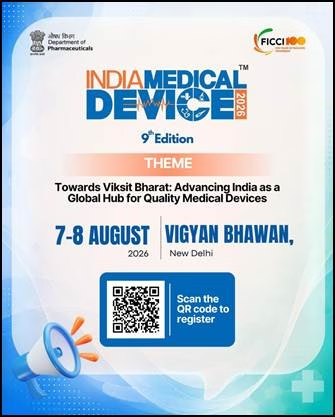
NEW DELHI — In a major push toward healthcare self-reliance and technological innovation, the Department of Pharmaceuticals, Ministry of Chemicals & Fertilizers, in collaboration with the Federation of Indian Chambers of Commerce & Industry (FICCI), will convene the 9th edition of India Medical Device 2026 on August 7th and 8th, 2026, at Vigyan Bhawan, New Delhi. Union Minister of Chemical and Fertilizers, Shri Jagat Prakash Nadda, alongside Union Minister of State Smt. Anupriya Patel, will address the flagship summit.
Centered on the theme “Towards Viksit Bharat: Advancing India as a Global Hub for Quality Medical Devices,” the national event aims to bridge crucial gaps in high-end domestic manufacturing, streamline regulatory pathways, and accelerate the adoption of cutting-rate technologies like Artificial Intelligence (AI) across primary and tertiary healthcare.
Strategic Shift: Moving from Import Reliance to Indigenous Manufacturing
India’s medical device market, currently valued between $15 billion and $18.3 billion, represents one of the fastest-expanding sectors in the global healthcare ecosystem. Historically, however, the country has relied heavily on foreign markets, importing an estimated 75% to 80% of its high-end medical technology—including sophisticated diagnostic imaging systems, radiation therapy equipment, and interventional cardiology implants.
The upcoming conference serves as a critical strategic node for assessing national policies designed to flip this ratio. Interventions such as the National Medical Devices Policy 2023 and the Production Linked Incentive (PLI) Scheme have earmarked over ₹3,420 crore (approximately $410 million) to incentivize local production of 55 high-value device categories.
“Building indigenous manufacturing capabilities isn’t simply an economic strategy; it is a fundamental public health imperative,” notes Dr. Arisudan Sharma, an independent public health analyst and former healthcare policy consultant. “When a nation manufactures its own diagnostic scanners, point-of-care analyzers, and surgical tools, it directly reduces capital expenditure for hospitals. That cost reduction is what ultimately makes advanced care affordable for everyday patients.”
According to government monitoring data, greenfield projects commissioned under the PLI initiative have already yielded over ₹12,300 crore in domestic sales and generated more than ₹5,800 crore in exports. However, industry observers emphasize that complete self-sufficiency requires localizing critical sub-components—such as X-ray tubes and specialized digital detectors—which still face supply chain bottlenecks.
Core Themes and Key Stakeholder Deliberations
The two-day conference will bring together top leadership from across the healthcare ecosystem. Key officials participating include Shri Manoj Joshi (Secretary, Department of Pharmaceuticals), Smt. Punya Salila Srivastava (Secretary, Ministry of Health & Family Welfare), Dr. Rajeev Singh Raghuvanshi (Drugs Controller General of India), and Dr. M. Srinivas (Member-Health, NITI Aayog).
India Medical Device 2026: Core Focus Areas
├── Component Localisation & Supply Chain Resilience
├── Testing Infrastructure & Quality Assurance Standards
├── AI Integration & Software as a Medical Device (SaMD)
├── Clinical Evidence Generation & Regulatory Harmonisation
└── Reimbursement Frameworks for Universal Health Coverage
High-Priority Agenda Topics
-
AI and Software as a Medical Device (SaMD): As artificial intelligence algorithms increasingly assist in clinical triage, radiological scoring, and early disease detection, regulators and developers will establish standardized evaluation frameworks to ensure patient safety and data privacy.
-
Quality Assurance & Testing Infrastructure: Expanding certified testing laboratories across India to ensure domestically produced equipment meets stringent international safety standards (such as ISO 13485) before reaching clinical settings.
-
Universal Health Coverage Integration: Aligning medical device innovation with public health schemes like Ayushman Bharat, ensuring that novel devices are economically viable for widespread public procurement.
Public Health Impact: What This Means for Patients
For the general public, the rapid evolution of India’s MedTech ecosystem directly addresses the nation’s changing epidemiological profile. Non-communicable diseases (NCDs)—such as cardiovascular conditions, type 2 diabetes, chronic kidney disease, and cancers—now account for over 65% of all deaths in India.
Managing chronic ill-health requires continuous monitoring, early screening, and accessible therapeutic interventions. When high-tech devices are developed locally, healthcare systems gain key advantages:
-
Lower Out-of-Pocket Expenses: Reduced import tariffs and localized production decrease the operational cost of diagnostic tests, MRI/CT scans, and interventional procedures.
-
Enhanced Primary Care Access: The roll-out of portable, ruggedized point-of-care devices—such as handheld ultrasound probes and automated blood analyzers—allows clinicians at rural health centers (Ayushman Arogya Mandirs) to detect conditions early.
-
Faster Equipment Servicing: Localized manufacturing ecosystems establish robust after-sales and maintenance networks, reducing machine downtime in tier-2 and tier-3 hospital settings.
┌─────────────────────────────────────────────────────────────────┐
│              TRICKLE-DOWN PATIENT BENEFIT CYCLE                 │
│                                                                 │
│  Domestic PLI Incentives ──► Lower Production Costs            │
│                                      │                          │
│  Widespread Rural Deployment ◄── Lower Hospital Procurement    │
│              │                                                  │
│              ▼                                                  │
│  Earlier NCD Detection & Reduced Patient Out-of-Pocket Expense  │
└─────────────────────────────────────────────────────────────────┘
Challenges and Counterarguments: Quality vs. Velocity
While the sector’s growth trajectory is promising, experts caution against prioritizing manufacturing velocity over rigorous quality control. Medical devices range from simple non-invasive bandages (Class A) to life-supporting implantable pacemakers and neural stimulators (Class D), each carrying distinct clinical risk profiles.
“Import substitution must not come at the expense of clinical efficacy,” cautions Dr. Meera Kulkarni, a clinical research strategist not affiliated with the summit organizers. “A machine that yields higher error margins in diagnostic imaging or point-of-care testing can lead to misdiagnosis. The real test for India’s MedTech sector is proving that domestic devices consistently match or exceed global benchmarks through rigorous, multi-center clinical trials.”
Industry representatives also point out that small and medium-sized enterprises (SMEs) face hurdles regarding high capital expenditure, long gestation periods for regulatory clearance, and fragmented after-sales service infrastructure in remote regions. Overcoming these structural challenges will require sustained public-private partnerships, streamlined single-window regulatory clearances, and expanded clinical testing centers.
Looking Ahead to Viksit Bharat@2047
As India moves toward its broader development targets, the India Medical Device 2026 summit represents a major operational step. By convening regulators, healthcare providers, and technology pioneers under one roof, the event aims to transform India from a major importer of medical technology into a self-reliant global exporter of high-quality healthcare solutions.
Reference Section
-
Press Information Bureau (PIB), Government of India. (2026, July 29). Union Minister J. P. Nadda to address India Medical Device 2026. Ministry of Chemicals and Fertilizers, Release ID: 2291191.
Medical Disclaimer: This article is for informational purposes only and should not be considered medical advice. Always consult with qualified healthcare professionals before making any health-related decisions or changes to your treatment plan. The information presented here is based on current research and expert opinions, which may evolve as new evidence emerges.