 0
0
 0
0
Addis Ababa, Ethiopia — May 27, 2026
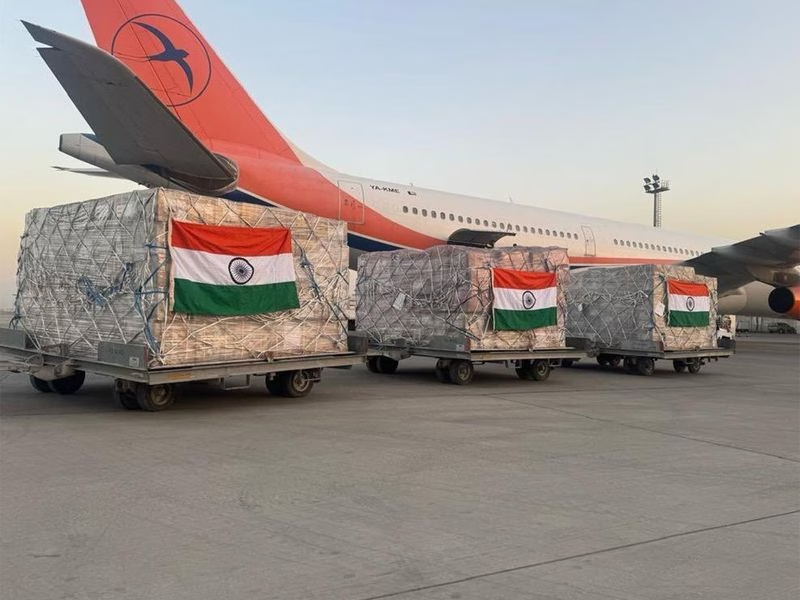
The Africa Centres for Disease Control and Prevention (Africa CDC) has publicly expressed its gratitude to the Government and people of India following the arrival of an emergency consignment of pharmaceutical and medical supplies. Delivered to the Eastern Africa Regional Coordinating Centre (RCC) in Uganda, this critical aid package is destined for immediate deployment to the frontlines in the neighboring Democratic Republic of Congo (DRC). The region is currently battling a severe outbreak of the Bundibugyo Ebola virus strain, which has begun spilling over national borders, threatening continental health security.
With the World Health Organization (WHO) recently declaring the crisis a Public Health Emergency of International Concern (PHEIC), India’s timely intervention represents a vital lifeline for a healthcare infrastructure pushed to its absolute limits by a combination of disease and regional conflict.
Key Findings: India’s Time-Sensitive Medical Assistance
On Wednesday, Africa CDC announced the official receipt of the emergency medical relief. The consignment contains a comprehensive array of medical countermeasures designed to address the immediate gaps in the outbreak response. The inventory includes:
-
Advanced diagnostic kits to accelerate early case identification.
-
Essential therapeutics for supportive patient care.
-
Infection Prevention and Control (IPC) materials, including high-grade Personal Protective Equipment (PPE).
-
Case management support materials to bolster makeshift isolation clinics.
“These supplies will soon be deployed to affected communities in eastern DRC,” Africa CDC stated via an official briefing on X (formerly Twitter). The continental public health agency emphasized that India’s contribution underscores a sustained international commitment to protecting vulnerable lives and reinforcing health security protocols across Africa.
Consignment Composition:
[Diagnostics] + [Therapeutics] + [IPC / PPE Materials] ──> Deployed to Eastern DRC
The Escalating Ebola Crisis: By the Numbers
The humanitarian intervention comes at a deeply precarious moment. According to epidemiological data released on May 26, 2026, by the DRC Ministry of Health, the outbreak has rapidly escalated across the highly volatile provinces of Ituri, North Kivu, and South Kivu.
| Metric | Confirmed Cases | Suspected Cases |
| Cases | 121 | 1,077 |
| Fatalities | 17 | 238 |
Simultaneously, cross-border transmission has been verified in Uganda, which has documented seven confirmed cases and one death. Three of these cases have been epidemiologically linked directly to recent travel from the DRC.
During a virtual ministerial briefing on May 25, 2026, the WHO Director-General described the situation in eastern DRC as a “catastrophic collision of disease and conflict.” Ongoing armed violence, mass civilian displacement, and acute food insecurity have severely hampered the ability of epidemiological surveillance teams to conduct thorough contact tracing or establish stable isolation centers.
A Particularly Dangerous Strain: No Approved Vaccine or Treatment
What makes this specific outbreak uniquely perilous is the causative agent: the Bundibugyo ebolavirus.
Unlike the more frequently documented Zaire ebolavirus strain—for which highly effective countermeasures exist, such as Merck’s Ervebo vaccine and monoclonal antibody treatments like Ebanga—the Bundibugyo strain currently has no fully approved, commercially available vaccines or targeted antiviral therapeutics.
Historically, the Bundibugyo strain exhibits a case fatality rate (CFR) hovering around 40%. While lower than the catastrophic 70–90% CFR occasionally observed with the Zaire strain, its clinical management is profoundly complicated by the absolute lack of pre-existing, strain-specific medical counter-measures. Regulatory bodies note that while Zaire-specific vaccines are highly effective against their target virus, their cross-protective efficacy against the Bundibugyo strain remains entirely unproven.
Expert Commentary: The Critical Role of Infection Control
Because conventional pharmaceutical interventions are limited, the public health response must fall back on foundational epidemiological controls.
“There are substantial barriers to moving a Bundibugyo-specific vaccine toward emergency regulatory approval or widespread clinical use,” explains Dr. Courtney Woolsey, an assistant professor at the University of Texas Medical Branch who has closely monitored viral hemorrhagic fever vaccine pipelines. “In the absence of a deployable vaccine, containment relies entirely on rigorous supportive care and breaking the chains of transmission.”
According to the WHO’s regional brief, standard operating procedures must prioritize early supportive hydration, electrolyte replenishment, stringent hospital hygiene, safe and dignified burial practices, and deep-tier community engagement.
The inclusion of robust IPC materials in the Indian aid package addresses an acute vulnerability. Multiple reports from the field have already highlighted suspected healthcare-associated (nosocomial) transmission, resulting in tragic infections and fatalities among local doctors and nurses who lacked adequate personal protection.
Russia’s Vaccine Announcement: Promise Cautiously Tempered
In tandem with international aid efforts, the Russian Embassy in South Africa recently amplified a statement from Russian Health Minister Mikhail Murashko, asserting that Russian scientists have developed a candidate vaccine against a novel Ebola variant that may exhibit cross-protective properties against the Bundibugyo strain. Preliminary discussions are reportedly underway with the WHO to evaluate potential global manufacturing collaborations.
However, the international medical community views the announcement with measured caution. Independent health experts emphasize that before any candidate vaccine can be deployed in an active emergency zone, rigorous, peer-reviewed data from human clinical trials must undergo stringent evaluation by independent regulatory bodies. To date, detailed phase-1 or phase-2 clinical data regarding this candidate vaccine have not been published in peer-reviewed medical journals.
Public Health Implications: What This Means for the Public
While a Public Health Emergency of International Concern signals a severe regional threat, global health agencies emphasize that the risk to the general public outside of East and Central Africa remains very low.
-
Transmission Vectors: Ebola viruses are not airborne. Transmission requires direct contact with the blood, secretions, organs, or other bodily fluids of an infected person, or surfaces (like bedding or clothing) contaminated with these fluids.
-
Travel and Trade: The WHO explicitly advises against any restrictions on international travel or trade, as such measures often destabilize local economies and hinder the influx of emergency medical personnel.
-
The Power of Supportive Care: Although a targeted cure does not exist, clinical data shows that early entry into supportive care—which includes intravenous fluids, oxygenation, and treating secondary infections—significantly boosts survival rates. The diagnostics and therapeutics provided by India are designed specifically to facilitate this early clinical management.
Limitations and Operational Challenges Ahead
The ultimate success of the containment campaign hinges on factors far removed from medical science. Public health agencies warn that official figures likely underrepresent the true scope of the epidemic due to inaccessible “blind spots” controlled by armed factions in eastern DRC.
Furthermore, this crisis strikes less than a year after a separate Ebola outbreak in the country resulted in 64 cases and 45 deaths, signaling a worrying pattern of viral persistence and recurrent spillover events. Without guaranteed humanitarian corridors and the safety of medical personnel, delivering India’s donated supplies to the most remote epicenters remains a profound operational challenge.
The coming weeks will act as a critical test of global solidarity. As international bodies reinforce cross-border surveillance between Uganda and the DRC, the deployment of these emergency medical supplies represents the immediate line of defense safeguarding thousands of lives while the broader scientific community races to develop definitive countermeasures.
Medical Disclaimer
Medical Disclaimer: This article is for informational purposes only and should not be considered medical advice. Always consult with qualified healthcare professionals before making any health-related decisions or changes to your treatment plan. The information presented here is based on current research and expert opinions, which may evolve as new evidence emerges.
References
-
NDTV, The Tribune India, Devdiscourse, and UN News Bureau regional reporting dispatches, May 25–27, 2026.