 0
0
 0
0
Published July 21, 2026
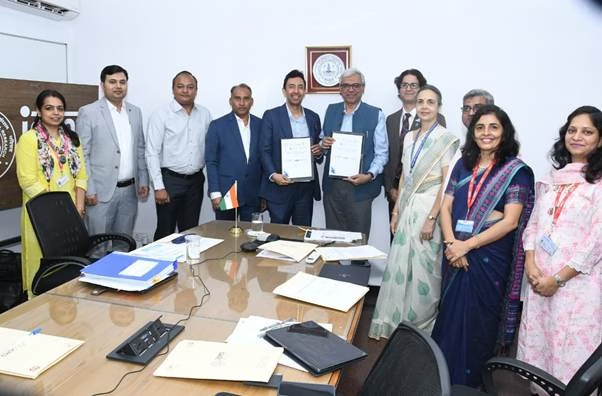
In a major leap forward for India’s healthcare self-reliance, the Indian Council of Medical Research (ICMR) announced today the licensing of three home-grown biomedical innovations to domestic pharmaceutical leaders. The public-to-private technology transfers—facilitated under ICMR’s Medical Innovations Patent Mitra framework—include a targeted, non-invasive therapeutic candidate for precancerous cervical lesions and two multi-pathogen enteric vaccine constructs.
The moves aim to bridge the gap between academic scientific discovery and large-scale, affordable manufacturing. By bringing government-funded research directly into industrial pipelines, public health officials hope to drastically cut costs for life-saving interventions in low- and middle-income regions.
1. Targeted Anti-HPV Therapy: A Non-Surgical Alternative for Cervical Precancer
Among the licensed innovations is SHetA2, a first-in-class small-molecule drug candidate engineered to treat Cervical Intraepithelial Neoplasia (CIN)—the precancerous cell changes on the cervix caused by persistent high-risk Human Papillomavirus (HPV) infection. The drug technology has been licensed to Pune-based Emcure Pharmaceuticals Ltd. for clinical development and manufacturing.
Developed through an international research partnership led by Dr. Showket Hussain at the ICMR–National Institute of Cancer Prevention and Research (ICMR-NICPR) in Noida and Dr. Doris M. Benbrook at the Stephenson Cancer Center, University of Oklahoma, SHetA2 operates via a distinct mechanism.
Unlike traditional treatments that rely on surgical removal or tissue destruction, SHetA2 targets heat shock proteins (HSP70) to disrupt viral oncoproteins, selectively triggering programmed cell death (apoptosis) in precancerous and cancerous cells while leaving healthy cervical tissue undamaged.
HPV-Infected Precancerous Cells ──> SHetA2 binds HSP70 ──> Disrupts Viral Oncoproteins ──> Selective Apoptosis (Healthy Cells Spared)
Why Precancerous Intervention Matters:
Cervical cancer is the second most common cancer among women in India. While preventative HPV vaccines protect against initial viral transmission, millions of women who harbor existing persistent infections face a high risk of developing CIN. Current standard treatments—such as LEEP (loop electrosurgical excision procedure), cold knife conization, or laser ablation—physically destroy cervical tissue. These surgical procedures can carry risks, including cervical incompetence, structural scarring, and elevated chances of premature delivery in future pregnancies.
“For decades, managing pre-invasive conditions like CIN or Stage 0 cervical carcinoma required surgical excisions that, while effective, could compromise cervical integrity and future pregnancy outcomes,” explained Dr. Sandeep Nayak, Chairman of Surgical Oncology at MACS-Renova Oncology Institute, who was not involved in the study. “SHetA2 represents a paradigm shift toward non-invasive medical management. Delivered locally via vaginal suppositories or orally, it could destroy abnormal cells while preserving healthy cervical architecture—a monumental advantage for younger women looking to preserve fertility.”
Preclinical animal models published in journals such as Gynecologic Oncology and PMC demonstrated that localized administration achieved high tissue drug concentration with no mutagenic or systemic toxicity. Phase I human trials conducted in the United States have further established its safety profile, setting the stage for advanced phase trials in India.
2. Next-Generation Enteric Vaccines: Broad Protection Against Waterborne Pathogens
Alongside the oncology transfer, ICMR facilitated the licensing of two next-generation vaccine candidate technologies to Hyderabad-based vaccine giant Biological E Ltd. Designed at the ICMR–National Institute of Research in Bacterial Infections (ICMR-NIRBI) in Kolkata by Dr. Santasabuj Das and his team, these candidates address waterborne enteric bacterial diseases that continue to cause significant mortality across developing nations.
┌─────────────────────────────────────────────────────────────┬─────────────────────────────────────────────────────────────┐
│ Candidate 1: Subunit Typhoid Construct                      │ Candidate 2: Multi-Pathogen Combination                     │
├─────────────────────────────────────────────────────────────┼─────────────────────────────────────────────────────────────┤
│ • Uses Salmonella typhi outer membrane protein (T2544)      │ • Recombinant fusion protein combining conserved antigens   │
│ • Designed to trigger strong systemic and mucosal antibody  │ • Formulated to protect against S. typhi, S. paratyphi,     │
│   responses                                                 │   and Shigella spp.                                         │
│ • Simpler, highly scalable recombinant manufacturing        │ • Aims to close a critical gap where no licensed vaccine    │
│                                                             │   currently exists for paratyphoid or shigellosis          │
└─────────────────────────────────────────────────────────────┴─────────────────────────────────────────────────────────────┘
Enteric diseases such as typhoid fever and shigellosis (bacillary dysentery) account for hundreds of thousands of pediatric hospitalizations globally each year. Current Vi-capsular polysaccharide conjugate vaccines against typhoid offer vital protection, but manufacturing them requires complex bacterial capsule harvesting and chemical conjugation.
By contrast, ICMR-NIRBI’s recombinant subunit approach relies on engineered expression vectors. This lowers manufacturing costs, eliminates batch-to-batch variation, and allows for broader immune recognition across multiple circulating mutant strains.
Furthermore, the multivalent recombinant vaccine candidate targets three major enteric bacterial threats at once (Salmonella typhi, Salmonella paratyphi A, and Shigella species). With antimicrobial resistance (AMR) rapidly eroding the efficacy of standard frontline antibiotics against Shigella and S. typhi, a preventative multi-pathogen vaccine offers a crucial public health safeguard.
3. Strengthening the Translation Pipeline
Historically, promising biomedical discovery in public research institutes struggled to navigate the “valley of death”—the capital-intensive gap between basic laboratory science and phase-appropriate commercial manufacturing.
To bridge this gap, ICMR instituted Medical Innovations Patent Mitra and MedTech Mitra. These structural initiatives provide academic researchers with intellectual property management, assistance with regulatory frameworks (such as the Central Drugs Standard Control Organisation), clinical trial infrastructure, and early engagement with industrial partners.
Discovery (ICMR Labs) ──> IP Protection (Patent Mitra) ──> Regulatory & Clinical Setup (MedTech Mitra) ──> Industry Licensing ──> Market Access
“ICMR is committed to ensuring that publicly funded research translates into products that improve health outcomes,” said Dr. Rajiv Bahl, Secretary of the Department of Health Research (DHR) and Director General of ICMR. “Through initiatives such as Medical Innovations Patent Mitra, we are strengthening the pathway from scientific discovery to commercialization by fostering partnerships between researchers and industry. These technology transfers demonstrate the growing maturity of India’s biomedical innovation ecosystem and represent another step towards achieving self-reliance in healthcare innovation.”
Limitations and Potential Challenges Ahead
While these technology transfers represent important milestones, independent experts caution that several technical hurdles remain before these treatments become available at neighborhood pharmacies or public clinics:
-
Clinical Trial Requirements: SHetA2 must complete rigorous Phase II and Phase III human clinical trials in India to confirm its efficacy in reversing CIN grade 2 and grade 3 lesions across diverse clinical demographics.
-
Delivery Formulations: Designing stable, localized vaginal delivery systems (such as slow-release suppositories or gels) that maintain therapeutic drug concentrations without causing localized tissue irritation requires precise pharmaceutical engineering.
-
Vaccine Immunogenicity in Pediatrics: Recombinant protein subunit vaccines often require tailored adjuvants to stimulate robust, long-lasting mucosal and cellular immune responses in infants and young children under two years of age.
-
Manufacturing Scale-Up: Biological E Ltd. and Emcure Pharmaceuticals Ltd. must adapt benchtop laboratory processes into Good Manufacturing Practice (GMP)-compliant, large-scale industrial runs capable of passing strict regulatory quality audits.
What This Means for Readers
For patients and families, these technology transfers reflect a shifting landscape in preventative medicine:
-
Future Non-Surgical Options for Women: Women diagnosed with abnormal cervical Pap smears or HPV-induced dysplasia may eventually have access to topically applied prescription medications, potentially avoiding invasive surgical procedures that carry risks to future fertility.
-
Simplified Immunization: Combination enteric vaccines could reduce the number of immunizations children in high-burden regions require, providing single-shot protection against typhoid, paratyphoid, and dysentery.
-
Affordable Healthcare: Because these technologies were developed using public funds within India, their eventual market rollout is expected to be significantly more affordable than imported patented biopharmaceuticals.
As clinical trials progress over the coming years, these indigenous scientific developments move closer to fulfilling their promise: transforming laboratory discoveries into real-world healthcare solutions.
Medical Disclaimer
Medical Disclaimer: This article is for informational purposes only and should not be considered medical advice. Always consult with qualified healthcare professionals before making any health-related decisions or changes to your treatment plan. The information presented here is based on current research and expert opinions, which may evolve as new evidence emerges.
References
-
Press Information Bureau (PIB), Delhi. (2026, July 21). ICMR transfers three indigenous biomedical technologies to advance cancer and infectious disease solutions. Press Release ID: 2286902.