 0
0
 0
0
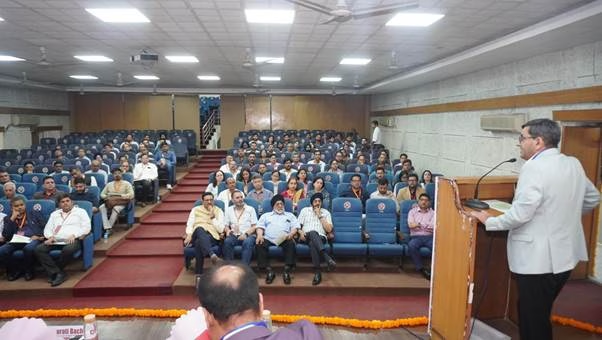
JAMMU, INDIA — In a pivotal move to fortify the safety and efficacy of India’s pharmaceutical landscape, the Indian Pharmacopoeia Commission (IPC), in collaboration with the Council of Scientific and Industrial Research (CSIR), convened a high-level Scientific Conclave on April 17, 2026. Held at the CSIR-Indian Institute of Integrative Medicine (CSIR-IIIM) in Jammu, the event gathered a powerhouse of regulators, academic researchers, and industry leaders to finalize the implementation of the Indian Pharmacopoeia (IP) 2026.
The conclave serves as a critical bridge between the release of the 10th edition of the IP earlier this year and its practical application across the “Pharmacy of the World.” By updating the rigorous standards that govern how medicines are manufactured and tested, the IPC aims to enhance public health safeguards and ensure that every dose of medicine—from common vitamins to complex cancer therapies—meets stringent global benchmarks.
The New Gold Standard: Key Developments in IP 2026
The IP 2026 is not merely a book of rules; it is a legally enforceable “bible” for drug quality in India. This 10th edition introduces 121 new monographs, bringing the total number of established drug standards to 3,340.
A monograph is a detailed scientific document that specifies the tests and limits for a drug’s purity and potency. At the Jammu conclave, experts highlighted several groundbreaking updates:
-
Blood Component Safety: For the first time, the IP includes 20 monographs for blood components used in transfusion medicine (such as red cells and plasma). This is designed to drastically reduce the risk of transfusion-transmitted infections.
-
Therapeutic Expansion: Standards have been significantly bolstered for high-impact therapeutic areas, including anti-tuberculosis, anti-diabetic, and anti-cancer medications.
-
Modern Analytics: The conclave focused on the transition to “stability-indicating” methods, utilizing advanced technologies like High-Performance Liquid Chromatography (HPLC) to detect even trace impurities.
Expert Perspectives: Why it Matters to You
While the technical details may seem complex, the real-world implications for patients are profound. The standardization of phytopharmaceuticals—medicines derived from plants—was a major focus of the discussions at CSIR-IIIM, an institute renowned for its work in natural products.
“The shift toward standardized phytopharmaceuticals is a game-changer for consumer trust,” says Dr. Aruna Sharma, a clinical pharmacologist not affiliated with the research. “In the past, herbal products often lacked the rigorous quality controls applied to synthetic drugs. By bringing these under the IP 2026 umbrella, we ensure that a patient receives the same therapeutic benefit in every bottle.”
Public health officials at the event emphasized that these standards are India’s primary defense against substandard and falsified (SF) medical products. By tightening impurity limits and adopting modern microbiological testing, the IPC is effectively raising the “floor” of quality for all manufacturers.
Background: India’s Rising Global Influence
The conclave arrives at a time when India is asserting its dominance in global regulatory circles. Since the release of the IP 2026 in January, the Indian Pharmacopoeia has gained recognition in 19 countries across the Global South.
Furthermore, India’s contribution to the World Health Organization’s (WHO) pharmacovigilance (drug safety monitoring) database has skyrocketed. In 2014, India was ranked 123rd globally; by 2026, it has climbed to the 8th position worldwide, reflecting a massive investment in reporting and tracking adverse drug reactions.
Public Health Implications and Practical Advice
For the average consumer, the IP 2026 means safer medicine cabinets. The inclusion of new standards for vitamins, minerals, and amino acids ensures that over-the-counter supplements are held to professional pharmaceutical grades rather than just food-grade standards.
What should readers do?
-
Look for “IP” on Labels: When purchasing medication in India, ensure the packaging mentions “IP” next to the drug name (e.g., Paracetamol IP). This indicates the product was manufactured according to these official standards.
-
Report Side Effects: If you experience an unexpected reaction to a medication, report it to your doctor or through the Pharmacovigilance Programme of India (PvPI). Your data helps regulators update these very standards.
Navigating Challenges: A Balanced View
Despite the advancements, the conclave acknowledged significant hurdles. Small and Medium Enterprises (SMEs) in the pharmaceutical sector may struggle with the cost of adopting the new “stability-indicating” analytical methods required by IP 2026.
Some industry critics argue that the rapid transition to more expensive testing equipment could lead to temporary price hikes in certain generic medications. However, the consensus among regulators at the Jammu session was clear: the long-term cost of a public health crisis caused by impure drugs far outweighs the immediate investment in better testing.
Looking Ahead
The collaboration between the IPC and CSIR-IIIM Jammu signifies a move toward “Integrative Medicine”—blending traditional knowledge with modern rigorous science. As the IP 2026 becomes the mandatory standard for all drugs produced and marketed in India, the focus now shifts to enforcement and industry-wide training to ensure no patient is left behind.
Reference Section
-
Primary Source: Press Information Bureau (PIB) Delhi. (2026, April 18). Scientific Conclave on Indian Pharmacopoeia (IP) 2026 held at CSIR-IIIM, Jammu. Ministry of Health and Family Welfare.
Medical Disclaimer: This article is for informational purposes only and should not be considered medical advice. Always consult with qualified healthcare professionals before making any health-related decisions or changes to your treatment plan. The information presented here is based on current research and expert opinions, which may evolve as new evidence emerges.