 0
0
 0
0
Published: April 14, 2026
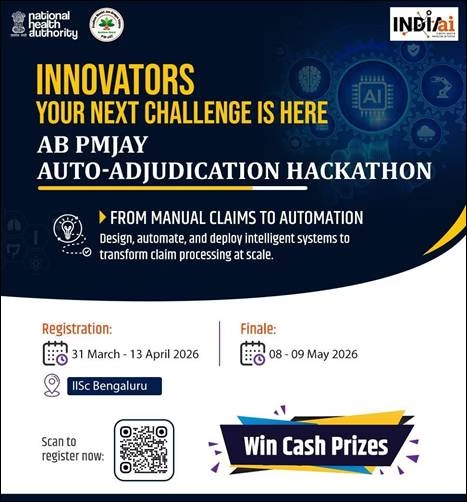
NEW DELHI — In a major move to modernize the backbone of India’s public healthcare delivery, the National Health Authority (NHA) has officially launched the Ayushman Bharat-Pradhan Mantri Jan Arogya Yojana (AB PM-JAY) Auto-Adjudication Hackathon 2026. Aimed at solving the logistical bottleneck of processing nearly 50,000 daily medical claims, the initiative seeks to leverage Artificial Intelligence (AI) and automation to ensure that patients and hospitals experience faster, more transparent reimbursements.
As of April 13, over 2,600 innovators—ranging from university students to seasoned tech startups—have registered to overhaul a system that currently relies heavily on manual intervention. With the registration window now closed, a high-stakes masterclass series has begun, leading toward a grand finale at the Indian Institute of Science (IISc) in Bengaluru this May.
The Efficiency Gap: Moving Beyond 20%
The AB PM-JAY scheme is the world’s largest government-funded health assurance program, providing a cover of ₹5 lakh per family per year to over 120 million vulnerable families. However, the sheer scale of the operation presents a unique challenge: processing 50,000 claims across 1,900 different treatment packages every single day.
Currently, only 15% to 20% of these claims are “auto-adjudicated”—meaning they are processed automatically by software without requiring a human to verify every document. The remaining 80% require manual review, which can lead to delays in hospital payments and administrative strain.
“The goal isn’t just to speed things up; it’s about accuracy and scalability,” says Dr. Aranya Sen, a digital health policy consultant not affiliated with the NHA. “When you deal with 1,900 distinct medical packages, a ‘one-size-fits-all’ software doesn’t work. We need solutions that are ‘package-agnostic’—systems smart enough to understand a heart surgery claim as easily as a cataract removal.”
The Tech Frontier: AI vs. Fraud
The hackathon focuses on three critical pillars of digital health:
-
Standardized Documentation: Developing tools that can read diverse medical records and formats.
-
AI-Based Fraud Detection: Identifying “red flags” in claims data in real-time to prevent the misuse of public funds.
-
Real-Time Verification: Ensuring that the patient who received treatment is the actual beneficiary, reducing identity errors.
By integrating these features, the NHA aims to create a “future-ready” framework. For the average citizen, this means less time spent waiting for discharge papers and more confidence that the hospital will be paid promptly by the government, ensuring the continuity of care.
Expert Perspectives and Public Impact
While the tech community is enthusiastic, public health experts emphasize the importance of human oversight.
“Automation in healthcare is a double-edged sword,” notes Rajesh Verma, a healthcare administrator. “While AI can eliminate human error in data entry, we must ensure that ‘algorithmic bias’ doesn’t lead to the unfair rejection of claims for patients with complex or rare conditions. The NHA’s decision to bring in outside innovators is a great step toward finding those nuances.”
From a public health standpoint, a more efficient claim system strengthens the entire ecosystem. When hospitals receive payments faster, they are more likely to participate in the scheme, thereby increasing the number of available beds and specialists for the poor.
The Road to Bengaluru
The NHA has structured a rigorous support system for the 2,600+ participants. A three-part Masterclass Series kicked off on April 13, designed to provide deep dives into the current claims ecosystem. These sessions, streamed live on the @AyushmanNHA YouTube channel, allow participants to hear directly from policy leaders and technical architects.
The journey culminates on May 8-9, 2026, at IISc Bengaluru. Winning teams will compete for cash prizes totaling several lakhs per problem statement and, perhaps more importantly, the chance to see their code implemented at a national scale.
Challenges and Limitations
Despite the optimism, shifting to a fully automated system faces hurdles. India’s diverse digital landscape means that a small rural clinic may not have the same data quality as a multi-specialty urban hospital. Any auto-adjudication system must be robust enough to handle “noisy” data or poor-quality scans of physical documents.
Furthermore, the NHA must navigate stringent data privacy laws, ensuring that patient medical records are encrypted and handled ethically during the automated review process.
Why This Matters to You
For the health-conscious consumer and the taxpayer, this hackathon represents a shift toward a more accountable government. Faster claims mean fewer “out-of-pocket” stresses for families during medical emergencies. As the NHA fosters this culture of innovation, India moves one step closer to a truly “Digital Health Nation.”
References
-
Primary Source: Press Information Bureau (PIB) Delhi. “National Health Authority Invites Innovators to Join AB PM-JAY Auto-Adjudication Hackathon 2026.” Posted April 13, 2026.
-
Institutional Source: National Health Authority (NHA) Official Portal. nha.gov.in/hackathon
Medical Disclaimer: This article is for informational purposes only and should not be considered medical advice. Always consult with qualified healthcare professionals before making any health-related decisions or changes to your treatment plan. The information presented here is based on current research and expert opinions, which may evolve as new evidence emerges.