 0
0
 0
0
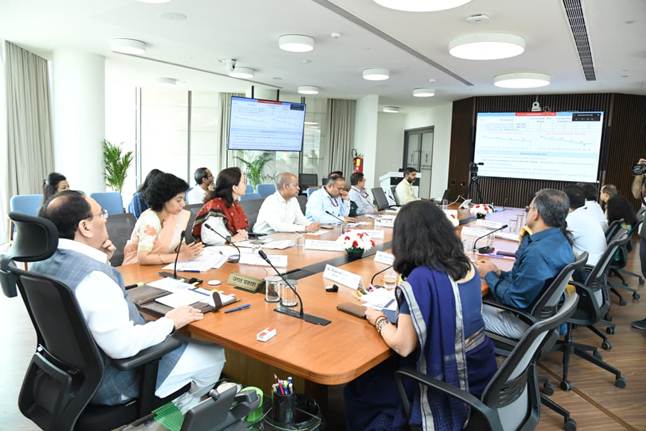
NEW DELHI — In a major move to revamp public health delivery, Union Health Minister Shri J.P. Nadda chaired a high-level review meeting on Saturday with West Bengal Chief Minister Shri Suvendu Adhikari. The virtual summit, held on May 23, 2026, focused on accelerating sluggish flagship healthcare schemes and modernizing medical infrastructure across the state. As an immediate shot in the arm, the Central Government announced the release of ₹527.58 crore as the first tranche of a massive ₹3,505.59 crore National Health Mission (NHM) allocation earmarked for West Bengal for the 2026–27 fiscal year.
The high-stakes meeting touched upon critical public health milestones, including the rollout of a nationwide human papillomavirus (HPV) vaccination drive to fight cervical cancer, the implementation of the TB Mukt Bharat Abhiyan (Tuberculosis-Free India Campaign), and the resolution of a long-standing impasse over the deployment of the Ayushman Bharat Pradhan Mantri Jan Arogya Yojana (AB PM-JAY) universal health insurance scheme in the state.
Critical Funding Infusion and Infrastructure Targets
The dialogue underscored a shared commitment to achieving the United Nations Sustainable Development Goals (SDGs), with specific emphasis on reducing three critical maternal and child health indicators:
-
Maternal Mortality Rate (MMR): The number of maternal deaths per 100,000 live births.
-
Under-5 Mortality Rate (U5MR): The probability of a child dying before reaching age five per 1,000 live births.
-
Neonatal Mortality Rate (NMR): The number of deaths of infants under 28 days of age per 1,000 live births.
Minister Nadda noted that West Bengal’s unique international border areas present distinct public health sensitivities, requiring heightened disease surveillance and robust cross-border containment strategies.
Beyond immediate monetary assistance, Chief Minister Adhikari raised pressing structural deficiencies in the state’s medical network. Highlighting Prime Minister Narendra Modi’s vision of establishing at least one medical college per district, Adhikari pointed out that three regions in West Bengal still completely lack a medical college.
Furthermore, the Chief Minister formally requested the establishment of a new All India Institute of Medical Sciences (AIIMS) in the northern part of West Bengal to bridge the massive gap in tertiary, high-end patient care and research facilities for North Bengal residents.
Tackling Cervical Cancer and Tuberculosis at the Grassroots
A pivotal point of the meeting was preventive oncology. Minister Nadda strongly urged West Bengal to immediately execute the nationwide HPV vaccination drive.
“Preventive healthcare and early intervention remain central pillars of the Government’s public health strategy,” Nadda stated during the review. “A large number of young girls remain highly susceptible to cervical cancer, and we must extend protection to them under a proactive preventive framework.”
According to the World Health Organization (WHO), cervical cancer is the second most common cancer among women in India, primarily caused by persistent infection with high-risk types of Human Papillomavirus. Clinical data shows that introducing the vaccine to girls aged 9 to 14 can prevent the vast majority of cervical cancer cases before exposure to the virus occurs.
Cervical Cancer Prevention Continuum
[Grassroots Screening via Ayushman Arogya Mandirs]
                  │
                  ▼
[Early Identification / Diagnosis of High-Risk HPV]
                  │
                  ▼
[Timely Clinical Intervention & Standardized Treatment]
In addition to cancer prevention, the Centre directed the state to ramp up the TB Mukt Bharat Abhiyan. Tuberculosis remains an immense public health challenge in India, which accounts for over a quarter of the global TB burden.
To boost flagging public involvement, Nadda suggested organizing dedicated sensitization workshops for Members of Parliament (MPs) and Members of Legislative Assemblies (MLAs) in West Bengal. This strategy aims to leverage political influence to destigmatize the disease, promote intensified local screening, and support treatment adherence at the village level.
The Ayushman Bharat Logjam: A Lifeline Awaiting Signature
Perhaps the most consequential policy discussion centered around the signing of a Memorandum of Understanding (MoU) to finally bring Ayushman Bharat PM-JAY to West Bengal. The centrally sponsored scheme offers a health cover of ₹5 lakh per family per year for secondary and tertiary care hospitalization.
If implemented, the expanded healthcare safety net will cover nearly 1.45 crore vulnerable families in West Bengal, including a massive cohort of senior citizens who require frequent medical interventions. Chief Minister Adhikari sought technical guidance from the Ministry to expedite the administrative paperwork, assuring that past and pending health-related data from the state are being streamlined on priority to ensure complete transparency.
Independent healthcare experts view this development with cautious optimism.
“Resolving administrative and political roadblocks between the Central Ministry and state machineries is essential for universal health coverage,” says Dr. K. Srinath Reddy, a prominent public health expert and former President of the Public Health Foundation of India (PHFI), who was not involved in the meeting. “A budget allocation is only as good as its execution. If West Bengal seamlessly adopts PM-JAY alongside its existing state mechanisms, it could dramatically reduce catastrophic out-of-pocket health expenditure, which currently pushes millions of Indian families into poverty each year.”
Monsoon Preparedness and Affordable Medicines
With the monsoon season fast approaching, the leaders discussed the immediate threat of vector-borne illnesses like Dengue, Malaria, Kala-azar (visceral leishmaniasis), and Lymphatic Filariasis. Chief Minister Adhikari stressed the urgent need for enhanced state preparedness, public awareness campaigns, and vector-control training to prevent seasonal spikes.
To address the high cost of daily pharmaceuticals, West Bengal proposed a major expansion of Pradhan Mantri Bhartiya Janaushadhi Pariyojana (Jan Aushadhi Kendras) and AMRIT Pharmacies across all districts. These centers provide high-quality generic medicines at fractions of the cost of branded equivalents, easing the financial burden on chronic disease patients requiring life-long therapies.
Challenges and Limitations in Execution
While the financial commitments and policy alignments are substantial, medical administrators warn of severe implementation bottlenecks. Infusing ₹527 crore is a positive step, but West Bengal has historically faced challenges in utilizing central funds effectively due to complex state-level bureaucratic clearances and accounting delays.
Furthermore, building medical colleges and an AIIMS campus takes years of planning, land acquisition, and structural development; it will not address the acute shortage of specialist doctors and nurses currently plaguing rural West Bengal health facilities. Experts also note that merely opening vaccine clinics is insufficient; overcoming vaccine hesitancy regarding the HPV shot will require deep-rooted community trust and carefully crafted behavioral communication campaigns.
Medical Disclaimer
Medical Disclaimer: This article is for informational purposes only and should not be considered medical advice. Always consult with qualified healthcare professionals before making any health-related decisions or changes to your treatment plan. The information presented here is based on current research and expert opinions, which may evolve as new evidence emerges.
References
Government & Institutional Sources
-
Press Information Bureau (PIB) Delhi: Official press release, Union Health Minister Shri J.P. Nadda reviews healthcare systems in West Bengal during virtual meeting with Chief Minister Shri Suvendu Adhikari, Published May 23, 2026.