 0
0
 0
0
WASHINGTON — In a major escalation of the federal response to a burgeoning agricultural and veterinary threat, the U.S. Food and Drug Administration (FDA) on June 11, 2026, granted emergency authorization for the first generic over-the-counter (OTC) medication to treat New World screwworm infestations in companion animals. The decision marks a critical expansion of treatment options as the highly destructive, flesh-eating parasite makes a troubling return to the United States after being eradicated nearly 60 years ago.
The emergency declaration authorizes generic nitenpyram tablets, manufactured by Felix Pharmaceuticals, for the immediate treatment of New World screwworm (Cochliomyia hominivorax) infestations in dogs, puppies, cats, and kittens. The authorization applies to pets weighing at least two pounds ($0.9\text{ kg}$) and older than four weeks of age. This milestone represents the first generic drug cleared by the FDA for this specific parasitic infection, joining a suite of 10 other emergency use authorizations (EUAs) and three conditional approvals previously issued by federal regulators to combat the outbreak.
Rapid Larvicidal Action and the Treatment Protocol
Nitenpyram is an oral insecticide that works rapidly by disrupting the central nervous system of parasites. According to FDA guidelines, the newly authorized tablet form kills the vast majority of screwworm larvae within hours of the first dose.
The treatment protocol mandates that pet owners administer a second oral dose exactly six hours after the initial treatment. Crucially, federal health officials emphasize that this medication must be viewed as an immediate intervention rather than a complete cure. Following the second dose, pet owners must promptly follow up with a licensed veterinarian to have any remaining dead or dying larvae physically extracted and the surrounding wounds professionally cleaned and treated.
Medical experts note that while nitenpyram is highly effective at clearing an active infestation, it offers no residual protection.
Critical Limitation: Nitenpyram does not prevent reinfection. Once the drug clears the animal’s system, the pet remains entirely vulnerable to future screwworm fly strikes if exposed to the parasite again.
While nitenpyram has long been available over the counter under common brand names like Capstar and Capaction for quick-kill flea control, this marks its inaugural emergency authorization specifically targeted at treating New World screwworm.
The regulatory decision is heavily backed by historical and clinical data. A landmark 2010 study by Correia et al. demonstrated a $100\%$ larvicidal efficacy of nitenpyram against Cochliomyia hominivorax in naturally infested dogs, with total larval mortality achieved within 6 hours of consumption. Furthermore, a subsequent clinical study published in the Brazilian Journal of Veterinary Medicine confirmed nitenpyram’s $100\%$ global efficacy for larval expulsion in complex ocular myiasis (maggot infestation of the eye) cases, showcasing its utility in severe anatomical presentations.
The Return of a Flesh-Eating Parasite
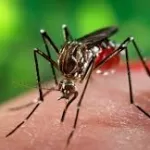
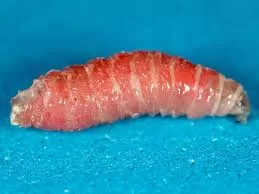
The New World screwworm fly reproduces by laying eggs in the open wounds, scratches, or natural body orifices (such as the eyes, ears, nose, and genitals) of warm-blooded animals. Within 12 to 24 hours, these eggs hatch into aggressive larvae, or maggots, which use specialized mouth-hooks to feed directly on the living tissue of the host.
The parasite was officially eradicated from the United States in 1966 through an aggressive biological control campaign led by the U.S. Department of Agriculture (USDA), which involved releasing billions of sterile male flies to disrupt the insect’s reproductive cycle. Between 1962 and 1975 alone, the U.S. and Mexico bred and released more than 94 billion sterile flies to establish a biological barrier.
That barrier fractured on June 3, 2026, when agricultural officials confirmed a positive screwworm case in a calf in Texas—the first confirmed domestic appearance of the parasite in decades. The infestation has since expanded, with at least four distinct cases identified in Texas livestock (including cattle and a goat). The threat shifted squarely into the domestic pet sphere when a dog in New Mexico was diagnosed as the first confirmed companion animal infection of this outbreak.
Expert Perspectives and Public Health Containment
Despite the graphic nature of the parasite’s life cycle, public health officials urge calm among pet owners, emphasizing that widespread panic is unwarranted.
“There is still little risk to pets,” says Dr. Sharon Nachman, chief of the division of pediatric infectious diseases at Stony Brook Children’s Hospital in New York. Dr. Nachman notes that dog owners can safely continue routine activities, such as daily walks, provided their pets do not have fresh, uncovered, or untreated injuries that could attract a female fly.
At the federal level, the authorization is viewed as both a defensive measure for companion animals and an economic shield for the multibillion-dollar U.S. livestock industry. Health Secretary Robert F. Kennedy Jr. stated that the emergency clearance “puts an affordable, fast-acting treatment in the hands of pet owners, strengthens our containment strategy, and helps stop this destructive parasite from spreading further in the United States.”
The FDA reveals that it has quietly prepared for this biosecurity scenario for nearly a year. Acting FDA Commissioner Kyle Diamantas reported that the agency’s proactive stance included laying the groundwork for multiple animal drug clearances. Among these was the mid-May 2026 clearance of Dectomax, an injectable veterinary drug authorized for preventing and treating screwworm infestations across a broad spectrum of livestock and wildlife, including dairy cattle, swine, horses, sheep, and deer.
What to Watch For: Clinical Signs of Screwworm Infestation
Because early intervention dramatically improves prognoses, health agencies have released specific clinical signs for pet owners to monitor:
-
Wound Deterioration: Wounds, surgical incisions, or even minor tick bites that visibly worsen rather than heal, rapidly becoming swollen, deeply painful, or highly inflamed.
-
Distinctive Odor: Infested wounds emanate a peculiarly foul, strong, and progressive odor characteristic of tissue decay.
-
Behavioral Markers: Continuous, obsessive licking, biting, or scratching at a localized injury site, accompanied by sudden lethargy, loss of appetite, or uncharacteristic aggression due to severe pain.
-
Visible Movement: Seeping discharge or bleeding from an open sore, alongside the physical visualization of moving larvae or a distinct rippling sensation within the wound tissue.
If an infection is suspected, owners must contact a veterinarian immediately. Veterinary professionals are equipped to safely extract the larvae, debride the tissue, and properly destroy the maggots to prevent further environmental contamination. To aid federal tracking, veterinarians can submit up to ten collected maggots to the National Veterinary Services Laboratories for definitive genetic identification.
Risk Assessment and Government Action
The USDA currently categorizes the overall risk to the broader U.S. animal population and the human public as “very low.” Officials stress that screwworm myiasis is entirely non-contagious; it cannot be transmitted directly from animal to animal, or from animals to humans. A new infection can only be initiated via the direct deposition of eggs by a fertile female fly.
While humans can technically contract New World screwworm, such cases are exceptionally rare in modern medical history and occur strictly through direct fly-to-human contact, typically targeting individuals with compromised mobility or exposed, uncleaned wounds near facial cavities or the genitals.
The primary danger remains localized to the host animal. If left untreated, the progressive tissue destruction from an expanding larval mass can induce systemic shock, secondary bacterial infections, and death.
To blunt the biological spread, the current U.S. containment strategy relies heavily on an aggressive, dual-front offensive:
[Air Drop: 4 Million Sterile Flies/Week] + [Ground Release: 4 Million Sterile Flies/Week]
                                       │
                                       ▼
                        [Population Suppression Zone]
Agriculture Secretary Brooke Rollins highlighted that combining this massive sterile fly deployment with readily accessible antiparasitic treatments like ivermectin and over-the-counter nitenpyram will “probably serve like a vaccination” to effectively ring-fence and suppress the flesh-eating pest before it achieves endemic status.
Presently, no animal drug carries full, permanent FDA approval specifically for New World screwworm myiasis; all available therapies utilize the Emergency Use Authorization or conditional approval pathways. These emergency-cleared products will remain legally available over the counter until the Department of Health and Human Services formally terminates the declaration that the parasite presents a national veterinary and public health emergency.
Medical Disclaimer
Medical Disclaimer: This article is for informational purposes only and should not be considered medical advice. Always consult with qualified healthcare professionals before making any health-related decisions or changes to your treatment plan. The information presented here is based on current research and expert opinions, which may evolve as new evidence emerges.
References
-
Reuters Health News Portfolio. (June 11, 2026). “FDA grants emergency approval for over-the-counter drug to treat screwworm in pets.”