 0
0
 0
0
NEW DELHI — In a major push to modernize India’s frontline healthcare and public nutrition framework, the Ministry of Women and Child Development (MWCD) has fully deployed the Poshan Tracker, a real-time digital governance application, across the nation’s network of Anganwadi Centres (AWCs). Serving as the technological backbone of Mission Saksham Anganwadi and Poshan 2.0, the application transforms how growth monitoring, supplementary nutrition, and early childhood education are delivered to millions of mothers and young children.
The announcement was confirmed in Lok Sabha by Minister of State for Women and Child Development, Smt. Savitri Thakur. Beyond real-time health tracking, the government has launched a new Nominee Module within the platform, designed to guarantee uninterrupted delivery of Take-Home Ration (THR) to vulnerable families even when primary caregivers face mobility or logistical barriers.
Real-Time Health Governance Replaces Paper Logs
Historically, tracking maternal and child nutrition across rural and urban Anganwadi centres relied on manual, paper-based registers—a system vulnerable to reporting delays, data gaps, and leakages. The Poshan Tracker application replaces these traditional methods with dynamic, real-time data collection.
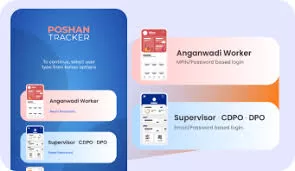
Through the mobile platform, frontline Anganwadi Workers (AWWs) record essential daily metrics, including:
-
Anganwadi Operations: Daily opening of AWCs and child attendance.
-
Nutrition Delivery: Tracking the distribution of Hot Cooked Meals (HCM) and Take-Home Ration (THR).
-
Growth Monitoring: Real-time entry of physical measurements (height, length, and weight) for children aged 0–5 years to identify stunting, wasting, and severe acute malnutrition early.
-
Early Childhood Care and Education (ECCE): Standardized learning sessions and structured home visits.
“Transitioning from retrospective paper records to real-time digital biometric tracking is a monumental shift in public health delivery,” notes Dr. Arisudan Sharma, an independent public health consultant and former community medicine epidemiologist not involved in the government rollout. “Early detection of growth faltering is critical. When an Anganwadi worker logs an infant’s weight and length in real time, the algorithm instantly flags severe acute malnutrition. This allows health systems to intervene before irreversible cognitive or physical stunting sets in.”
To support operational efficiency at the community level, the Central Government provides financial assistance on a cost-sharing model: ₹10,000 plus GST per smartphone for Anganwadi Workers, Lady Supervisors, and Block Coordinators, alongside ₹8,000 for a set of four standardized Growth Monitoring Devices (GMDs)—comprising infantometers, stadiometers, infant weighing scales, and mother-and-child scales.
Fraud Prevention via Biometrics and the New Nominee Module
Under Mission Saksham Anganwadi and Poshan 2.0, services are universal with zero entry barriers. However, to eliminate ghost entries and ensure food security reaches legitimate beneficiaries, service delivery is anchored in biometric verification.
Currently, 99.88% of registered beneficiaries on the Poshan Tracker dashboard are Aadhaar-verified. For last-mile authentication, the MWCD integrated a Facial Recognition System (FRS) into the application for food distribution.
Recognizing that rigid biometric systems can inadvertently exclude vulnerable individuals—such as working mothers, ill beneficiaries, or those residing in remote locations—the Ministry launched the Nominee Module.
                                  +------------------------------+
                                  | Primary Beneficiary Registered|
                                  +--------------+---------------+
                                                 |
                                                 v
                                  +------------------------------+
                                  | Can Primary Visit AWC?       |
                                  +-------+--------------+-------+
                                          |              |
                                 YES      |              | NO
                                          v              v
      +-------------------------------------+          +-------------------------------------+
      | Direct FRS Verification at AWC      |          | Beneficiary Selects Nominee         |
      +-------------------------------------+          +------------------+------------------+
                                                                          |
                                                                          v
                                                       +-------------------------------------+
                                                       | Nominee e-KYC (One-Time Setup)      |
                                                       +------------------+------------------+
                                                       |
                                                       v
                                                       +-------------------------------------+
                                                       | Nominee FRS Scan at Every Pick-Up   |
                                                       +------------------+------------------+
                                                       |
                                                       v
                                                       +-------------------------------------+
                                                       | Take-Home Ration (THR) Delivered     |
                                                       +-------------------------------------+
How the Nominee Module Operates:
-
Nomination: If a registered beneficiary cannot visit the Anganwadi Centre to receive her THR via FRS scan, she designates a trusted nominee.
-
One-Time e-KYC: The chosen nominee undergoes digital e-KYC authentication just once to confirm identity.
-
Flexible Access: The nominee undergoes face-matching at the center each time they collect rations on the beneficiary’s behalf.
-
Preserved Rights: Adding a nominee does not lock out the primary beneficiary; she retains full authority to collect her rations directly whenever possible.
This flexibility balances fraud prevention with human-centered care, ensuring no household loses access to essential supplemental nutrition due to temporary hardship or work obligations.
Integrating Early Childhood Education and Brain Development
In addition to physical growth metrics, the digital platform serves as a hub for Early Childhood Care and Education (ECCE). Grounded in national early education frameworks—specifically Navchetana (National Framework for Early Childhood Stimulation) and Aadharshila (National Curriculum for Early Childhood Care and Education)—the app offers digital learning tools directly to health workers and parents.
The platform currently hosts:
-
249 ECCE Instructional Videos for structured learning activities.
-
190 Audio Messages covering early stimulation and healthcare practices.
-
Over 130 Activity-Based Resources designed for classroom and home engagement.
-
14 Specialized Videos covering 140 Home-Based Activities tailored for infants and toddlers (ages 0–3), guiding frontline workers during home visits to encourage parent-led stimulation.
By standardizing learning content across rural and urban centers, the initiative bridges the early learning gap for socioeconomically disadvantaged children during critical neurological growth windows.
Scientific Evaluation and Implementation Challenges
An independent, outcome-based evaluation study conducted by the Development Monitoring and Evaluation Office (DMEO), NITI Aayog (2025) verified the platform’s multi-dimensional impact. Drawing from institutional assessments and household survey data, the NITI Aayog report highlighted that replacing manual logbooks with the Poshan Tracker significantly improved beneficiary authentication, inventory control, and overall service delivery efficiency across the Supplementary Nutrition Programme (SNP).
Despite these measurable gains, pediatric health advocates and field researchers note important operational nuances that require ongoing attention:
| Pillar | Advantages Realized | Ongoing Challenges & Considerations |
| Nutritional Tracking | Real-time flagging of acute malnutrition (stunting/wasting) using WHO growth standards. | Requires consistent calibration and maintenance of Growth Monitoring Devices in rural sectors. |
| Service Authenticity | FRS biometrics and Aadhaar integration (99.88%) eliminate ghost beneficiaries. | Network latency or server downtime in deep rural areas can delay live authentication. |
| Delivery Accessibility | Nominee Module prevents ration loss when primary caregivers are unavailable. | Digital literacy barriers among elderly or surrogate family nominees require community assistance. |
| Early Childhood Learning | Universal access to 500+ standardized digital videos, audio guides, and learning modules. | Ensures digital materials supplement—rather than replace—hands-on, interactive play and human bonding. |
“Digital tracking tools are only as robust as the human infrastructure behind them,” emphasizes Dr. Sunita Deshmukh, a senior maternal-child healthcare researcher based in Mumbai. “While real-time analytics provide unprecedented visibility at the ministerial level, we must ensure Anganwadi workers receive continuous technical support, fair compensation, and stable connectivity so that administrative data entry does not distract from hands-on clinical care and feeding.”
What This Means for Families and Healthcare Practitioners
For healthcare providers, pediatrician networks, and community health officers, the Poshan Tracker offers a structured data ecosystem. Individual growth records can seamlessly inform primary healthcare interventions, immunizations, and referral pathways for severely malnourished children.
For families and caregivers, the digital transformation offers concrete advantages:
-
Guaranteed Entitlements: Aadhaar and FRS verification ensure that food allocations reach the intended household without diversion.
-
Uninterrupted Access: The Nominee Module ensures that working mothers do not have to choose between a daily wage and collecting their child’s supplementary rations.
-
Empowered Caregiving: Parents gain direct access to early stimulation exercises and practical health advice that support early cognitive and physical development.
As digital health systems scale globally, India’s integrated model under Mission Saksham Anganwadi and Poshan 2.0 demonstrates how real-time technology, combined with flexible access policies, can safeguard public health and early childhood development.
Medical Disclaimer: This article is for informational purposes only and should not be considered medical advice. Always consult with qualified healthcare professionals before making any health-related decisions or changes to your treatment plan. The information presented here is based on current research and expert opinions, which may evolve as new evidence emerges.
References & Sources
-
Government Announcement: Press Information Bureau (PIB), Delhi. Ministry of Women and Child Development. “Poshan Tracker digital application is an important governance tool for real time monitoring and tracking under Mission Saksham Anganwadi and Poshan 2.0.” Issued July 24, 2026.