 0
0
 0
0
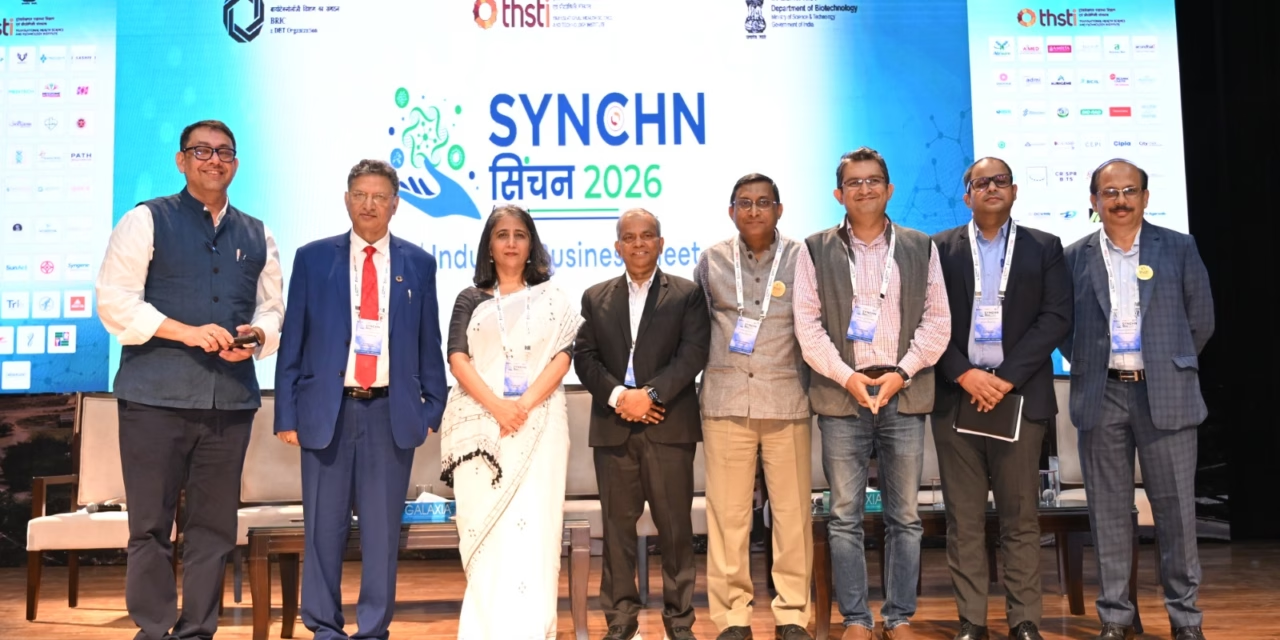
FARIDABAD, INDIA — In a major push to transform laboratory discoveries into manufacturable medical treatments, the Translational Health Science and Technology Institute (THSTI) hosted its third annual industry-business meet, SYNCHN 2026 (Synergistic Collaboration in Healthcare Innovation), on July 15, 2026. Held at the NCR Biotech Science Cluster campus in Faridabad, the summit gathered global healthcare leaders, biotechnology experts, venture capitalists, and policymakers to systematically bridge the coordination gap that frequently stalls experimental medical science before it reaches human patients.
The high-level convergence comes at a pivotal moment for India’s healthcare landscape. While local academic laboratories excel at uncovering basic molecular pathways and drug targets, moving those breakthroughs through complex clinical trials and regulatory frameworks remains a notoriously high-risk bottleneck known globally as the translational “valley of death.”
From Bench to Bedside: Overcoming the Translation Bottleneck
Delivering a virtual address at the summit, Chief Guest Dr. Kiran Mazumdar-Shaw, Executive Chairperson of Biocon, emphasized that the global health sector is entering a new era dominated by biotechnology and artificial intelligence. However, she noted that the true metric of success lies in implementation.
“While India has built world-class scientific institutions, our challenge has never been science but its translation,” Dr. Mazumdar-Shaw observed. “Building an ecosystem that takes innovation seamlessly from discovery to commercialization is precisely why advanced institutes like THSTI and platforms like SYNCHN are so critical. Value is created only when scientific excellence matches translational excellence through cross-boundary trust and collaboration.”
This focus on measurable progress was echoed by Prof. Ganesan Karthikeyan, Executive Director of THSTI and an accomplished clinical cardiologist. Prof. Karthikeyan presented a clear growth trajectory for the annual summit: while the inaugural SYNCHN in 2024 yielded 13 Letters of Intent, the 2025 edition advanced to 19 binding strategic agreements. He reasserted that the institute is shifting its accountability metrics away from mere scientific “outputs” (such as published papers) and moving directly toward tangible “outcomes” (such as commercialized diagnostics, vaccines, and therapeutics).
Expanding Core Infrastructure for Early-Phase Human Trials
To de-risk commercialization for corporate partners and startups, THSTI showcased its highly specialized, operational research infrastructure. Central to this strategy are two primary national initiatives:
-
The Medical Research Centre (MRC): This center features an early-phase clinical trial unit, an advanced cellular therapy unit focusing on chimeric antigen receptor T-cell (CAR-T) research, and India’s first Controlled Human Infection Studies (CHIS) facility. CHIS, often called human challenge studies, allows researchers to safely expose healthy volunteers to weakened pathogens in highly controlled settings to rapidly determine vaccine efficacy.
-
The Accelerated Productisation and Epidemic Preparedness (APEX) Initiative: This initiative acts as a national-scale pilot production platform, engineered to scale up validated research leads into manufacturable biologics under strict quality controls before full commercial manufacturing begins.
+--------------------------------------------------------------------------+
|                      INDIA'S BIOMEDICAL ECOSYSTEM                        |
+--------------------------------------------------------------------------+
|                                                                          |
|  [ Basic Research ] ---> [ Medical Research Centre ] ---> [ Commercial ]|
|   Lab Discoveries             - CAR-T Cell Research        Manufacturing |
|                               - Human Infection (CHIS)                   |
|                                                                          |
|                          [ APEX Scaling Platform ]                       |
|                             Pilot Biologics Production                   |
|                                                                          |
+--------------------------------------------------------------------------+
Regulatory and Financial Reforms Underway
Translating complex therapeutics requires parallel shifts in government regulatory pathways and venture financing. National health administrators at the summit detailed several policy modifications intended to keep pace with rapid scientific advancements.
Dr. Rajeev Singh Raghuvanshi, the Drugs Controller General of India (DCGI) at the Central Drugs Standard Control Organization (CDSCO), announced that the regulatory agency is actively reshaping its oversight framework for biologics. Notably, the new system integrates independent, non-government industry experts directly into policy formulation and operational process flows to reduce administrative lag. Concurrently, Prof. M. Srinivas, representing NITI Aayog, advocated for establishing tighter structural corridors between premier clinical hospitals and core research laboratories to ensure new tools remain affordable and scalable for real-world public health needs.
On the financial front, Dr. Manish Diwan highlighted the rollout of the Biotechnology Industry Research Assistance Council (BIRAC) Research Development and Innovation (RDI) Fund. As a component of the government’s broader ₹1 lakh crore deep-tech initiative, the fund provides patient capital explicitly aimed at stabilizing startups through long-gestation research phases.
This targeted funding lands within an expanding economic framework. According to Amit Pandey of the Indian Venture Capital Association (IVCA), India’s broader bioeconomy is sustaining a 18% year-on-year growth rate, expanding from $165.7 billion in 2024 toward a national target of $300 billion by 2030.
Balancing Innovation with Public Safety and Trial Limitations
While the infrastructure expansions presented at SYNCHN 2026 mark significant operational milestones, independent public health experts urge a balanced perspective regarding implementation timelines.
Dr. Ananya Chatterjee, a public health policy researcher not involved in the THSTI summit, noted that specialized methodologies like Controlled Human Infection Studies (CHIS) must navigate rigorous ethical boundaries. “Human challenge models are incredibly powerful for accelerating vaccine design, but they require uncompromising safety monitoring and international ethical alignment to maintain public trust,” Dr. Chatterjee stated.
Furthermore, clinical trial experts emphasize that early-phase platforms, while useful for bridging early discovery gaps, do not automatically guarantee late-stage clinical success. Historically, more than 80% of novel therapeutic candidates that show promise in laboratory models or early first-in-human trials fail during subsequent Phase II or Phase III multi-center trials due to unpredictable efficacy challenges or long-term safety profiles across diverse patient populations.
Real-World Impact on Public Health
For health-conscious consumers and patients, the structural collaborations formalized at SYNCHN 2026 are expected to have practical long-term implications. By integrating clinical research platforms, regulatory reforms, and targeted venture funding, the ecosystem aims to shorten the traditional decade-long timeline required to bring novel treatments to market. For individuals managing complex conditions, this translates into faster local access to affordable, next-generation therapies—such as targeted localized cancer immunotherapies and rapid-response vaccine platforms—engineered and manufactured entirely within the country.
The summit concluded with interactive forums matching commercial sector representatives directly with academic scientists, alongside guided tours of the NCR Biotech Science Cluster’s core infrastructure platforms, setting the operational agenda for the coming fiscal year.
References
Institutional & Event Sources
-
Event: SYNCHN 2026 (Third Annual Industry Business Meet: Synergistic Collaboration in Healthcare Innovation), hosted July 15, 2026, at the NCR Biotech Science Cluster, Faridabad. Press announcement tracking via Press Information Bureau (PIB) Delhi.
Medical Disclaimer: This article is for informational purposes only and should not be considered medical advice. Always consult with qualified healthcare professionals before making any health-related decisions or changes to your treatment plan. The information presented here is based on current research and expert opinions, which may evolve as new evidence emerges.