 0
0
 0
0
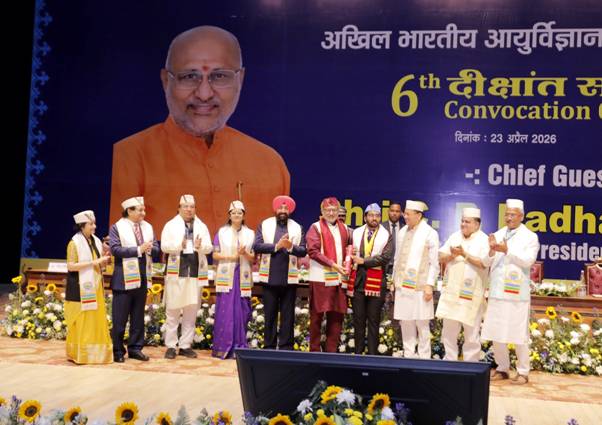
RISHIKESH, UTTARAKHAND — In a ceremony that blended traditional academic solemnity with a forward-looking vision for global health leadership, Vice-President Shri C.P. Radhakrishnan addressed the 6th Convocation of the All India Institute of Medical Sciences (AIIMS) Rishikesh today. Speaking to a new generation of medical graduates, the Vice-President characterized healthcare as a “public trust,” urging the outgoing cohort to balance cutting-edge technology with deep-seated empathy. The event highlighted India’s evolving role in the global health landscape, from its resilient COVID-19 response to the integration of drone technology in rural medicine.
The convocation was attended by high-ranking officials, including Union Minister of State for Health and Family Welfare, Smt. Anupriya Patel, Uttarakhand Chief Minister Shri Pushkar Singh Dhami, and Governor Lt. Gen. Gurmit Singh (Retd.). Beyond the conferring of degrees, the ceremony served as a policy pulpit to outline the “Viksit Bharat” (Developed India) 2047 roadmap, emphasizing medical ethics, digital health accessibility, and the “One Health” approach.
From Pandemic Resilience to Global Solidarity
A central theme of the Vice-President’s address was India’s performance during the COVID-19 pandemic. He cited the implementation of the world’s largest free vaccination drive—covering over 140 crore citizens—as a testament to the country’s commitment to health equity.
“India’s response was not just a domestic success but a global service,” Radhakrishnan stated, referring to the Vaccine Maitri initiative. Under this program, India supplied vaccines to more than 100 countries, a move the Vice-President described as being rooted in the philosophy of Vasudhaiva Kutumbakam (The World is One Family).
According to Ministry of Health data, the vaccination drive administered over 220 crore doses, including boosters. For healthcare professionals, this period remains a benchmark for rapid infrastructure scaling and public health mobilization.
Innovation in Difficult Terrains: Drones and Helicopters
AIIMS Rishikesh was specifically commended for overcoming the “geographical tax” associated with the Himalayan region. The Institute has pioneered several logistical innovations to ensure that being remote does not mean being without care:
-
Drone Delivery: Use of unmanned aerial vehicles (UAVs) to deliver essential medicines during the Char Dham Yatra.
-
Heli-Ambulance Services: Dedicated emergency helicopter responses for trauma patients in inaccessible hilly areas.
-
Telemedicine Expansion: Digital consultation suites that connect rural clinics with specialists at the Rishikesh hub.
Smt. Anupriya Patel noted that these innovations are part of a larger fiscal shift. Public health expenditure has now surpassed ₹1.06 lakh crore, contributing to a significant drop in “out-of-pocket” (OOPE) expenditure for citizens—falling from 62.5% to 39.4%. For the average patient, this represents a shift toward financial protection against catastrophic health events.
The Four Pillars for the Modern Physician
Union Minister Anupriya Patel outlined four mandatory principles for the graduating class, which experts say are critical in an era of increasing automation and physician burnout:
-
Integrity and Service: Upholding the “highest form of service” to maintain patient trust.
-
Lifelong Learning: Adapting to the rapid evolution of genomic medicine and AI-driven diagnostics.
-
Effective Communication: Recognizing that patient outcomes are often tied to how well a doctor listens and explains.
-
Social Responsibility: Giving back to the communities that supported their intensive education.
“Medical science evolves daily,” Patel noted. “Without continuous upskilling, even the best education becomes obsolete in a decade.”
Integrative Medicine and ‘One Health’
The convocation also highlighted the “Integrative Medicine” model at AIIMS Rishikesh. This approach seeks to combine evidence-based traditional systems (such as Ayurveda and Yoga) with modern allopathic medicine.
Furthermore, the “One Health” approach was underscored as the future of pandemic prevention. This framework recognizes that the health of people is closely connected to the health of animals and our shared environment. By monitoring zoonotic diseases (diseases that jump from animals to humans) at the source, the government aims to create a more resilient surveillance system.
Public Health Implications: What This Means for You
For the general public, the directives shared at the AIIMS convocation signal three major shifts in the Indian healthcare experience:
-
Regional Self-Sufficiency: The expansion of AIIMS institutions means patients in states like Uttarakhand no longer need to travel to Delhi for tertiary care or complex surgeries.
-
Technological Integration: Patients can expect more “phygital” (physical + digital) interactions, where routine follow-ups occur via telemedicine, saving travel time and costs.
-
Focus on Preventive Ethics: There is a renewed push for doctors to act as “health educators” rather than just “disease treaters,” emphasizing lifestyle interventions alongside clinical prescriptions.
Limitations and Challenges
While the expansion of infrastructure is notable, independent health analysts often point to the “human resource gap.” Building an AIIMS facility is a capital-intensive task, but staffing it with world-class faculty and maintaining the high patient-to-doctor ratio remains a challenge. Additionally, while OOPE has decreased, critics argue that the cost of private-sector drugs and diagnostics continues to burden many middle-income families who fall outside the net of free government schemes.
As the Vice-President released the annual chronicle, RUDRAKSHA, he reminded the graduates that their degrees are not just certificates of knowledge, but “contracts with humanity.”
Medical Disclaimer
Medical Disclaimer: This article is for informational purposes only and should not be considered medical advice. Always consult with qualified healthcare professionals before making any health-related decisions or changes to your treatment plan. The information presented here is based on current research and expert opinions, which may evolve as new evidence emerges.
References and Sources
Official Reports & Data:
-
Press Information Bureau (PIB) Delhi: “Vice-President Shri C.P. Radhakrishnan Addresses 6th Convocation of AIIMS Rishikesh,” Posted 23 APR 2026.