 0
0
 0
0
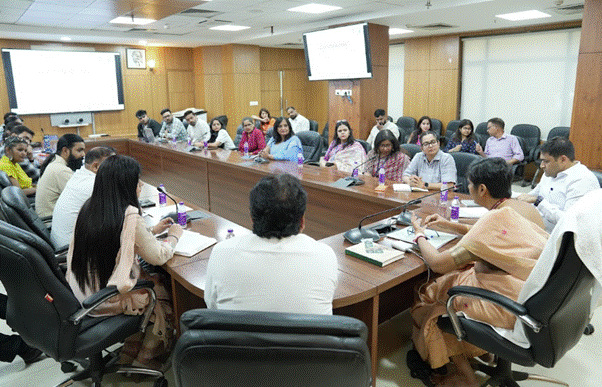
NEW DELHI — In an era marked by an unprecedented global demographic shift toward an aging population, the Ministry of Ayush took a decisive step forward on Monday. The Ministry convened a high-profile RJ and Influencer Meet at Ayush Bhawan, forging a strategic alliance with leading radio personalities, digital content creators, and media professionals. The collaborative initiative aims to catalyze public participation ahead of the International Day of Yoga (IDY) 2026 on June 21, rallying the nation around a critical public health mandate: “Yoga for Healthy Ageing.”
Addressing the gathering, Ms. Alarmelmangai D, Joint Secretary of the Ministry of Ayush, contextualized the initiative within a global framework. Since its inception in 2015, IDY has expanded into one of the world’s most expansive public health movements, observed across more than 180 countries. This year’s specialized focus on healthy aging underscores a mounting public health necessity: providing accessible, evidence-based, and holistic lifestyle interventions to preserve physical autonomy, cognitive clarity, and emotional resilience in later life.
The Clinical Subtext: Moving Past Anecdote to Evidence
For decades, yoga was widely perceived by the public as a general wellness or stress-reduction practice. However, the Ministry’s current push to anchor yoga in preventive healthcare coincides with a profound evolution in geriatric research. Western clinical frameworks are increasingly validating what Eastern traditions have long asserted.
According to a rigorous, multi-centric randomized controlled trial published in Frontiers in Public Health—the “Yoga for the Healthy Ageing Phenotype” (yHAP) study—a 26-week yoga-based intervention in sedentary older adults aged 60 to 80 demonstrated measurable, holistic improvements across critical biomarkers of aging. The trial reported significant drops in glycated hemoglobin ($HbA1c$) and systolic blood pressure, alongside a 65% reduction in the clinical risk classification for physical frailty. Remarkably, the study also tracked an upward regulation of Klotho, a well-documented longevity protein known to protect against cognitive decline and vascular inflammation.
Furthermore, a comprehensive meta-analysis of 33 randomized controlled trials involving over 2,300 participants over the age of 65, published in the Annals of Internal Medicine, established that regular yoga practice directly improves gait speed and the ability to rise from a chair. In geriatric medicine, these two metrics are considered primary predictors of physical independence and overall longevity.
Expanding the Preventive Toolkit: Yoga 365 and Targeted Protocols
To transition yoga from a symbolic single-day celebration into a sustainable, daily medical countermeasure, the Ministry of Ayush highlighted its year-round Yoga 365 initiative. The program focuses on embedding standard yoga practices into community frameworks, public institutions, and domestic routines.
As part of this preventive healthcare integration, the Ministry has introduced highly structured, clinical-grade resources, including:
-
Ten Specialized Disease Protocols: Tailored regimens optimized for managing highly prevalent non-communicable diseases (NCDs), such as type 2 diabetes, osteoarthritis, and hypertension.
-
Yoga for Air Travel Protocol: A specific, low-impact sequence designed to mitigate deep vein thrombosis (DVT), joint stiffness, and circulatory stasis during long-duration travel.
-
Demographic-Specific Modules: Variable, prop-supported, and low-velocity modules specifically mapped to the baseline physical limitations often seen in advanced age.
Expert Perspectives: Why Mindful Movement Alters the Aging Trajectory
Independent medical professionals emphasize that yoga’s multi-system impact makes it uniquely suited for geriatric care compared to conventional, single-modality exercises.
“Aging is fundamentally a multi-component process of decline across musculoskeletal, neurological, and cardiovascular lines,” explains Dr. Ananya Mukherjee, a geriatric care specialist not involved in the Ministry’s campaign. “While standard aerobic exercise benefits cardiorespiratory fitness, yoga incorporates an active attentional and neurocognitive component. The deliberate pairing of controlled breathwork (pranayama) with precise physical alignment (asanas) down-regulates the hypothalamic-pituitary-adrenal axis. This reduces systemic cortisol and inter-leukin-6 markers, effectively blunting the chronic, low-grade systemic inflammation that drives cellular aging.”
Neurological research corroborates this mind-body connection. Systematic reviews in the Journal of Cognitive Enhancement show that mindful movement practices yield a moderate effect size ($g = 0.33$) in enhancing executive function, processing speed, and sustained attention in older populations. By challenging balance and spatial awareness under a state of focused mindfulness, yoga stimulates neuroplasticity and neural pathways that static stretching cannot replicate.
Public Health Implications: A Strategy for Healthy Longevity
The public health data surrounding global aging presents a stark socioeconomic reality. The World Health Organization (WHO) notes that by 2030, one in six people worldwide will be aged 60 or over. In developing healthcare infrastructures, an expanding elderly demographic with poorly managed chronic conditions represents a massive, compounding economic burden.
By utilizing digital influencers and community radio networks, the Ministry is attempting to decentralize preventive medicine. RJs and content creators possess the unique ability to translate complex epidemiological imperatives into relatable, culturally resonant messaging. Cultivating a grassroots adoption of yoga serves to directly mitigate fall risks—the leading cause of accidental injury among adults aged 65 and older—thereby reducing emergency hospital admissions and maximizing what epidemiologists call the “healthspan” (the period of life spent free from chronic disease and disability).
Critical Caveats: Safety Boundaries and Methodological Limits
Despite the compelling clinical data, sports medicine experts and gerontologists urge caution, noting that yoga is not a universal panacea and carries inherent risks if misapplied.
The Annals of Internal Medicine meta-analysis carefully observed that while standing styles of yoga significantly improved lower-body strength and gait, chair-based protocols showed limited efficacy in improving dynamic balance. Conversely, advanced or unassisted standing poses pose an acute fall risk for individuals with severe vestibular dysfunction or advanced osteoporosis.
Medical professionals advise adopting a highly individualized framework when integrating yoga into an older adult’s routine:
| Parameter | Recommended Approach | Clinical Rationale |
| Initial Screening | Pre-exercise clearance by a primary care physician. | To evaluate for occult cardiovascular risks, severe joint degradation, or spinal instability. |
| Style Selection | Iyengar or Hatha styles utilizing props (blocks, straps, chairs). | Minimizes rotational strain on vulnerable joints; prevents hyper-extension of the lumbar spine. |
| Instruction Quality | Certified instructors with specialized training in geriatrics. | Avoids high-velocity or high-pressure transitions that can cause rapid blood pressure shifts (orthostatic hypotension). |
Furthermore, researchers concede that much of the existing historical literature on yoga features small sample sizes or lacks rigorous, long-term follow-up data. Additional long-term, double-blind trials are required to determine exactly how well yoga-induced benefits hold up over multiple years compared to standard physical therapy.
The Path Forward to June 21 and Beyond
The interactive session at Ayush Bhawan concluded with a unified commitment from digital and traditional media voices to dismantle old stereotypes of yoga as a discipline reserved exclusively for the young, hyper-flexible, or structurally fit.
By weaponizing modern communication channels with clear, scientifically backed guidance, the campaign aims to re-engineer aging as an active, dignified, and empowered phase of life. As June 21 approaches, the national conversation is shifting from merely extending the lifespan to actively elevating the quality of those years—one mindful breath at a time.
Reference Section
- https://www.pib.gov.in/PressReleasePage.aspx?PRID=2270457®=48&lang=1
Medical Disclaimer: This article is for informational purposes only and should not be considered medical advice. Always consult with qualified healthcare professionals before making any health-related decisions or changes to your treatment plan. The information presented here is based on current research and expert opinions, which may evolve as new evidence emerges.