 0
0
 0
0
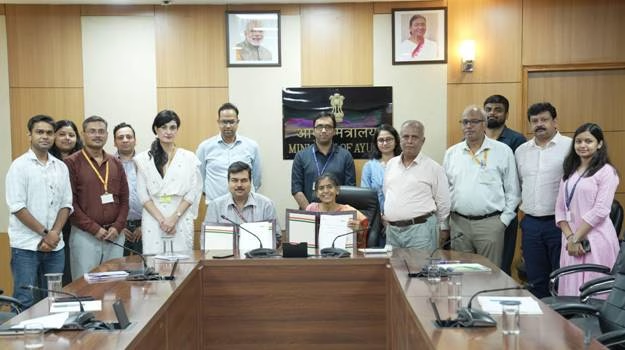
NEW DELHI — In a landmark partnership aimed at blending centuries-old medical heritage with state-of-the-art computational science, India’s Ministry of Ayush and the IndiaAI Mission under the Ministry of Electronics and Information Technology (MeitY) signed a Memorandum of Understanding (MoU) on July 31, 2026. The strategic agreement establishes a comprehensive national framework to accelerate artificial intelligence (AI)-driven innovation, rigorous clinical research, and data-driven infrastructure across India’s traditional systems of medicine.
The agreement—signed by Dr. Kavita Jain, Joint Secretary and Chief Vigilance Officer at the Ministry of Ayush, and Shri Sudeep Srivastava, Chief Operating Officer of the IndiaAI Mission and Joint Secretary at MeitY—signals a transformative policy shift toward evidence-based standardization for traditional healthcare. By integrating advanced algorithms with traditional systems—including Ayurveda, Yoga and Naturopathy, Unani, Siddha, and Homoeopathy (Ayush)—the initiative seeks to enhance drug discovery, optimize botanical supply chains, and modernize clinical decision-making.
Unlocking Traditional Datasets via AIKosh and High-Performance Computing
A cornerstone of the newly established partnership is the onboarding of the Ministry of Ayush onto AIKosh, India’s national sovereign AI repository. Under this arrangement, the Ministry of Ayush will contribute eligible, anonymized health research artifacts—including vast observational datasets, clinical trial metadata, machine learning toolkits, and validated medical use cases.
Historically, traditional medicine research has faced challenges due to fragmented clinical documentation and non-standardized terminology. By centralizing verified datasets within AIKosh, researchers, bioinformaticians, academic institutions, and healthtech startups gain secure, regulated access to data needed to build specialized large language models (LLMs) and diagnostic tools tailored to traditional healthcare.
┌─────────────────────────────────────────────────────────────────────────┐
│                     INDIA'S AI-AYUSH INTEGRATION ROADMAP                │
├──────────────────────────────┬──────────────────────────────────────────┤
│ Core Pillar                  │ Operational Focus                        │
├──────────────────────────────┼──────────────────────────────────────────┤
│ AIKosh Integration           │ Sharing anonymized clinical datasets,    │
│                              │ research metadata, and predictive models │
├──────────────────────────────┼──────────────────────────────────────────┤
│ Subsidized Compute (GPUs)    │ Affordable access to high-performance    │
│                              │ supercomputing for AI model training     │
├──────────────────────────────┼──────────────────────────────────────────┤
│ Ayush Grid Acceleration      │ Digital health digitization, EHRs, and   │
│                              │ national health registry integration     │
├──────────────────────────────┼──────────────────────────────────────────┤
│ Botanical & Drug Security    │ AI-monitored medicinal plant mapping,    │
│                              │ supply chain tracking, and quality control│
└──────────────────────────────┴──────────────────────────────────────────┘
To address the computational bottlenecks that often hinder deep-learning initiatives in healthcare, the MoU grants researchers in the Ayush ecosystem subsidized access to high-performance computing (HPC) infrastructure and graphics processing unit (GPU) clusters through the IndiaAI Compute platform. This computing power is expected to significantly accelerate complex simulations, such as screening phytoconstituents against biological targets and predicting botanical compound interactions.
Leadership Perspectives: Evidence-Based Science Meets Heritage
Speaking at the signing ceremony in New Delhi, institutional leaders emphasized that the collaboration focuses on scientific rigor rather than replacing traditional clinical intuition.
“The integration of Artificial Intelligence with Ayush will open new avenues for evidence-based research, knowledge management, and innovation,” stated Dr. Kavita Jain, Joint Secretary at the Ministry of Ayush. “This collaboration with IndiaAI will help leverage advanced capabilities across research, medicinal plant mapping, drug administration, and capacity building, making the Ayush ecosystem technology-driven and future-ready.”
Highlighting the digital architecture, Shri Sudeep Srivastava, COO of the IndiaAI Mission, noted that enriching AIKosh with traditional medical knowledge bridges two distinct disciplines.
“This agreement is a crucial step toward enriching AIKosh with traditional healthcare datasets,” Srivastava said. “Fusing modern technology with traditional knowledge systems empowers researchers and clinicians to develop sovereign, scalable solutions that address modern public health challenges.”
Shri Naman Goyal, Officer on Special Duty (OSD) for Ayush Grid, underscored the role of digital health architecture. He explained that Ayush Grid’s Emerging Technologies division is actively deploying AI modules across national health portals, making this partnership a foundational milestone in digital health transformation.
Strategic Context: The Ayush Grid and Global Digital Health
This initiative builds upon the foundational work of the Ayush Grid, established in 2018 as the IT backbone for India’s traditional medicine sector. Operating in alignment with the Ayushman Bharat Digital Mission (ABDM), the Ayush Grid has digitized millions of health records using tools like the Ayush Hospital Information Management System (AHMIS) and standardized international terminology portals like the NAMASTE portal.
               ┌────────────────────────────────────────┐
               │    Ayushman Bharat Digital Mission     │
               └───────────────────┬────────────────────┘
                                   │
               ┌───────────────────▼────────────────────┐
               │              Ayush Grid                │
               │   (AHMIS, NAMASTE Portal, AI Modules)   │
               └───────────────────┬────────────────────┘
                                   │
      ┌────────────────────────────┴────────────────────────────┐
      ▼                                                         ▼
┌─────────────────────────────┐           ┌─────────────────────────────┐
│       IndiaAI / AIKosh      │           │ High-Performance GPU Access │
│  Anonymized Data Repository │           │ Deep Learning & Simulations │
└─────────────────────────────┘           └─────────────────────────────┘
Internationally, the World Health Organization (WHO) and the International Telecommunication Union (ITU) have emphasized the need for standardized AI benchmarking in complementary medicine through the Topic Group on Traditional Medicine under the WHO-ITU Focus Group on AI for Health (FG-AI4H). India’s proactive integration of AI aligns with global guidelines aimed at evaluating AI diagnostic tools, preserving traditional knowledge, and establishing strict ethical governance.
Public Health Implications for Patients and Clinicians
For everyday health-conscious consumers and integrative medicine practitioners, the integration of AI into Ayush carries several practical implications:
-
Precision Herbal Medicine: AI algorithms can analyze complex multi-herb formulations alongside genomic or metabolic data, supporting more tailored therapeutic approaches.
-
Enhanced Safety and Pharmacovigilance: Machine learning models can analyze real-world clinical data to identify potential herb-drug interactions, adverse reactions, or contraindications when traditional therapies are combined with conventional pharmaceuticals.
-
Supply Chain Transparency and Quality Assurance: Computer vision and spectral analysis tools can help verify the authenticity of raw medicinal plants, combatting adulteration and preserving endangered species.
-
Accelerated Early Diagnostics: Pattern-recognition models trained on traditional diagnostic metrics—such as pulse diagnosis (Nadi Pariksha) or constitutional profiling (Prakriti)—can help clinicians detect risk factors early.
Challenges, Ethical Considerations, and Limitations
While the convergence of AI and traditional medicine offers significant potential, medical experts and bioethicists urge measured optimism. Traditional medical systems rely on holistic, individualized diagnostic models that do not always align neatly with binary or linear digital structures.
Key challenges that researchers and policymakers must navigate include:
-
Data Quality and Algorithmic Bias: Machine learning models are only as accurate as the data used to train them. Historical traditional medicine texts and clinical records must be systematically digitized, translated, and validated to avoid biased output.
-
Preservation of Context: Traditional systems evaluate health through holistic balance rather than isolated disease markers. AI tools must be designed to reflect these holistic principles rather than reducing complex formulations to single active molecules.
-
Data Privacy and Consent: Patient information contributed to the AIKosh platform must undergo rigorous anonymization to comply with national health data privacy regulations and protect patient confidentiality.
-
Requirement for Rigorous Clinical Validation: AI-assisted predictions, whether for drug discovery or treatment protocols, cannot replace prospective, randomized controlled clinical trials or established regulatory clearance processes.
The Path Ahead
The partnership between the Ministry of Ayush and IndiaAI represents a structural step toward modernizing traditional healthcare through digital technology. By providing secure data repositories, computational resources, and collaborative framework, the initiative creates a path for evidence-based traditional medicine.
As pilot programs roll out across research institutions and digital platforms under the Ayush Grid, the broader health community will watch closely to evaluate how effectively these AI models perform in clinical settings, maintain patient safety, and advance global health research.
References
-
Press Information Bureau (PIB), Government of India. “Ministry of Ayush and IndiaAI Join Hands to Harness Artificial Intelligence for the Future of Traditional Medicine.” Ministry of Ayush, Released July 31, 2026. PIB Delhi Release ID: 2292169.
Medical Disclaimer: This article is for informational purposes only and should not be considered medical advice. Always consult with qualified healthcare professionals before making any health-related decisions or changes to your treatment plan. The information presented here is based on current research and expert opinions, which may evolve as new evidence emerges.