 0
0
 0
0
CHANDIGARH, India — In a move that could reshape global primary healthcare, member nations of the BRICS bloc have formally agreed to create a dedicated institutional vertical and Expert Working Group to standardize, validate, and integrate Traditional, Complementary, and Integrative Medicine (TCIM) into national health systems.
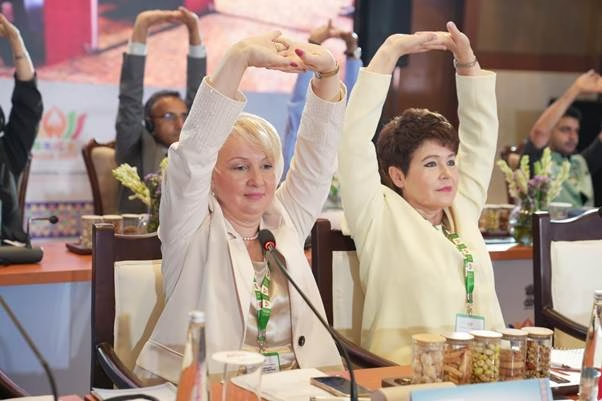
The landmark agreement was finalized during the BRICS TCIM Meeting hosted in Chandigarh under India’s 2026 BRICS Chairship, held under the umbrella theme “Building for Resilience, Innovation, Cooperation & Sustainability”.
Senior health officials and technical delegates from all nine core member states—Brazil, China, Egypt, Ethiopia, India, Iran, Russia, South Africa, and the United Arab Emirates—unanimously adopted the Terms of Reference (ToR) for the newly minting BRICS Expert Working Group on TCIM. The initiative establishes a permanent multilateral mechanism inside the BRICS Health Track, marking a transition for traditional medicine from isolated regional practices toward a unified, evidence-based global paradigm.
Bridging Ancient Wisdom and Rigorous Science
According to the World Health Organization (WHO), an estimated 88% of member states report using traditional and complementary medicine, ranging from Acupuncture and Ayurveda to Herbalism and Traditional Chinese Medicine (TCM). Despite its widespread utilization—particularly in low- and middle-income countries—the sector has historically faced significant hurdles, including inconsistent regulatory standards, variable product quality, and limited clinical trial data.
The newly formed BRICS Expert Working Group aims to directly address these historical shortcomings. The finalized Terms of Reference establish concrete mechanisms for:
-
Joint Scientific Validation: Conducting cross-country multi-center clinical trials to evaluate the efficacy and safety profiles of herbal formulations and non-pharmacological therapies.
-
Regulatory Harmonization: Streamlining quality-control standards, pharmacovigilance (post-market safety tracking), and cross-border safety approvals for traditional medicinal products.
-
Academic & Workforce Standardization: Establishing unified educational curricula, scholarship frameworks, and faculty exchange initiatives to ensure practitioner competence.
-
Digital Knowledge & Patent Protection: Creating shared digital databases to catalog indigenous medical knowledge, preserving intellectual property while enabling modern research discovery.
“The BRICS initiative regarding traditional medicine began as a side event, but today experts gathered to formalize something far greater,” said Vaidya Rajesh Kotecha, Secretary of India’s Ministry of Ayush, during the opening proceedings. “India proposed the formation of an expert working group dedicated to TCIM—a proposal agreed upon by consensus. Establishing this institutional vertical within the BRICS framework creates a structured pathway to generate scientific evidence and scale holistic healthcare globally.”
A Shared Challenge: Integrating Complementary Care into Universal Health
For many BRICS nations, integrating traditional modalities into public health infrastructures is not just a cultural endeavor—it is a pragmatic necessity for universal health coverage (UHC).
Speaking at the summit, Iranian delegate Dr. Arman Zargaran highlighted the strategic value of the platform: “BRICS provides a strong platform for global collaboration. Many member states, including India, China, and Iran, possess extraordinarily rich, centuries-old traditional medical systems that are already deeply integrated into our healthcare infrastructures. Coordinating our scientific and regulatory efforts allows us to strengthen global public health.”
                       ┌─────────────────────────────────────────┐
                       │     BRICS TCIM Collaborative Framework  │
                       └────────────────────┬────────────────────┘
                                            │
         ┌──────────────────────────────────┼──────────────────────────────────┐
         ▼                                  ▼                                  ▼
┌─────────────────┐                ┌─────────────────┐                ┌─────────────────┐
│  Evidence &     │                │   Regulatory    │                │  Human Resource │
│  Research       │                │  Harmonization  │                │  Development    │
├─────────────────┤                ├─────────────────┤                ├─────────────────┤
│ • Clinical      │                │ • Quality       │                │ • Standardized  │
│   Validation    │                │   Standards     │                │   Curricula     │
│ • Digital Data  │                │ • Safety &      │                │ • Academic      │
│   Sharing       │                │   Pharmacovig.  │                │   Exchanges     │
└─────────────────┘                └─────────────────┘                └─────────────────┘
However, integration presents unique systemic challenges for countries managing vast, diverse populations. Brazilian delegate Arthur Fernandes da Silva noted that introducing complementary practices into universal care models requires rigorous coordination at the primary care level.
“In Brazil, our universal healthcare system (SUS) covers over 200 million people,” Fernandes da Silva explained. “Our key challenge is establishing primary healthcare as the central coordinator of patient care while safely integrating complementary and integrative therapies. Learning from the structural experiences of partner nations like India, Russia, and South Africa is invaluable.”
Independent Clinical Perspective: Potential and Pitfalls
Independent public health experts have largely welcomed the multilateral agreement, noting that standardized research protocols could protect consumers from unregulated or ineffective treatments.
“Historically, traditional medicine has suffered from a polar narrative—either uncritical acceptance or total skepticism from modern biomedicine,” says Dr. Elena Rostova, a clinical epidemiologist and health policy analyst not affiliated with the BRICS summit. “When BRICS nations pool resources to conduct rigorous, randomized controlled trials and set unified safety parameters, it shifts the focus back to science. It allows clinicians to separate evidence-backed interventions—such as acupuncture for chronic pain management or specific herbal preparations for metabolic support—from unproven claims.”
However, medical researchers also urge caution regarding implementation limits.
Key Clinical Takeaway: Integrative medicine is designed to complement, not replace, proven modern medical treatments. Experts emphasize that traditional therapies should be evaluated using the same epidemiological rigor applied to modern pharmaceuticals—focusing on active ingredient standardization, herb-drug interactions, and clear toxicity parameters.
Practical Takeaways for Patients and Healthcare Providers
For the general public and practicing clinicians, the formalization of the BRICS Expert Working Group signals a gradual transformation in how integrative care will be delivered and evaluated globally:
-
Enhanced Safety and Product Quality: As member states harmonize manufacturing and safety regulations, consumers can expect higher quality-control standards for commercial herbal supplements and natural products.
-
Clearer Communication with Physicians: Standardized evidence frameworks make it easier for primary care physicians to discuss complementary therapies with patients, reducing the risk of adverse herb-drug interactions.
-
Focus on Preventive Health: The framework emphasizes non-pharmacological wellness interventions—such as Yoga, dietary modifications (e.g., Ayush Aahar), and stress-reduction protocols—to address non-communicable diseases (NCDs) like hypertension and type 2 diabetes.
Looking Ahead: A Parallel Agenda for Global Health
The Chandigarh meeting serves as a key precursor to the Sixteenth BRICS Health Ministers’ Meeting. Recommendations established by the new TCIM Working Group will feed directly into broader global health strategies, complementing ongoing initiatives in digital health architecture, pandemic preparedness, and tuberculosis control.
By creating a structured framework rooted in scientific inquiry and regulatory oversight, the BRICS coalition aims to ensure that ancient medical wisdom can meet modern clinical standards—offering patients worldwide healthcare choices that are safe, effective, and accessible.
Reference Section
Primary News Source & Event Documentation
-
Press Information Bureau (PIB) Delhi, Government of India. “BRICS Nations Join Hands to strengthen TCIM, Expert Working Group Taking Shape.” Published July 21, 2026.
Medical Disclaimer: This article is for informational purposes only and should not be considered medical advice. Always consult with qualified healthcare professionals before making any health-related decisions or changes to your treatment plan. The information presented here is based on current research and expert opinions, which may evolve as new evidence emerges.