 0
0
 0
0
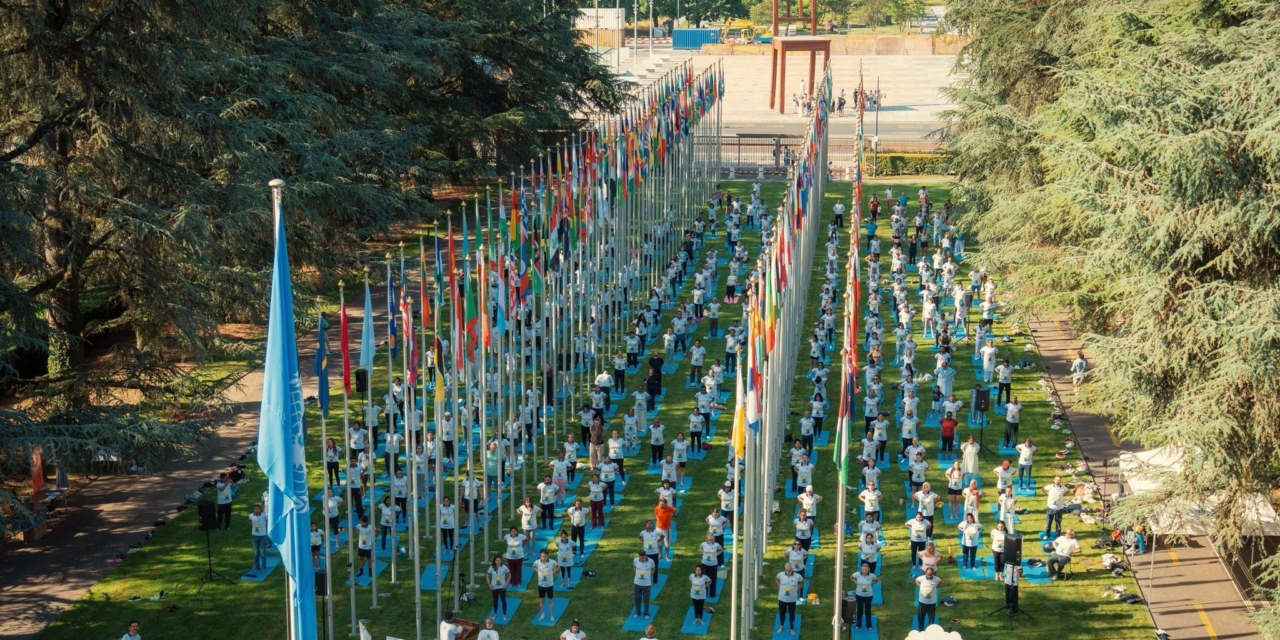
GENEVA — Marking the 12th International Day of Yoga, the World Health Organization (WHO) has formally integrated the ancient practice into its global public health strategy for older populations. In a statement released on June 21, 2026, the global health agency focused on “healthy ageing,” underscoring yoga’s potential to support balance, flexibility, strength, mobility, and mental well-being. According to the WHO, the initiative reflects a critical shift in public health priorities: prioritizing not just life expectancy, but health expectancy—adding high-quality, functional years to life rather than merely increasing longevity.
While the announcement has been welcomed by wellness advocates, the scientific consensus remains nuanced. Clinical data suggests that while yoga offers distinct benefits for physical mobility and psychological mood, it should be treated as a supportive wellness practice rather than a standalone medical intervention or a proven cure for age-related cognitive decline.
Balancing the Body and Mind in Later Life
The WHO framework positions yoga as a highly adaptable, multi-component intervention combining low-impact physical movement, controlled breathing, and mindfulness techniques. In an aging world, these elements are increasingly viewed as tools to help older adults preserve functional independence, personal autonomy, and dignity.
“As people live longer, our goal is not just more years, but better years,” said Dr. Tedros Adhanom Ghebreyesus, WHO Director-General. “Yoga supports this through gentle movement, breathing, and mindfulness.”
The clinical relevance of these components is underscored by their direct application to daily living. For older individuals, clinical improvements in stability and flexibility translate directly to a lower burden of daily stress, greater confidence in movement, and a reduced fear of falling. These adjustments facilitate essential everyday tasks, such as walking steadily on uneven surfaces, rising safely from a chair, and maintaining the physical capacity required for community and social engagement.
Examining the Clinical Evidence Base
To evaluate these public health assertions, researchers have increasingly subjected yoga to systematic reviews and meta-analyses. The accumulated data demonstrates clear clinical efficacy for physical outcomes, alongside more conservative findings regarding psychological and cognitive impacts.
A comprehensive systematic review and meta-analysis published in the International Journal of Older People Nursing evaluated the effects of yoga among community-dwelling older adults. The data demonstrated statistically significant improvements in:
-
Postural Balance: Enhanced stability during stationary and transitional movement.
-
Flexibility: Increased range of motion across major joint groups.
-
Muscle Strength: Measurable gains in upper and lower body skeletal muscle force.
-
Depressive Symptoms: Notable reductions in self-reported depressive scores.
However, the authors noted substantial heterogeneity among the analyzed trials, meaning the variations in yoga styles, duration, and study designs limit the ability to draw uniform conclusions.
       [ YOGA-BASED INTERVENTION ]
          /         |         \
         /          |          \
   [PHYSICAL]  [PSYCHOLOGICAL] [COGNITIVE]
    Strong       Moderate-Weak   Promising
   Evidence        Evidence      Evidence
   (Balance,       (Stress,      (Memory,
  Flexibility)       Gait)      Attention)
The evidence regarding cognitive preservation is similarly qualified. While several recent systematic reviews in Frontiers in Aging Neuroscience investigating yoga-based interventions have documented positive trends in executive function, short-term memory retention, and focused attention, researchers stress that these findings are preliminary. The existing literature is frequently constrained by modest sample sizes, structural variations in study methodologies, and a lack of long-term follow-up data. Consequently, medical authorities emphasize that yoga should be presented as a lifestyle element within a broader healthy aging strategy, not as a primary clinical treatment for dementia or progressive cognitive disorders.
Public Health Scalability and Economic Viability
From a macroeconomic public health perspective, the WHO has aligned the promotion of yoga with the United Nations Decade of Healthy Ageing. Demographic projections indicate a rapid expansion of aging populations globally, creating an acute demand for low-cost, scalable interventions that mitigate the financial strain on healthcare infrastructure.
Yoga represents a highly practical candidate for public health deployment because it requires no specialized or expensive equipment. It can be easily adapted to diverse environments, including independent home practice, organized community centers, and structured clinical rehabilitation programs.
Independent medical experts emphasize the preventive utility of this accessibility. “Regular yoga can help older adults improve mobility, balance, confidence, and mental health, while remaining simple, low-cost, and accessible,” noted Dr. Arunansu Talukdar, Professor and Head of the Department of Geriatric Medicine at Medical College and Hospital, Kolkata. Dr. Talukdar, who was not involved in the drafting of the WHO statement, added that the primary medical value of yoga is realized when it is integrated safely and consistently over an extended period, rather than used as a reactionary measure.
Methodological Limitations and Safety Cautions
Despite its widespread acceptance, the clinical literature on yoga features several notable limitations. Methodological discrepancies across trials—such as comparing active, physically demanding styles like Vinyasa with restorative, sedentary styles—make comprehensive cross-study comparisons difficult. Furthermore, while physical benefits like balance and flexibility are well-documented, clinical evidence tracking its impact on specific gait parameters and objective physiological stress markers remains inconsistent.
Safety also represents an essential consideration for clinicians and patients alike. Older populations are highly diverse, presenting a wide spectrum of physical capacities and pre-existing medical conditions. A 2021 review focusing on yoga for seniors warned that standard, unassisted poses can introduce mechanical stress and injury risks if they are not systematically adapted to age-related physiological vulnerabilities.
Clinical Guidance for Special Populations: Older adults diagnosed with clinical conditions such as advanced osteoporosis, severe cardiovascular disease, degenerative joint pain, or chronic vestibular balance disorders require specialized supervision, modified poses (such as chair-assisted variations), or entirely separate, targeted physical therapy regimens.
Public health professionals advise that older participants should strictly avoid pushing through acute pain, sudden dizziness, or shortness of breath. Initiating a practice under the guidance of a credentialed instructor who specializes in geriatric modifications is highly recommended.
Practical Action Steps for Consumers and Clinicians
For health-conscious consumers, the practical takeaway is clear: yoga can serve as a beneficial, low-impact component of a comprehensive weekly physical routine. It is most effective when utilized as a structural supplement to—rather than a replacement for—established health habits, including regular aerobic walking, progressive resistance training, evidence-based fall-prevention strategies, and routine medical screenings.
For healthcare providers, the WHO’s explicit integration of yoga into its healthy aging framework signifies that the practice has transitioned from a general wellness trend into a clinically recognized supportive therapy. The current state of the research justifies the cautious, evidence-based recommendation of modified yoga routines for appropriate patient populations. Moving forward, the medical community’s focus must shift toward clinical standardization, more rigorous randomized controlled trials, and clearer diagnostic guidelines to identify exactly which patient populations stand to benefit the most.
Reference Section
- https://www.who.int/news/item/22-06-2026-who-celebrates-the-power-of-yoga-for-healthy-ageing
Medical Disclaimer: This article is for informational purposes only and should not be considered medical advice. Always consult with qualified healthcare professionals before making any health-related decisions or changes to your treatment plan. The information presented here is based on current research and expert opinions, which may evolve as new evidence emerges.