 0
0
 0
0
NEW DELHI — In an era where soaring healthcare costs and rapid technological advancements often outpace national budgets, India and Sri Lanka have entered a landmark partnership to redefine how medical value is measured.
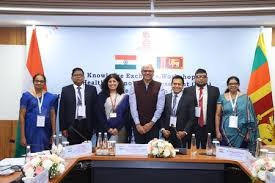
On February 10, 2026, a high-level, five-day workshop on Health Technology Assessment (HTA) officially commenced at the Sushma Swaraj Bhawan in New Delhi. Hosted by India’s Department of Health Research (DHR) and the Ministry of External Affairs, the event marks a significant evolution in bilateral “healthcare diplomacy.” The primary goal: to institutionalize a rigorous, evidence-based framework that ensures every rupee—and every rupee-equivalent—spent on healthcare delivers the maximum possible benefit to patients.
What is Health Technology Assessment?
For the average citizen, HTA may sound like bureaucratic jargon, but its impact is felt at the pharmacy counter and in the hospital ward. HTA is a multidisciplinary process that evaluates the clinical effectiveness, safety, and cost-efficiency of medical interventions.
“HTA is the bridge between scientific evidence and policy decision-making,” says Dr. Rajiv Bahl, Secretary of the DHR and Director General of the Indian Council of Medical Research (ICMR). “It isn’t just about finding the cheapest option; it’s about finding the best value for our unique populations.”
By systematically reviewing everything from new cancer drugs to diagnostic imaging machines, HTA helps governments decide which treatments should be subsidized by public funds and which do not offer enough benefit to justify their cost.
A Strategic Blueprint for Sri Lanka
Sri Lanka, known for having one of the most robust public health systems in South Asia, is currently looking to modernize its procurement and pricing strategies. The workshop aims to provide Sri Lankan delegates with a strategic pathway to build their own national HTA body, modeled after the successful Health Technology Assessment in India (HTAIn).
Anu Nagar, Additional Secretary of the DHR, noted that HTAIn has already become a cornerstone of India’s healthcare landscape. “The institutionalization of HTA allows for transparent, evidence-informed decisions,” Nagar stated during the inaugural session. “Sharing this framework with Sri Lanka strengthens not just their health system, but the health security of the entire region.”
The five-day curriculum covers:
-
Institutional Frameworks: How to build a governing body that is independent and objective.
-
Methodologies: The math behind “cost-per-life-year-saved.”
-
Procurement & Pricing: Using data to negotiate better prices with global pharmaceutical and medical device manufacturers.
Why This Matters for Public Health
The implications of this partnership extend far beyond government boardrooms. For patients in both nations, a robust HTA system means:
-
Lower Out-of-Pocket Costs: When governments use HTA to negotiate drug prices, those savings are often passed down to the consumer.
-
Safety Assurance: HTA requires a rigorous look at real-world safety data, ensuring that only the most reliable technologies reach the public.
-
Equity in Access: By prioritizing cost-effective treatments, public health systems can cover more people for more conditions, reducing the “lottery” of who gets care.
“In resource-constrained environments, every bad investment in an ineffective technology is a missed opportunity to save a life elsewhere,” says Dr. Aris Angelis, a researcher in health economics (not involved in the workshop). “India’s HTAIn has shown that you can balance innovation with affordability. Sri Lanka adopting this model is a win for regional health equity.”
Challenges and Considerations
While the benefits are clear, institutionalizing HTA is not without hurdles. Critics often worry that “cost-effectiveness” can lead to “rationing” of care. If a life-saving drug is deemed too expensive by an HTA body, patients may lose access to it.
Furthermore, HTA requires high-quality data. In many South Asian regions, electronic health records are still being standardized, making it difficult to track long-term patient outcomes.
“Data integrity is our biggest challenge,” notes a public health consultant familiar with regional policy. “To make good decisions, you need good data. The collaboration between India and Sri Lanka will need to focus heavily on digital health infrastructure to feed the HTA engine.”
The Road Ahead
The workshop is expected to culminate in a series of collaborative initiatives, potentially leading to joint research projects and a shared regional database for medical technology performance. As both nations face an aging population and a rise in non-communicable diseases like diabetes and heart disease, the need for surgical precision in health spending has never been greater.
By moving away from ad-hoc purchasing and toward a data-driven HTA model, India and Sri Lanka are signaling a shift in South Asian healthcare: one where “value” is the ultimate currency.
Medical Disclaimer
This article is for informational purposes only and should not be considered medical advice. Always consult with qualified healthcare professionals before making any health-related decisions or changes to your treatment plan. The information presented here is based on current research and expert opinions, which may evolve as new evidence emerges.
References and Sources
Official Statements & Reports:
-
Ministry of Health and Family Welfare (MoHFW), India: Press Release: India-Sri Lanka Workshop on Health Technology Assessment, Feb 10, 2026.