 0
0
 0
0
April 16, 2026
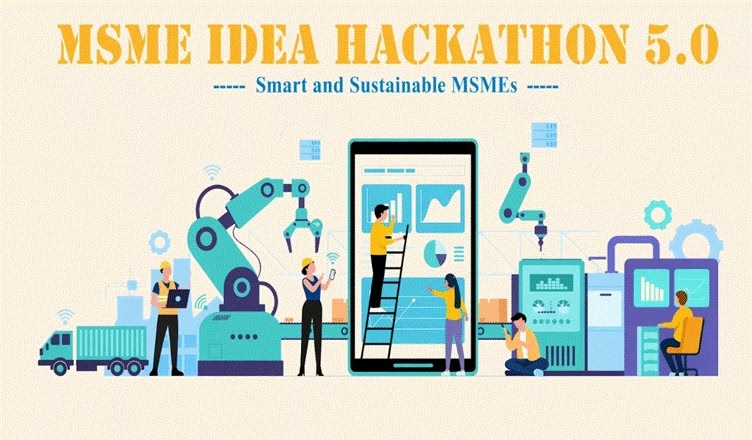
NEW DELHI – In a significant leap for integrative medicine and veterinary care, the All India Institute of Ayurveda (AIIA) has secured a prestigious victory at the MSME Idea Hackathon 5.0. The institute’s incubation wing, iCAINE, successfully championed a breakthrough medical device titled “MITE OUT,” designed to non-invasively treat myiasis—a painful and often destructive parasitic infestation—in livestock. The selection, announced by the Ministry of Micro, Small and Medium Enterprises, highlights a growing national shift toward merging traditional Ayurvedic principles with cutting-edge biomedical engineering to solve critical agricultural and public health challenges.
A New Frontier for Ayurvedic Innovation
The MSME Idea Hackathon 5.0 serves as India’s premier platform for scouting high-potential startups that offer solutions to “real-world” problems. While the AIIA is primarily known for its clinical excellence in human Ayurveda, its role as a designated Host Institute (HI) under the Ministry of Ayush has allowed it to expand its reach into “One Health”—a collaborative approach that recognizes the interconnection between people, animals, and their shared environment.
The star of this year’s hackathon, MITE OUT: A Dual-Action Non-Invasive Device for Safe Extraction of Myiasis Larvae, was developed by innovator Anneasa Manna and her team. The project has been awarded financial assistance of up to ₹15 lakh, alongside structured mentorship through the AIIA–iCAINE ecosystem.
“This achievement reflects AIIA’s unwavering commitment to fostering innovation within the Ayurveda ecosystem,” said Prof. P.K. Prajapati, Director of AIIA. “The selection of ‘MITE OUT’ reinforces our vision of integrating traditional knowledge with modern innovation to address challenges that impact both the economy and animal welfare.”
Understanding the Challenge: What is Myiasis?
To understand the significance of this device, one must understand the severity of the condition it treats. Myiasis is the infestation of live human or vertebrate animals with dipterous larvae (maggots) which, at least for a certain period, feed on the host’s dead or living tissue.
In livestock, particularly in tropical climates like India’s, myiasis can lead to:
-
Significant Tissue Damage: Larvae burrow deep into the flesh, causing necrotic wounds.
-
Economic Loss: Reduced milk yield, weight loss, and high mortality rates in cattle and goats.
-
Zoonotic Risks: Certain species of flies that cause livestock myiasis can also infect humans, making it a public health concern.
Traditionally, extracting these larvae is a grueling process for the animal, often involving invasive manual removal or the heavy use of chemical pesticides that can leave residues in meat and milk.
The ‘MITE OUT’ Innovation: Dual-Action Science
The “MITE OUT” device proposes a “dual-action” mechanism. While specific technical blueprints remain proprietary during the incubation phase, the core concept centers on a non-invasive extraction method.
“At iCAINE, our focus is on ideas that create meaningful impact,” explained Dr. Shivakumar Harthi, In-charge of AIIA–iCAINE. “MITE OUT is a testament to the strength of our incubation ecosystem. We are empowering startups to transform concepts into enterprises that solve problems safely and sustainably.”
The device likely utilizes a combination of biochemical attractants—potentially derived from Ayurvedic ethnoveterinary medicine—and a mechanical vacuum or thermal stimulus to draw larvae to the surface. This avoids the trauma of surgical intervention and reduces the need for aggressive chemical treatments.
Public Health and Economic Implications
The selection of this project is timely. According to data from the Food and Agriculture Organization (FAO), parasitic diseases in livestock account for billions of dollars in annual losses globally. In India, where the dairy and livestock sector is a backbone of the rural economy, a low-cost, non-invasive tool like MITE OUT could be transformative.
Dr. Rajesh Kumar, a veterinary consultant not involved in the study, notes the importance of this shift:
“Mechanical and non-invasive extraction is the ‘holy grail’ of myiasis treatment. If we can remove larvae without causing further secondary infections or using toxic organophosphates, we improve animal welfare and ensure a cleaner food chain for consumers.”
The Road Ahead: From Lab to Farm
While the win at the MSME Hackathon provides the necessary capital, the journey from prototype to the barnyard involves several hurdles:
-
Clinical Trials: The device must undergo rigorous testing on different livestock species to ensure efficacy across various types of larvae.
-
Scalability: To be effective, the tool must be affordable for small-scale farmers in rural India.
-
Regulatory Approval: As a medical/veterinary device, it will require clearance from Indian regulatory bodies to ensure safety standards are met.
Critics and some traditional practitioners argue that “high-tech” solutions may face resistance in remote areas where traditional herbal pastes are the norm. However, the AIIA’s involvement suggests that MITE OUT will likely incorporate these traditional elements into its delivery system, bridging the gap between old and new.
Strengthening India’s Innovation Ecosystem
The success of iCAINE (Incubation Centre for Ayurveda and Innovative Explorations) underscores the government’s “Atmanirbhar Bharat” (Self-Reliant India) initiative. By providing infrastructure, technical validation, and strategic guidance, the AIIA is proving that Ayurveda is not just a system of medicine, but a framework for broader scientific inquiry.
As the “MITE OUT” team begins their incubation, the eyes of the medical and agricultural communities will be on them. If successful, this dual-action device could become a staple in veterinary kits across the country, proving that sometimes the best way to move forward is to look back at traditional wisdom through a modern lens.
Statistical Context: Livestock Parasitism
-
Economic Impact: Livestock diseases cost the Indian economy an estimated ₹50,000 crore annually.
-
Myiasis Prevalence: In some tropical regions, up to 15-20% of open wounds in livestock can become infested with larvae if left untreated.
-
Hackathon Support: MSME Idea Hackathon 5.0 provides up to ₹15 lakh per approved idea to bridge the “valley of death” between prototype and product.
Reference Section
Sources:
-
Press Information Bureau (PIB) Delhi. (2026, April 15). AIIA-iCAINE Marks Excellence at MSME Hackathon 5.0 with Breakthrough Idea Selection.
Medical Disclaimer: This article is for informational purposes only and should not be considered medical advice. Always consult with qualified healthcare professionals before making any health-related decisions or changes to your treatment plan. The information presented here is based on current research and expert opinions, which may evolve as new evidence emerges.