 0
0
 0
0
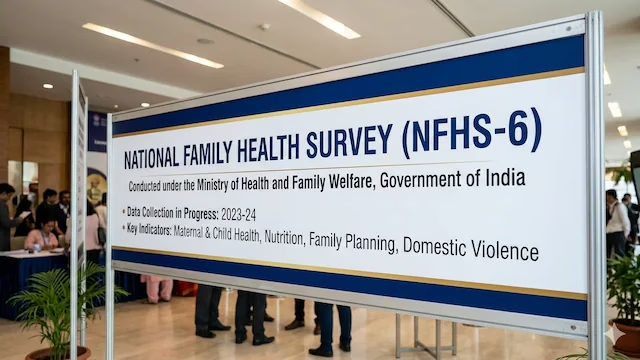
NEW DELHI — When the Ministry of Health and Family Welfare released the provisional fact sheets for India’s sixth National Family Health Survey (NFHS-6) on May 29, 2026, healthcare professionals and policy analysts expected critical updates on the nation’s baseline health markers. Instead, they were blindsided by a glaring omission: data tracking anaemia—one of India’s most severe and deeply entrenched nutritional crises—has been entirely removed from the official health profile sheets.
In response to immediate pushback from the medical community, the Health Ministry clarified that haemoglobin testing was intentionally excluded from the NFHS-6 cycle. Officials cited long-standing technical concerns that the “finger-prick” capillary blood sampling method utilized in prior survey rounds heavily skewed and overestimated true anaemia rates.
Going forward, the government states that national anaemia estimates will be managed under a separate initiative: the Indian Council of Medical Research’s (ICMR) Diet and Biomarkers Survey of India (DABS-I). While the shift aims for clinical precision by transitioning to venous blood samples, public health experts warn that the sudden mid-track protocol change risks creating a dangerous blind spot in tracking immediate maternal and child health trends.
The Scale of India’s Anaemia Crisis
The decision to omit these figures from the primary national health registry comes at a delicate time. Data from the previous survey round, NFHS-5 (conducted between 2019 and 2021), painted a worrying picture of nutritional health across demographic lines:
-
Women (Aged 15–49): Anaemia prevalence rose from 53.1% in NFHS-4 to 57%.
-
Children (Aged 6–59 months): Prevalence spiked dramatically from 58.6% to 67.1%.
-
Pregnant Women: Rates climbed steadily from 50.4% to 52.2%.
These numbers demonstrate that over half of India’s women and more than two-thirds of its toddlers were classified as anaemic just a few years ago. The crisis also features distinct regional and socio-economic disparities. For instance, Assam reported some of the country’s most severe outcomes, with 65.9% of women and 68.4% of children experiencing low haemoglobin levels. Across almost all evaluated states, rural communities consistently display a higher burden of disease than urban centers.
Why the Testing Method Changed
The government’s pivot away from the NFHS testing protocol stems from a valid, decade-long methodological debate in clinical diagnostics. Previous NFHS rounds relied on capillary blood testing—obtained via a rapid finger-prick. While fast and highly practical for large-scale field workers, the technique is highly susceptible to field errors. Squeezing the finger to extract blood can inadvertently introduce interstitial fluid (the fluid surrounding tissue cells), which dilutes the sample and artificially lowers the recorded haemoglobin concentration.
A comprehensive systematic review published in 2019 confirmed that notable variations between capillary and venous blood measurements are common across global health literature. Often, capillary collections yield less stable baseline results compared to direct blood draws from a vein.
The upcoming ICMR-DABS-I study, orchestrated by the National Institute of Nutrition (NIN) in Hyderabad, shifts entirely to venous blood sampling—the universally acknowledged medical gold standard. Emerging research from recent venous-based testing pilots indicates that true anaemia prevalence might indeed be lower than earlier finger-prick surveys suggested, with a vast majority of cases shifting into the “mild” clinical category rather than severe.
However, this upgrade creates a major hurdle for epidemiological tracking. Because the diagnostic techniques are fundamentally different, future data sets cannot be directly compared against the NFHS-5 baseline, essentially breaking the historical trend line.
Expert Concerns About Data Gaps
Public health advocates argue that while fixing diagnostic inaccuracies is necessary, it should not come at the expense of continuous public oversight.
“Methodological improvements should not create gaps in tracking major health problems,” notes Poonam Muttreja, Executive Director of the Population Foundation of India. Characterizing anaemia as one of the most pressing public health challenges in the region, Muttreja emphasizes that central interventions require regular, synchronized, and open data infrastructure to evaluate if multi-crore welfare programs are working.
“If the methodology changes, bridge estimates should be provided so that trends can still be tracked over time,” Muttreja added, warning that the condition risks losing its visibility in high-level policymaking “precisely when it needs more attention.”
Clinical literature emphasizes that unmanaged iron-deficiency anaemia is not merely a matter of fatigue; it significantly elevates maternal mortality risks, triggers low birth weight, impairs childhood cognitive development, and dampens overall economic productivity.
A Broadening Shift in Public Indicators
The missing anaemia metrics are part of a larger structural contraction within the newly published health profiles. The NFHS-6 fact sheets now monitor 101 key health, nutrition, and demographic measures—a notable drop from the 131 indicators tracked in NFHS-5.
Senior Health Ministry officials have firmly pushed back against allegations that essential indicators are being suppressed. According to administration representatives, several data tracks are simply being redirected to specialized agency pipelines or existing administrative platforms. For instance:
-
Sanitation and clean cooking fuel metrics are increasingly tracked through internal ministry dashboards.
-
Birth and mortality statistics continue to stream through the Sample Registration System (SRS) and Civil Registration System (CRS).
“The Fact Sheets are the first stage of dissemination. The detailed National Report will provide a much broader picture,” an official stated, reassuring the public that these initial releases are provisional data compilations and that subsequent long-form reports will provide deeper analytical context.
Other Notable Omissions Raise Questions
Despite official assurances, independent medical researchers remain cautious, pointing out that several other vital socio-medical indicators are missing from the primary NFHS-6 sheets:
-
Demographics: Broader population sex ratios and specific sex ratios at birth are absent.
-
Preventative Oncology: Critical screening rates for breast, cervical, and oral cancers have been left out.
The omission of oncology screenings is particularly notable given that the government has recently upgraded over 1.5 lakh rural clinics to Ayushman Arogya Mandirs, explicitly tasked with tackling non-communicable diseases. Prior NITI Aayog evaluations from 2024 underscored a massive gap in preventative care uptake, noting that fewer than 1% of eligible citizens had undergone oral or breast cancer screenings, and only 1.9% had been screened for cervical malignancies.
Assessing Impact Without Outcome Data
This data restructuring creates an ironic contradiction in the NFHS-6 reporting structure. While the final impact metric (actual population haemoglobin levels) is absent, the survey continues to track and praise input metrics, such as iron-folic acid (IFA) tablet compliance among pregnant women. The provisional data actually highlights an increase in the percentage of mothers taking daily supplements for the recommended 100-to-180-day periods.
Furthermore, the central government’s flagship Anaemia Mukt Bharat (Anaemia-Free India) campaign has significantly intensified its structural reach. By March 2024, the state successfully phased out standard custom-milled rice across public safety net programs, replacing it entirely with fortified rice variations rich in iron, folic acid, and vitamin B12. For the 2024–2025 financial period alone, the government earmarked ₹805.91 crore directly to states to sustain these nutritional interventions.
Yet, healthcare analysts stress that distribution tallies are poor substitutes for direct biological verification.
| Data Type | What It Tracks | What It Misses |
| Administrative Records | Supply chain volume, tablet distribution, fortification budgets. | Actual biological absorption, patient adherence, true health efficacy. |
| Population Surveys | Household health statuses, actual blood haemoglobin values. | Real-time supply chain disruptions. |
“Administrative records may show how many tablets are distributed, but population surveys reveal whether people’s health is improving,” Muttreja warns. “What doesn’t get counted also does not get done.”
Looking Forward: What to Watch for
Medical researchers and international observers are stopping short of labeling the missing metrics as a deliberate shift in national health priorities. Many agree that the restructuring could simply reflect evolving diagnostic standards or a phased approach to data release.
Nonetheless, the upcoming comprehensive, long-form NFHS-6 report will face intense scrutiny. The healthcare sector will be looking closely for three primary answers:
-
Whether the omitted preventative oncology and demographic data reappear in the final appendices.
-
The exact mathematical models used to calibrate the new venous-testing methodologies under the ICMR-DABS-I survey.
-
Whether the government will offer historical mathematical “bridge estimates” to help compare old capillary data with new venous baselines.
Ultimately, the utility of the NFHS platform relies on its unique structure: evaluating health, gender, fertility, and economic welfare together within a single, highly unified household sample. Splitting these vital data tracks across isolated agency surveys makes it harder to build a clear, comprehensive picture of public health progress. For a population where millions of women and children live with iron deficiencies, clear and accessible data isn’t just about statistics—it’s an indispensable tool for survival.
Medical Disclaimer
Medical Disclaimer: This article is for informational purposes only and should not be considered medical advice. Always consult with qualified healthcare professionals before making any health-related decisions or changes to your treatment plan. The information presented here is based on current research and expert opinions, which may evolve as new evidence emerges.
References
- https://health.economictimes.indiatimes.com/news/policy/anaemia-data-missing-from-nfhs-6-fact-sheets-govt-says-new-survey-will-fill-gap/131570458?utm_source=top_story&utm_medium=homepage