 0
0
 0
0
MUMBAI — On July 4, 2026, the Maharashtra Food and Drug Administration (FDA) issued an urgent public health alert naming three popular skin-lightening products after laboratory analysis revealed dangerously high levels of toxic heavy metals, including mercury and lead. State regulatory officials reported that prolonged application of these topical cosmetics poses severe health risks, specifically threatening the kidneys, central nervous system, and skin integrity. The enforcement action underscores a growing global challenge: while statutory limits strictly govern heavy metals in retail cosmetics, unregulated online marketplaces continue to funnel contraband, high-hazard formulas directly to consumers.
Regulatory Action and the E-Commerce Gap
Following routine market surveillance and laboratory testing, the Maharashtra FDA classified three specific brands as “Not of Standard Quality”:
-
Goree Beauty Cream
-
Face Fresh Gold (both Beauty Cream and Beauty Serum variants)
-
Golden Star Beauty Cream
Laboratory assays revealed that one of the flagged products contained mercury at an astronomical 752 times the legally permitted therapeutic baseline.
A primary concern for enforcement agencies is the supply chain architecture. Goree Beauty Cream, for instance, is manufactured in Pakistan and officially barred from standard commercial import. However, regional investigators confirmed that numerous independent third-party vendors bypass standard customs checkpoints by listing these illicit formulations on major e-commerce platforms and social media marketplaces.
This modern digital pipeline creates a stark gap between laboratory-based regulatory enforcement and real-world consumer access. While brick-and-mortar pharmacies are easily monitored, digital storefronts can rapidly clear inventories or relist under alternate names before regional regulators can issue takedown notices.
The Biological Toll: Why Mercury Matters
To understand why heavy metals are introduced into these products, it helps to examine basic skin biology. Skin pigmentation is primarily driven by melanin, a natural pigment produced by specialized cells called melanocytes. Within these cells, an enzyme called tyrosinase plays a critical role in synthesizing melanin.
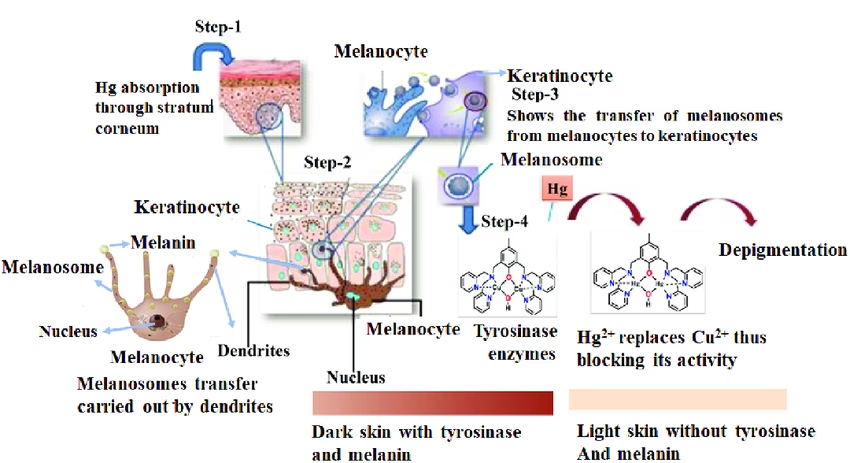
As illustrated above, mercury works by actively interfering with this biological pathway. When applied topically, mercury is absorbed through the stratum corneum (the outermost layer of skin). Once inside the tissue, ionic mercury replaces essential copper ions within the tyrosinase enzyme, completely blocking its activity.
By halting tyrosinase, the skin temporarily stops producing new melanin, causing a rapid, noticeable lightening effect. However, this cosmetic outcome comes at a devastating physiological cost. Topically applied heavy metals do not remain localized; they enter systemic blood circulation through transdermal absorption.
Unlike water-soluble compounds that the body can clear rapidly, mercury accumulates in tissues over time. According to toxicology data from the World Health Organization (WHO) and the Centers for Disease Control and Prevention (CDC), chronic exposure to accumulated mercury can destroy the filtration units of the kidneys, erode neural pathways in the brain, and cause severe dermatological degradation. Exposure is particularly dangerous for pregnant individuals, as circulating mercury readily crosses the placental barrier, threatening fetal neurological development.
Clinical Evidence and Statistical Context
The regional alert is supported by striking clinical data from local medical centers. In the city of Nagpur, nephrologists documented a cluster of 18 women presenting with unexplained renal impairment over a two-year period. Retrospective patient histories revealed a single, striking commonality: every individual reported prolonged, daily usage of Goree Beauty Cream.
While public health researchers note that retrospective correlation is not definitive proof of singular causation in every individual clinical case, the statistical signal is incredibly strong.
On a broader scale, a peer-reviewed study published in Science of the Total Environment evaluated imported skin-lightening cosmetics across India. The researchers discovered that a significant portion of unvetted, imported creams vastly exceeded the internationally accepted safety ceiling of 1 part per million (ppm)—a standard codified by both the Minamata Convention on Mercury and India’s Cosmetics Rules, 2020.
Crucially, the study calculated the “hazard quotient”—a mathematical ratio used to assess systemic health risks based on chemical exposure levels. For adult women applying these highly contaminated creams, the hazard quotients exceeded 100. In public health screening, any hazard quotient greater than 1 indicates a substantial, unacceptable risk of systemic toxicity.
Expert Perspectives on the “Fairness” Illusion
Independent dermatologists and public health specialists warn that the rapid aesthetic results promised by these creams are actually the first signs of cellular poisoning.
“The rapid reduction in pigmentation isn’t a sign of skin health; it’s a sign of profound chemical interference,” explains a Mumbai-based dermatologist not involved in the FDA investigation. “Initially, the symptoms of systemic heavy metal poisoning are subtle and easily misattributed. Patients frequently present with vague complaints—persistent fatigue, unexplained headaches, a mild tremor in the hands, or localized skin rashes—long before severe organ damage becomes clinically obvious.”
Furthermore, environmental scientists point out that the threat extends beyond the individual consumer. When a user washes their face or bathes, the accumulated heavy metals are rinsed down the drain. Because municipal wastewater treatment facilities are rarely equipped to filter out dissolved heavy metals, these toxic elements pass directly into local aquatic ecosystems, leading to bioaccumulation in fish and long-term environmental degradation.
The Social Dimension and Public Health Strategy
The enduring demand for these unregulated products is inextricably tied to deep-seated cultural pressures. For generations, colorism—the societal prejudice favoring lighter skin tones—has been monetized by the beauty industry, framing fairness as a prerequisite for social mobility, marriageability, and professional success.
Sociological and public health researchers emphasize that traditional top-down enforcement is only half the battle. If regulatory agencies simply seize products without addressing the underlying demand, desperate consumers will merely migrate to deeper, more dangerous gray-market channels.
Public health campaigns are most effective when they move away from shaming the consumer. Instead, modern strategies focus on transparently deconstructing the toxic mechanisms of these products, celebrating natural skin diversity, and providing clear, actionable guidance on identifying safe, regulated skincare alternatives.
Actionable Guidelines for Stakeholders
For Consumers:
-
Evaluate the Timeline: Avoid any product that promises unnaturally rapid whitening or “instant fairness.” Safe, legal dermatological treatments take months to alter skin appearance safely.
-
Inspect the Labeling: Legitimate cosmetics must display a transparent, complete list of ingredients, a manufacturing batch number, and verified corporate contact details. If the label is vague, poorly translated, or missing an ingredients list entirely, discard it.
-
Audit the Sourcing: Exercise extreme caution when purchasing skincare products through social media marketplaces, independent digital classification sites, or unvetted e-commerce third-party vendors.
For Clinicians:
-
Expand Patient Histories: When evaluating patients presenting with unexplained proteinuria (protein in the urine), early-stage renal decline, uncharacteristic neurological tremors, or recalcitrant dermatitis, actively inquire about their cosmetic and topical skincare routines.
For Regulators:
-
Tighten Digital Borders: Shift enforcement focus toward e-commerce fulfillment hubs, mandating strict algorithmic filtering and verification protocols for third-party cosmetic listings on digital platforms.
Reference Section
Study Citations
- https://www.ndtv.com/india-news/maharashtra-bans-3-beauty-products-including-pak-made-fairness-cream-over-toxic-mercury-11729688
Medical Disclaimer: This article is for informational purposes only and should not be considered medical advice. Always consult with qualified healthcare professionals before making any health-related decisions or changes to your treatment plan. The information presented here is based on current research and expert opinions, which may evolve as new evidence emerges.