 0
0
 0
0
GANDHINAGAR, INDIA — In one of the largest coordinated environmental health interventions in recent regional history, the Gujarat Health Department’s “Namo Swachhata Abhiyan” has unearthed and processed more than 5.11 lakh (511,000) unusable items from government healthcare facilities in just its first five days.
The state-wide campaign, which spans more than 11,900 government health institutions, is slated to run through July 7, 2026. According to official data released by state health authorities, the intensive purge has already successfully freed up an estimated 1,512 rooms across the state—reclaiming vital clinical real estate that had long been surrendered to broken furniture, obsolete medical devices, and administrative scrap.
While a mass logistics cleanup might sound like an exercise in simple aesthetics, public health experts emphasize that hospital clutter is a critical, often overlooked vector in infection control, patient safety, and operational efficiency.
Behind the Numbers: Reclaiming the Clinical Floor
According to the Gujarat Health Department, the opening phase of the campaign identified exactly 511,221 unusable items choking corridors, storage bays, and patient care areas. On the fifth day of the drive alone, inspection teams flagged 58,594 stagnant items across 12,000 facilities, managing to safely dispose of 14,390 pieces of scrap on-site.
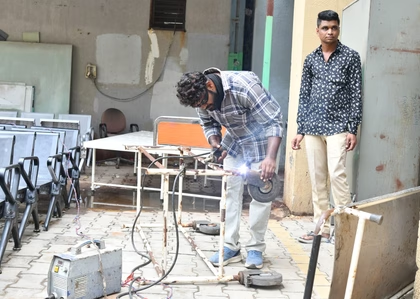
Crucially, the initiative is not merely a junk-disposal program; it features a heavy emphasis on asset rehabilitation. Technicians and facility engineers have repaired roughly 10,165 essential items over the five-day period. This includes restoring functional furniture, repairing IT and electronic infrastructure, servicing broken medical devices, and returning grounded vehicles and ambulances back into active service.
Beyond scrap removal, the campaign mandates intensive structural deep-cleaning, pipeline overhauls, and the remediation of drinking water systems to reinforce the state’s primary and secondary healthcare tiers.
The Medical Science of Clean Space
To the untrained eye, a stack of broken wheelchairs in a back hallway is an eyesore. To an epidemiologist, it is a dangerous disruption to public safety.
According to guidelines from the World Health Organization (WHO), poorly managed healthcare environments and accumulated waste pose severe risks of infection, physical injury, and environmental contamination to healthcare workers, patients, and visitors alike. The WHO emphasizes that inadequate waste and asset management directly compromises the sterile field required for safe patient care.
Medical literature strongly reinforces the link between rigorous environmental hygiene and patient outcomes:
-
The REACH Trial: A major cluster-randomized trial published in The Lancet Infectious Diseases across 11 Australian hospitals evaluated a multimodal environmental cleaning bundle. The study demonstrated that systematic, targeted cleaning significantly improved surface decontamination and was associated with a measurable reduction in vancomycin-resistant enterococci (VRE) infections—a highly problematic, antibiotic-resistant hospital pathogen.
-
Annals of Internal Medicine Systematic Review: A comprehensive technical brief published by researchers in the Annals of Internal Medicine concluded that optimizing the cleaning of hard surfaces in patient rooms is an indispensable pillar in preventing healthcare-associated infections (HAIs), though they noted that comparative evidence favoring specific chemical agents over others remains limited.
When storage areas are packed to capacity with scrap, staff are forced to hoard active supplies or squeeze diagnostic equipment into patient-facing areas. This creates uneven surfaces that are notoriously difficult to disinfect properly.
Expert Commentary: Sustainability Over Sporadic Swings
While the scale of Gujarat’s mobilization has drawn praise, public health authorities warn against viewing deep-cleans as a silver bullet.
“Massive campaigns are highly effective for resetting a system’s baseline,” says Dr. Anita Vyas, an independent public health consultant specializing in infectious disease control, who was not involved in the state drive. “Clearing out 1,500 rooms drastically improves the physics of a hospital—improving airflow, workflow, and visibility. However, the true public health dividend will only be realized if these facilities embed daily, systematic waste segregation and routine maintenance protocols into their permanent operating procedures.”
WHO’s global guidance explicitly echoes this caution, stating that healthcare waste management must be treated as a continuous, daily operational discipline rather than a sporadic, reactionary cleanup exercise.
Furthermore, observers note that while the state’s data regarding “rooms cleared” and “items repaired” is structurally impressive, the campaign metrics currently lack patient-level correlation. There is no long-term health data yet available to show whether this five-day blitz will directly translate to lowered rates of hospital-acquired infections or improved clinical recovery times in Gujarat’s public facilities.
The Logistical Battle Against Superbugs
A central challenge highlighted by peer-reviewed research in hospital management is the “sustainability decay.” Studies tracking environmental interventions frequently show that cleanliness gains begin to erode within weeks if there is a lack of continuous training, routine auditing, and clear institutional accountability.
For the Namo Swachhata Abhiyan to deliver lasting benefits, the cleared areas must be strictly partitioned for clinical utility rather than allowed to slowly accumulate a new generation of broken hardware. Additionally, local authorities must ensure that the final disposal of the 46,000+ local items complies strictly with established biomedical waste management and recycling rules, avoiding localized environmental hazards.
What This Means for Patients and Providers
For patients and families navigating the public health system, the message is one of balanced vigilance. A visibly organized, uncrowded hospital campus is an encouraging sign of administrative health, but it does not replace the fundamental personal habits that stop disease transmission. Hand hygiene, proper mask-wearing in high-risk zones, and the responsible disposal of personal waste remain the frontline defenses for individuals.
For hospital administrators and frontline healthcare professionals, the Gujarat drive serves as a massive case study. Unused gear and structural clutter are not benign administrative backlogs—they are active impediments to clean, rapid, and dignified patient care.
References
Epidemic & Clinical Studies
- https://www.lokmattimes.com/health/gujarat-over-511-lakh-unusable-items-identified-in-govt-health-facilities-under-cleanliness-drive-1/
Medical Disclaimer: This article is for informational purposes only and should not be considered medical advice. Always consult with qualified healthcare professionals before making any health-related decisions or changes to your treatment plan. The information presented here is based on current research and expert opinions, which may evolve as new evidence emerges.