 0
0
 0
0
NAIROBI, Kenya — For nearly a year, 60-year-old Harada Hussein Abdirahman battled a relentless cycle of fever, weight loss, and debilitating fatigue. Living in the arid stretches of far-northeastern Kenya, she sought help repeatedly, only to be sent home with standard treatments for malaria or dengue. By the time a clinician finally suspected kala-azar (visceral leishmaniasis), the parasitic disease had advanced to a critical stage, requiring weeks of intensive, life-saving intervention.
Abdirahman’s ordeal is becoming dangerously common. According to Kenya’s Ministry of Health, the country is witnessing a dramatic spike in cases, jumping from 1,575 in 2024 to 3,577 by the second half of 2025. This surge is not just a statistical anomaly; it represents a major hurdle in the global push to eliminate one of the world’s deadliest neglected tropical diseases (NTDs) by 2030.
What is Kala-azar and Why is it Fatal?
Kala-azar, a Persian term meaning “black fever”—so named for the dusky skin discoloration often seen in patients—is a parasitic infection caused by Leishmania parasites. It is transmitted to humans through the bite of infected female phlebotomine sandflies.
While many tropical diseases cause discomfort, kala-azar is uniquely lethal. If left untreated, it is fatal in 90% to 95% of cases. The parasite attacks the internal organs, specifically the bone marrow, lymph nodes, liver, and spleen.
Recognizing the Symptoms:
-
Persistent Fever: An unexplained fever lasting more than two weeks.
-
Organ Enlargement: Noticeable swelling of the abdomen due to an enlarged spleen and liver.
-
Anemia: Significant paleness and fatigue.
-
Wasting: Progressive weight loss and loss of appetite.
-
Night Sweats: Intense perspiration during sleep.
The complexity of the disease lies in its treatment. Unlike malaria, which can often be treated with a short course of oral pills, kala-azar requires prolonged injectable regimens, sometimes lasting several weeks. In advanced cases, patients like Abdirahman may also require blood transfusions and stabilization for secondary infections.
A Geographic Expansion: Beyond the Arid North
Historically, kala-azar was confined to Kenya’s most remote, arid counties such as Wajir, Mandera, Marsabit, Turkana, and Isiolo. However, recent data suggests the disease is migrating.
Epidemiologists are now tracking cases in previously less-affected zones and parts of western Kenya. This “expansion of endemicity” is largely driven by human movement. Migrant laborers working in quarries, farms, and construction sites in northern regions often have no prior immunity or knowledge of the disease. In Mandera County, a 2025 surge among quarry workers became so severe that local authorities restricted movement during dusk and dawn—the peak biting hours for sandflies.
The Diagnostic Bottleneck: Why Cases are Missed
The primary driver of the current death toll is “under-suspection.” In many rural health outposts, diagnostic tools are non-existent.
“Kenya has very few facilities capable of reliably diagnosing and treating kala-azar,” says Dr. Paul Kibati, a tropical disease expert at Amref Health Africa. “Without point-of-care diagnostics and better-trained health workers, mistakes in testing and treatment can be fatal.”
When a patient presents with a fever in Kenya, the default clinical assumption is often malaria or typhoid. For Harada Hussein Abdirahman, a local pharmacist provided repeated antimalarial regimens for a year. This diagnostic delay allows the parasite to multiply unchecked, making the eventual treatment harder on the body and more expensive for the health system.
The Intersection of Climate and Poverty
The surge is also an environmental story. Sandfly vectors thrive in semi-arid conditions, finding refuge in termite mounds and the cracks of parched earth.
-
Climate Instability: Record droughts followed by erratic, heavy rainfall have disrupted traditional settlement patterns, pushing pastoralist communities into closer contact with sandfly habitats.
-
Economic Barriers: While the Kenyan government and partners like Médecins Sans Frontières (MSF) aim to provide treatment for free, the indirect costs are staggering. For a family in a remote village, the cost of transport to a regional center and the loss of weeks of wages can make seeking care an impossible choice.
Global Goals vs. Local Realities
The World Health Organization (WHO) has set an ambitious 2030 roadmap to eliminate visceral leishmaniasis as a public health problem. In 2023, Kenya joined five other African nations in a regional framework to strengthen surveillance and vector control.
However, organizations on the front lines warn that the current surge threatens these gains. MSF, which has supported programs in Turkana, has urged governments to scale up mobile screening clinics to reach nomadic populations. Without reaching people where they live, the “elimination” remains a distant goal on a map.
Protecting Yourself and Your Community
For those living in or traveling to endemic regions, awareness is the most potent tool. Public health experts recommend several practical steps:
For Individuals:
-
The “Two-Week Rule”: If a fever persists for more than 14 days, specifically ask a healthcare provider: “Could this be kala-azar?”
-
Physical Barriers: Use insecticide-treated bed nets (ITNs). Because sandflies are smaller than mosquitoes, fine-mesh nets are most effective.
-
Avoid Ground Sleeping: Sandflies are weak fliers and usually stay close to the ground; sleeping on elevated beds can reduce risk.
-
Peak Hour Protection: Limit outdoor activity at dusk and dawn, and wear long-sleeved clothing if outside during these times.
For the Community:
-
Vegetation Management: Clearing brush and cluttered vegetation near homes can remove sandfly resting sites.
-
Education: Utilizing community health workers to explain the difference between malaria and kala-azar can shorten the time between the first symptom and the correct diagnosis.
The Path Forward
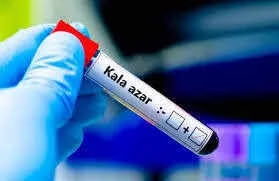
The crisis in Kenya serves as a wake-up call for the global health community. Integrating kala-azar screening into primary healthcare—rather than treating it as a specialized “outbreak” issue—is essential. This includes funding routine training for rural nurses and ensuring that rapid diagnostic tests are as available as pregnancy tests or malaria strips.
As the parasite moves into new territories, the “silent killer” can no longer be ignored. For patients like Abdirahman, the difference between a year of suffering and a swift recovery is not just a miracle of medicine, but a triumph of early detection.
Medical Disclaimer: This article is for informational purposes only and should not be considered medical advice. Always consult with qualified healthcare professionals before making any health-related decisions or changes to your treatment plan. The information presented here is based on current research and expert opinions, which may evolve as new evidence emerges.
References
https://health.economictimes.indiatimes.com/news/industry/neglected-killer-kala-azar-surge-in-kenya-leaves-record-deaths-missed-diagnoses/128091623?utm_source=latest_news&utm_medium=homepage