 0
0
 0
0
NEW DELHI — India’s premier medical entrance examination, the National Eligibility cum Entrance Test-Undergraduate (NEET-UG), is trapped in an administrative gridlock that threatens the pipeline of the nation’s future healthcare workforce. Following fresh allegations of question paper leaks that forced the cancellation of the May 3, 2026, exam, intense pressure has mounted on regulators to abandon traditional pen-and-paper testing.
However, a high-stakes disagreement between key government entities has stalled the transition to Computer-Based Testing (CBT). While the National Testing Agency (NTA) is technically prepared to digitize the exam, a standoff with the Union Health Ministry and the National Medical Commission (NMC) over exam fairness, normalization metrics, and structural logistics has left more than 2.2 million medical aspirants in a state of prolonged uncertainty.
The Catalyst: A Systemic Crisis at Massive Scale
The urgency to reform India’s medical entrance framework peaked following the NTA’s decision to cancel the May 3 examination, handing investigations over to federal authorities after credible evidence of a paper leak emerged. The cancellation disrupted approximately 2.28 million students nationwide, sparking widespread protests and intensifying public scrutiny over the integrity of the admissions process.
This is not an isolated administrative failure; it represents a recurring bottleneck for India’s public health infrastructure. Because NEET-UG serves as the sole gateway to all undergraduate medical (MBBS) and dental (BDS) seats across the country, any disruption to the examination cycle delays the academic calendar. This stalls the entry of thousands of new doctors into a healthcare system already strained by provider shortages.
The Reform Blueprint vs. Operational Realities
In October 2024, a high-level government-appointed reform panel led by former Indian Space Research Organisation (ISRO) chief K. Radhakrishnan explicitly recommended that NEET-UG transition from pen-and-paper to digital testing.
The panel’s core argument centered on vulnerability reduction:
-
Physical Vulnerabilities: Printing, physical transport via logistics networks, and storage at local bank vaults create dozens of potential “leak points” where human intervention can compromise security.
-
Digital Advantages: CBT allows for encrypted, encrypted-at-rest question banks to be pushed to secure servers mere minutes before the examination begins, effectively eliminating the transit-based vulnerabilities inherent to paper.
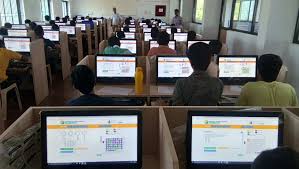
The Radhakrishnan panel proposed establishing a standardized network of 400 to 500 dedicated testing centers capable of securely hosting 200,000 to 250,000 candidates per session. However, building or auditing an infrastructure of this magnitude has lagged far behind schedule. The operational reality on the ground remains inadequate to support a simultaneous, nationwide digital exam for over two million applicants.
The Mathematical Gridlock: Single Shift vs. Normalization
The core technical dispute holding back the digital transition is not whether CBT is more secure, but how to administer it equitably.
The NTA has stated that to accommodate 2.2 million candidates digitally, the exam must be spread across approximately 20 distinct shifts due to nationwide computer lab constraints. Conversely, the Union Health Ministry and the NMC insist that any digital iteration must occur in a single, simultaneous shift.
       [ 2.2 Million Candidates ]
                   │
         ┌─────────┴─────────┐
         ▼                   ▼
  [ NTA Proposal ]    [ Health Ministry ]
   Multi-Shift CBT     Single-Shift CBT
   (20 Sessions)       (1 Session Only)
         │                   │
         ▼                   ▼
  Requires Complex    Infrastructure
    Normalization       Bottleneck
This divide stems from the complex mathematics of “normalization”—the statistical method used to equalize scores when different cohorts of students take different sets of question papers. While the NTA successfully utilizes normalization for the Joint Entrance Examination (JEE Main) for engineering, medical admissions operate on razor-thin margins.
In NEET-UG, a fraction of a single mark can shift a candidate’s national rank by thousands of places, determining whether they secure a highly coveted, subsidized seat at a government medical college or face the prohibitive costs of private education. Critics argue that even the most advanced statistical normalization formulas cannot completely erase public suspicion that one shift’s paper was marginally easier than another’s.
Legal and Policy Grey Areas
The legal framework governing medical education complicates the transition further. The National Medical Commission (NMC) Act, 2019 stipulates a “common and uniform” national entrance test.
While the NTA’s official documentation mirrors this language, neither the text of the Act nor the agency’s guidelines explicitly mandates that the exam occur in a single, concurrent window. This ambiguity leaves a multi-shift CBT model highly vulnerable to litigation from dissatisfied candidates, who could argue that varying question papers violate the statutory requirement for uniformity.
An NTA official, speaking on the condition of anonymity, indicated that the testing agency is fully equipped to execute a digital transition, provided the Health Ministry issues explicit, written authorization accepting the logistical necessity of a multi-shift format. Meanwhile, a senior Health Ministry official maintained that a single-shift administration remains the only definitive way to preclude widespread litigation and ensure absolute transparency.
The Public Health Cascading Effect
While the debate is frequently framed as an educational or bureaucratic dispute, its long-term implications present a serious challenge to national public health.
[Exam Irregularities/Leaks] ──► [Admissions Delays] ──► [Delayed Residency & Training] ──► [Workforce Shortages in Hospitals]
Repeated cancellations and legal delays create a compounding ripple effect throughout the medical ecosystem:
-
Delayed Academic Cycles: Postponed exams delay the commencement of the first-year MBBS curriculum, pushing back graduation dates.
-
Workforce Pipeline Bottlenecks: A delay in producing new medical graduates directly impacts the availability of junior resident doctors in teaching hospitals, who form the backbone of secondary and tertiary care in India.
-
Erosion of Institutional Trust: The psychological toll on aspirants and their families erodes institutional trust in the fairness of the medical profession’s entry gate, potentially discouraging top-tier talent from pursuing healthcare careers.
The Path Forward: What Stakeholders Need to Know
For students and parents navigating this volatile landscape, experts emphasize that digital testing is not an absolute panacea. A secure CBT model requires more than just replacing paper with screens; it demands robust cybersecurity protocols, biometric identity verification, audited data centers, and transparent grievance redressal mechanisms to prevent localized digital malpractice or hacking.
For policymakers, the path forward likely requires a compromised, phased rollout. Transitioning to a digital format may necessitate a hybrid structure or a gradual scale-up of state-of-the-art, government-audited testing centers over several fiscal cycles. Until the NTA, the Health Ministry, and the NMC reconcile the logistical demands of scale with the mathematical absolute of absolute fairness, India’s medical gatekeeper will remain vulnerable to the systemic weaknesses of an aging examination model.
References
- https://medicaldialogues.in/news/education/neet-cbt-shift-stalled-by-nta-nmc-differences-amid-repeated-paper-leak-controversies-170757
Medical Disclaimer: This article is for informational purposes only and should not be considered medical advice. Always consult with qualified healthcare professionals before making any health-related decisions or changes to your treatment plan. The information presented here is based on current research and expert opinions, which may evolve as new evidence emerges.