 0
0
 0
0
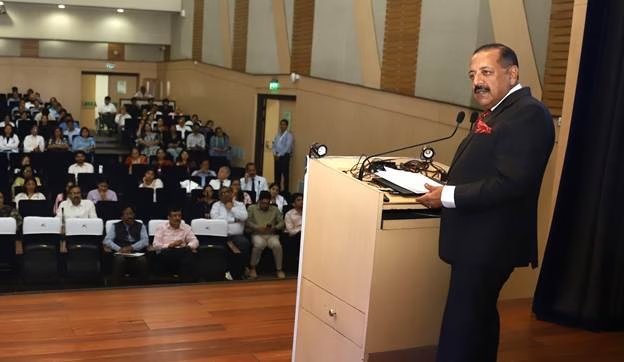
NEW DELHI — In a major call to action targeting the country’s shifting public health landscape, Union Minister Dr. Jitendra Singh warned that India is facing an interconnected “liver epidemic” and Type-2 diabetes surge. Speaking at the third anniversary of the Liver & Metabolic Disease Network (InFLiMeN) at the Institute of Liver & Biliary Sciences (ILBS) on July 4, 2026, Dr. Singh stated that these conditions are part of a larger, deeply entwined metabolic network affecting increasingly younger populations. The Minister called for an immediate, mission-mode national response focused heavily on preventive healthcare, early diagnosis, and mass public awareness.
“The liver, despite being the body’s most resilient and regenerative organ, is increasingly coming under stress,” Dr. Singh remarked, pointing to an array of modern triggers including poor dietary habits, sedentary lifestyles, disrupted sleep patterns, chronic stress, and environmental pollution.
Medical experts nationwide are echoing these concerns, noting that the traditional view of metabolic diseases as ailments of the middle-aged no longer applies to the unique health realities of modern India.
Unpacking the “Metabolic Nexus”
For decades, conditions like fatty liver disease, Type-2 diabetes, hypertension (high blood pressure), and dyslipidemia (unhealthy cholesterol levels) were treated as separate medical issues. Today, researchers view them as branches of the same tree, deeply rooted in insulin resistance—a condition where the body’s cells stop responding effectively to the hormone insulin, causing glucose to build up in the blood.
When the body cannot properly manage insulin and excess sugars, surplus fat begins accumulating in the liver. This condition, known as Non-Alcoholic Fatty Liver Disease (NAFLD)—more recently updated by global medical bodies to Metabolic Dysfunction-Associated Steatotic Liver Disease (MASLD)—acts as both a consequence and a driver of Type-2 diabetes.
According to data from the World Health Organization (WHO) and the Indian Council of Medical Research (ICMR), India is already home to over 101 million people living with diabetes. Simultaneously, independent epidemiological estimates suggest that nearly one in three adults in India may have some degree of fatty liver disease, creating a massive, overlapping population at high risk for cardiovascular disease and permanent liver scarring (cirrhosis).
The “Indian Phenotype” Vulnerability
A critical focal point of the recent scientific gathering was India’s distinct metabolic profile. Dr. Singh emphasized that global health guidelines, often built around Western data, fail to capture the reality of the “Indian phenotype.”
The Lean-Fat Paradox: People of South Asian descent possess a genetic predisposition to accumulate visceral fat—the dangerous fat wrapped around internal organs—even while maintaining a relatively low or normal Body Mass Index (BMI).
This means an individual who looks thin on the outside can still be metabolically unhealthy on the inside, facing the exact same risks for diabetes and fatty liver disease as someone who is visibly obese. Because of this unique genetic and structural vulnerability, medical leaders are emphasizing the urgent need for local research, indigenous biomarkers, and distinct screening tools tailored specifically to Indian bodies rather than relying entirely on international benchmarks.
A Crisis Striking the Young
Perhaps the most alarming trend highlighted by clinicians is the age shift. Pediatric and adolescent clinics are seeing unprecedented numbers of young adults and teenagers presenting with fatty liver and pre-diabetes.
“We are diagnosing conditions in 20-year-olds that we traditionally didn’t expect to see until someone was in their 50s,” says Dr. Aakash Shukla, a gastroenterologist not involved with the InFLiMeN network. “When metabolic damage begins in adolescence, the long-term economic and public health consequences are severe. We are looking at potential liver failure or advanced heart disease hitting individuals during their most productive working years.”
This structural shift threatens the foundational vision of Viksit Bharat 2047—India’s long-term national development roadmap—which heavily relies on the health and productivity of its massive young demographic.
Moving from Treatment to Early Interventions
To counter this trajectory, the Department of Science & Technology (DST)-supported InFLiMeN platform is driving collaborations between scientific institutions and frontline clinicians. A major pillar of this effort includes the utilization of the National Liver Biobank at ILBS to discover affordable, community-level screening tools.
Public health strategies are pivoting toward advanced biotechnology, precision medicine, and the integration of Artificial Intelligence (AI) to identify at-risk individuals before irreversible organ damage occurs.
However, technology alone cannot solve a lifestyle crisis. Experts stress that the public must be empowered with accurate information to combat a growing tide of nutritional misinformation online. The national strategy emphasizes several key areas for daily life:
-
Nutritional Literacy: Shifting diets away from ultra-processed foods, hidden sugars, and refined carbohydrates that place an immediate metabolic load on the liver.
-
Circadian Health: Correcting erratic sleep schedules, which clinical studies show directly disrupt glucose metabolism and liver enzyme regulation.
-
Active Living: Incorporating regular physical movement to burn visceral fat and restore insulin sensitivity.
Nuance and Limitations in Public Screening
While the call for mass screening is vital, public health policy experts note that implementing nationwide testing comes with logistical hurdles. Screening the entire population for fatty liver using advanced imaging like transient elastography (FibroScan) is cost-prohibitive for a developing healthcare economy.
Furthermore, because there is currently no single “magic pill” approved to reverse fatty liver disease, the primary medical recommendation remains aggressive lifestyle and dietary modification. Critics point out that without fixing the underlying systemic issues—such as the high cost of healthy foods, lack of safe urban spaces for exercise, and high stress environments—diagnostic screenings will only identify problems without providing sustainable pathways to cures. Therefore, community-level awareness and environmental policy changes must lead the charge.
Reversing the metabolic crisis will require a prolonged, unified effort. As Dr. Singh concluded, scientific advancements must merge with active public participation and behavioral shifts to safeguard the health of the nation’s youth.
Reference Section
Government & Institutional Sources
-
Press Information Bureau (PIB) Delhi: Government of India. “India’s Liver Epidemic, Diabetes Surge Part of a Larger Metabolic Nexus; Calls for Mission-Mode Public Awareness: Dr Jitendra Singh.” Published July 4, 2026.
Medical Disclaimer: This article is for informational purposes only and should not be considered medical advice. Always consult with qualified healthcare professionals before making any health-related decisions or changes to your treatment plan. The information presented here is based on current research and expert opinions, which may evolve as new evidence emerges.