 0
0
 0
0
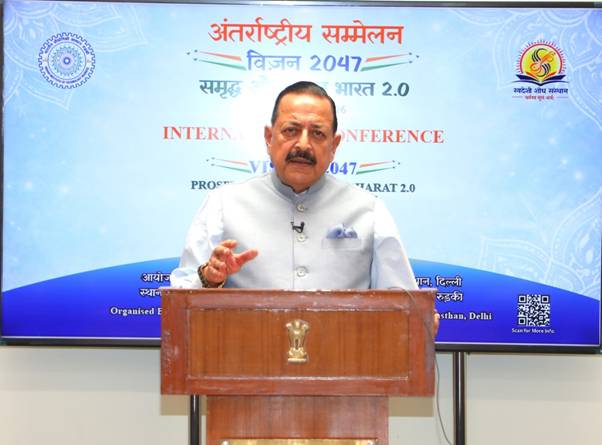
ROORKEE, India — At the “Vision 2047” conference hosted by IIT Roorkee this week, Union Minister Dr. Jitendra Singh declared that the 21st century belongs to India, driven by a monumental shift toward a biology-led economy. Addressing an international cohort of scientists and policymakers, Singh revealed that India’s bio-economy—currently valued at over $165 billion—is projected to reach a staggering $1 trillion by 2047. This transformation is being fueled by a surge in biotechnology startups, which have grown from a mere 50 in 2014 to more than 11,000 today, signaling a new era of “full-stack” technological leadership ranging from genomic medicine to quantum computing.
From “Gene to Qubit”: A National Transformation
The Minister’s keynote address underscored a pivot in India’s national strategy: moving away from traditional manufacturing and service models toward a “Bio-manufacturing-led” growth engine. This vision is codified in the BioE3 Policy (Biotechnology for Economy, Environment, and Employment), a 2024 initiative designed to integrate high-performance biomanufacturing into the national fabric.
“India is moving decisively towards full-spectrum technological capability,” Singh stated during the virtual address. He emphasized that the country’s progress is no longer siloed, but spans “from the ocean depths to outer space.”
Key Pillars of the $1 Trillion Roadmap:
-
Genome India: A massive effort to sequence the Indian genome to better understand local genetic diversity and disease predisposition.
-
CAR-T Cell Therapy: The indigenous development of “living drugs” for cancer treatment, significantly lowering costs for patients.
-
National Quantum Mission: Accelerated milestones in computing that will eventually assist in complex drug discovery and molecular modeling.
The Medical Breakthroughs Driving Growth
For the general public and healthcare professionals alike, the most tangible impacts of this bio-economy are found in clinical advancements. Singh highlighted several milestones that are transitioning from laboratories to bedside care.
1. CAR-T Therapy and mRNA Platforms
India has successfully developed indigenous Chimeric Antigen Receptor (CAR) T-cell therapy. This immunotherapy involves modifying a patient’s own T-cells to attack cancer cells. While traditionally costing hundreds of thousands of dollars globally, Indian innovation is aiming to make this life-saving treatment accessible to the masses. Similarly, the development of domestic mRNA vaccine platforms—refined during the pandemic—is now being pivoted toward other infectious diseases and personalized medicine.
2. Genome India Project
The Genome India project is a critical medical infrastructure development. By cataloging the genetic variations of the Indian population, researchers can identify specific markers for prevalent conditions like Type 2 diabetes, cardiovascular diseases, and rare genetic disorders. This moves the needle toward precision medicine, where treatments are tailored to an individual’s genetic makeup rather than a “one-size-fits-all” approach.
3. Nuclear Medicine and Affordable Cancer Care
The expansion of nuclear medicine facilities across the country is intended to decentralize cancer diagnostics. By utilizing radioisotopes for targeted imaging and therapy, the government aims to reduce the burden on tertiary care centers in metro cities.
Economic Engines: Startups and Funding
The sheer scale of the $1 trillion target is supported by unprecedented financial commitments. The Anusandhan National Research Foundation (ANRF) boasts a ₹50,000 crore corpus, complemented by a ₹1 lakh crore Research, Development, and Innovation (RDI) Fund. These funds are specifically earmarked for “deep-tech” innovation—technologies based on tangible engineering breakthroughs or scientific discoveries.
“The growth of biotech startups by over 22,000% in a decade is not just a statistical fluke,” says Dr. Arvinder Singh, a healthcare policy analyst not affiliated with the conference. “It represents a fundamental shift in risk appetite among Indian scientists. However, the challenge remains in scaling these startups from ‘proof-of-concept’ to global market leaders.”
| Metric | 2014 | 2026 (Current) | 2047 (Projected) |
| Bio-Economy Value | $10 Billion | $165+ Billion | $1 Trillion |
| Biotech Startups | ~50 | 11,000+ | 50,000+ |
| Global Innovation Index | 81st | 39th | Top 5 |
Public Health Implications and Challenges
While the vision is ambitious, the transition to a bio-economy carries significant weight for public health. A biology-led economy means that future jobs, environmental sustainability, and healthcare will be intertwined. For example, bio-manufacturing aims to replace petroleum-based chemicals with biological alternatives, potentially reducing the industrial carbon footprint and improving air quality—a major public health concern in South Asia.
Potential Limitations
Despite the optimism, some experts urge caution. Dr. Rajesh Khanna, a public health researcher, notes that “technological leadership must be matched by a robust regulatory framework. As we venture into genome editing and advanced biomanufacturing, ethical oversight and data privacy for genomic data must be ironclad to maintain public trust.”
Furthermore, the transition to high-tech medical solutions like CAR-T therapy requires a highly specialized workforce. The “Amrit Generation” of students at institutions like IIT Roorkee will need to bridge the gap between complex biotechnology and rural healthcare delivery to ensure that the $1 trillion economy doesn’t leave the most vulnerable behind.
Looking Ahead: Milestones for 2030 and Beyond
The roadmap outlined by Dr. Jitendra Singh includes specific checkpoints:
-
2030: Target bio-economy value of $300 billion.
-
2035: Operationalization of the Bharatiya Antariksha Station (Indian Space Station) for microgravity biological research.
-
2040: Scaling marine biotechnology through missions like Samudrayaan to explore deep-sea medicinal resources.
-
2047: Achieving a top-three global rank in the bio-economy.
As India positions itself as a global biotech hub, the focus remains on “Viksit Bharat” (Developed India)—a goal that hinges on the synergy between laboratory research and the entrepreneurial spirit of the nation’s youth.
Reference Section
-
Press Information Bureau (PIB). “21st Century Belongs to Bharat; Bio-Economy to Reach $1 Trillion by 2047, Says Union Minister Dr. Jitendra Singh.” Posted April 24, 2026.
.
Medical Disclaimer: This article is for informational purposes only and should not be considered medical advice. Always consult with qualified healthcare professionals before making any health-related decisions or changes to your treatment plan. The information presented here is based on current research and expert opinions, which may evolve as new evidence emerges.